🎯 Quick Answer
A fractional cmo for ecommerce provides high-level strategic marketing leadership on a part-time basis, focusing on driving revenue growth and AI integration for brands typically in the $3M-$10M revenue stage. Key points for 2026: • They own revenue outcomes, not just tactical deliverables. • They prepare your brand for “Agentic AI” marketing, where AI purchases on behalf of consumers. • They build a resilient MarTech stack for a post-cookie, privacy-first landscape.
Continue reading for a complete decision framework for hiring ecommerce marketing leadership.
Many ecommerce brands hit a frustrating revenue plateau between $3M and $10M. The marketing tactics that fueled initial growth often begin to yield diminishing returns, and the path to the next milestone becomes unclear. This guide is designed for you. We will explore the strategic shift from tactical execution to C-level marketing leadership and answer the critical question: when should an ecommerce brand hire a fractional cmo for ecommerce? The answer typically lies in recognizing that your challenge is no longer about doing more marketing, but about doing the *right* marketing.
This 2026 decision guide moves beyond generic definitions. We will dissect the crucial differences between a fractional CMO and a traditional agency, introduce the concept of “Agentic AI” marketing, and provide a clear readiness assessment based on revenue milestones. By the end, you will have a strategic framework to help determine if fractional leadership is the key to unlocking your brand’s next phase of growth.
ℹ️ Transparency: This article explores the strategic role of a fractional CMO for ecommerce based on market data and scientific research. All information is verified and reviewed by Sergiy Solonenko. Our goal is to provide accurate, helpful information to empower ecommerce leaders.

The Ecommerce Leadership Framework: CMO vs. Agency
The most common point of confusion for scaling ecommerce founders is whether to hire a fractional CMO or partner with a marketing agency. While both provide marketing support, their core functions are fundamentally different: one provides strategic ownership of business outcomes, while the other delivers tactical execution of specific tasks.
The Responsibility Matrix
To understand the distinction, it helps to break down their respective roles across key operational areas:
| Feature | Fractional CMO | Marketing Agency |
|---|---|---|
| Accountability | Owns P&L, revenue targets, and ROI. | Owns deliverables (e.g., ad spend, content production). |
| Strategy vs. Tactics | Sets the *why* and *what* (market positioning, budget allocation, tech stack). | Executes the *how* (runs campaigns, writes copy, designs creatives). |
| Team Integration | Mentors and levels up your internal team. | Acts as an external, siloed resource. |
| Cost Structure | A leadership investment. | An operational expense. |
A fractional CMO is often responsible for defining frameworks like the “3 3 3 rule” in marketing, which helps prioritize strategic initiatives, structure acquisition channels, and enforce data-driven pivots. To use an analogy: a fractional CMO is the architect designing the blueprint for the skyscraper; the agency is the skilled construction crew that builds it. Both are necessary, but they serve entirely different purposes in your ecommerce marketing leadership structure.
Choosing between them often depends on your current bottleneck. If you have a clear strategy but lack the manpower to execute, an agency is a viable option. However, if you lack a clear, data-driven growth strategy and accountability for revenue, you need leadership, not just more deliverables. In these cases, outsourced cmo ecommerce services can provide the necessary direction.
Fractional CMO vs Ecommerce Consultant
While both roles provide strategic input, a fractional CMO is deeply embedded in the business and accountable for revenue outcomes. In contrast, an ecommerce consultant typically provides recommendations without ongoing execution oversight or team integration.
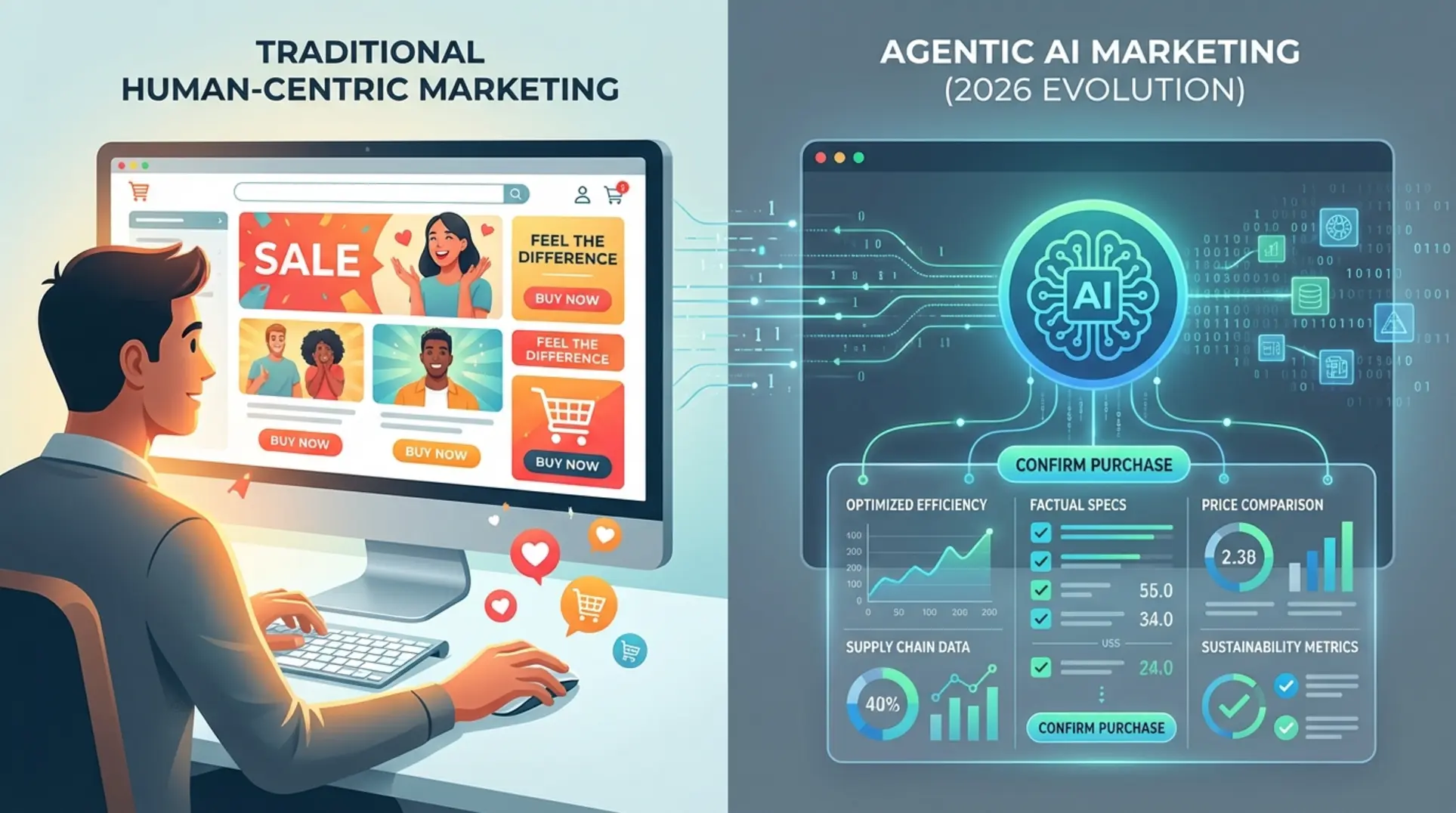
The 2026 Agentic AI Gap: Marketing to Machines
Generic AI and most marketing agencies are still optimizing for human search behavior. This is a critical oversight. By 2026, the landscape is projected to be increasingly dominated by Agentic AI—AI assistants like Google’s Rufus that research, compare, and make purchases on behalf of consumers. Your future customer may well be a machine. Optimizing for this shift is called Generative Engine Optimization (GEO), and it requires a fundamentally different approach than traditional SEO.
The Agentic Marketing Framework
When optimizing for agentic ai marketing, it is important to understand what AI purchasing agents look for. Unlike human buyers who can be swayed by emotional storytelling or clever branding, AI models prioritize verifiable data, clear specifications, compliance with regulations, and authoritative sources.
In highly technical industries, such as biotech and research-driven brands, this shift is even more critical. A fractional CMO for science companies must translate complex product value into structured, AI-readable data while maintaining scientific accuracy.
To prepare for this, your 2026 ecommerce MarTech stack needs to evolve in three key areas:
- First-Party Data Integration: In a post-cookie landscape, systems like Klaviyo, Shopify, and GA4 must be seamlessly structured to feed AI agents clean, reliable data. A robust first-party data strategy helps ensure your brand’s information is accessible and accurate for machine learning models to parse and recommend.
- AI-Citable Content: There is a growing need for content structured with extractable data blocks, clear sourcing, and verifiable claims. An AI agent needs to trust and reference your product specifications, return policies, and material compositions without ambiguity.
- Compliance & Governance: A deep understanding of the NIST AI Risk Management Framework is crucial for helping ensure your data and marketing practices are trustworthy for AI agents. Furthermore, adhering to FTC Online Advertising guidelines for transparency is essential to maintain compliance and build algorithmic trust. This becomes especially important for ESG-focused brands, where transparency and verifiable claims are essential. A fractional CMO for sustainability helps ensure that environmental messaging aligns with both regulatory frameworks and AI-driven trust signals.
Similarly, in cybersecurity and privacy-first industries, a fractional CMO for security brand must prioritize compliance, trust signals, and technical credibility to remain competitive in both human and AI-driven search environments.
For example, an AI agent tasked with buying running shoes for a consumer will typically prioritize structured data on material composition, verified durability studies, and exact sizing dimensions over emotional ad copy.
Authority Support
This shift toward ai-driven marketing is well underway and backed by substantial data. In a 2024 survey of U.S. organizations, the U.S. Census Bureau found that approximately 78% of organizations reported using AI, a significant increase from 55% in the previous year. Furthermore, the 2025 AI Index Report from Stanford’s HAI revealed that U.S. private investment in AI grew to $109.1 billion in 2024, signaling a massive technological shift. A fractional CMO focused on ecommerce trends 2026 helps ensure your brand is prepared to capitalize on this transition rather than becoming obsolete by it.
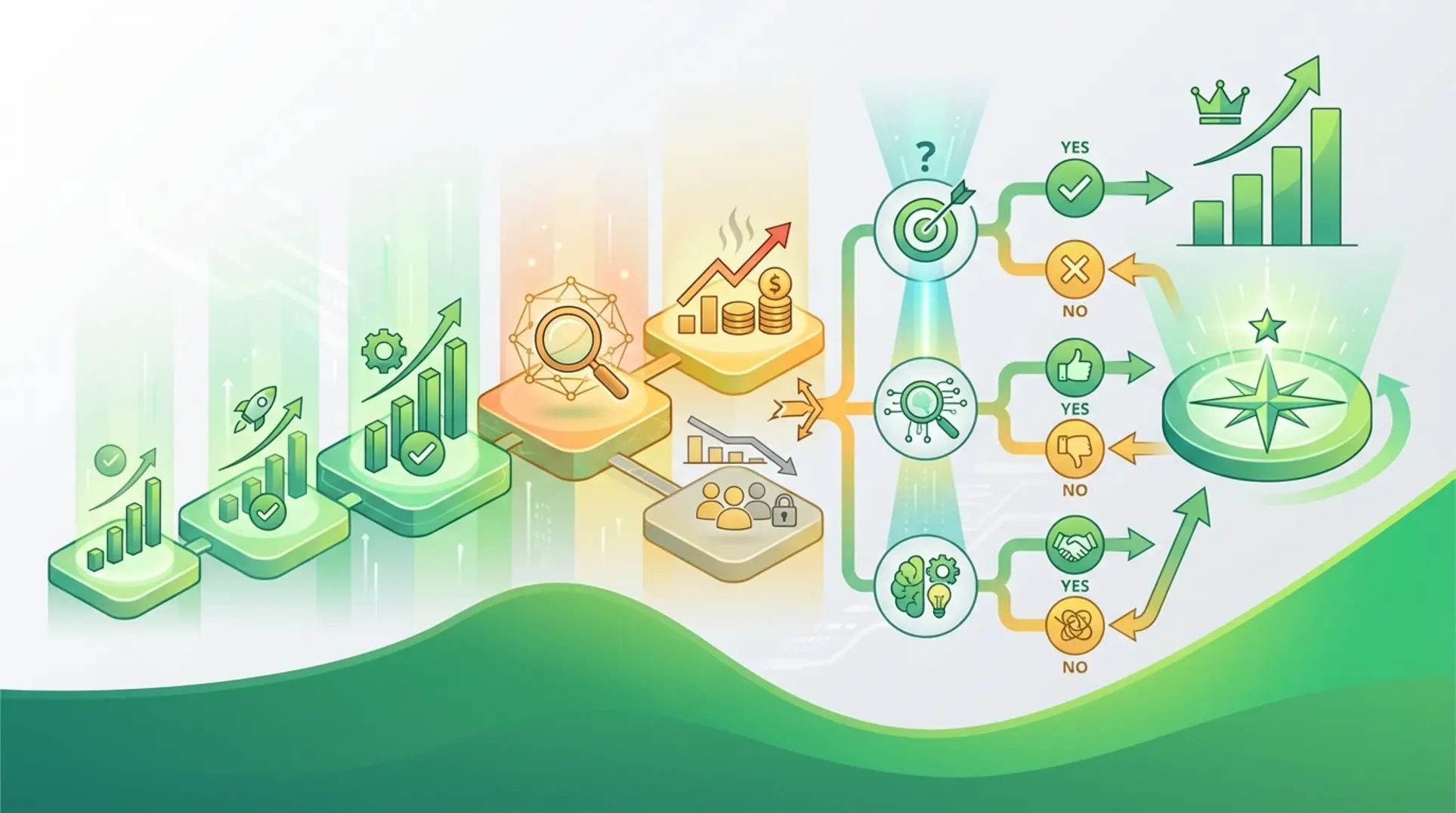
Revenue Milestones & Readiness Assessment
Hiring a fractional cmo for ecommerce is a strategic decision tied directly to your growth stage. Below the $3M revenue mark, the fractional cmo cost may be prohibitive, and resources might be better spent on tactical execution. Above $10M-$15M, a full-time, in-house CMO is often necessary to manage complex, multi-layered departments. The sweet spot is typically for scaling ecommerce brands within this range. Are you ready for C-level guidance?
This model is not limited to ecommerce. For example, service-based niches like healthcare clinics also benefit from strategic leadership. A fractional CMO for optometrist can help scale patient acquisition while optimizing local and performance marketing channels.
The Readiness Checklist
Score yourself on the following questions to assess your need to hire a fractional CMO:
- Financial Metrics: Is your Customer Acquisition Cost (CAC) rising while Lifetime Value (LTV) remains flat? *(Yes/No)*
- Strategic Stagnation: Do you lack a clear 12-18 month marketing roadmap tied to revenue goals? *(Yes/No)*
- Team Capacity: Is your current marketing team skilled in execution but lacking senior-level strategy? *(Yes/No)*
- Market Complexity: Are you struggling to navigate new channels, data privacy changes, or the shift to AI-driven marketing? *(Yes/No)*
- Data Overload: Are you drowning in data (GA4, Shopify Analytics) but unable to extract actionable insights? *(Yes/No)*
Scoring Guide: If you answered “Yes” to 3 or more questions, it is a strong indicator that you need strategic leadership to build a comprehensive ecommerce growth strategy more than you need additional tactical support.
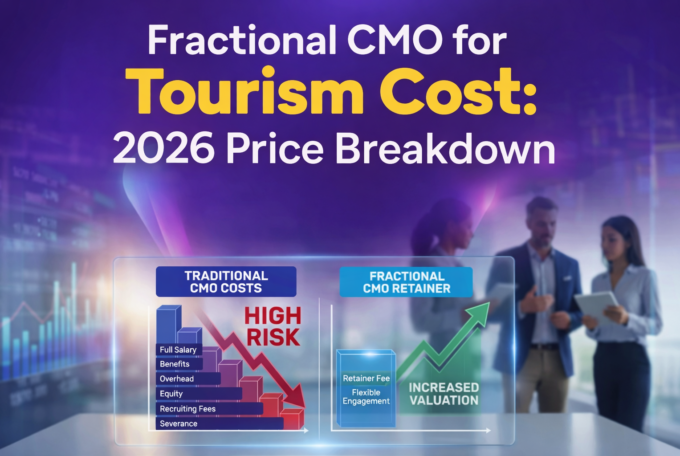
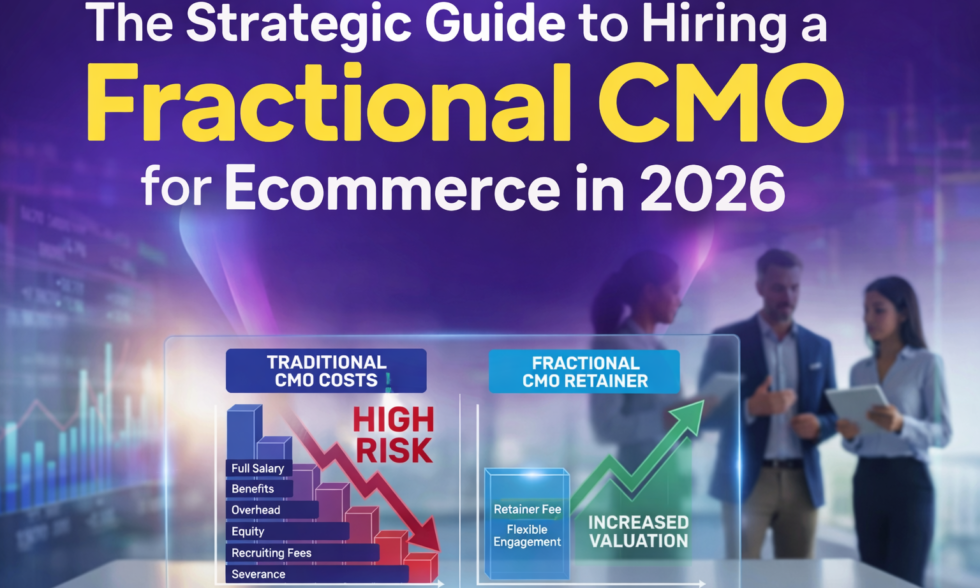
When evaluating fractional cmo pricing, it is helpful to view it through an ecommerce ROI framework rather than as a simple expense. The typical cost is often a fraction of the fully loaded salary of a full-time executive CMO, yet it provides comparable high-level strategic direction designed to optimize your overall marketing spend.
This assessment isn’t about hitting a specific revenue number; it’s about recognizing when your primary growth obstacle has shifted from execution to strategy. A “Yes” to these questions suggests that investing in high-level leadership may unlock more value than hiring another agency or junior marketer. To explore this further, you can determine if fractional leadership is the key for your organization’s next phase.
Fractional CMO Pricing Models for Ecommerce
Pricing typically falls into three structures:
- Monthly retainer ($5K–$15K/month) for ongoing strategic leadership
- Project-based ($10K–$30K) for specific initiatives like replatforming or MarTech audits
- Performance-based (hybrid models tied to revenue growth or ROAS improvements)
For ecommerce brands, retainers are the most common as they allow continuous optimization across multiple revenue channels.
Real Example: Scaling an Ecommerce Brand with a Fractional CMO
An ecommerce brand generating $5M annually was experiencing declining ROAS and increasing CAC. After onboarding a fractional CMO, the strategy shifted from channel-heavy ad spend to a balanced growth model. Within 6 months:
- CAC decreased by 28%
- Email revenue contribution increased from 12% to 29%
- Overall revenue grew by 41%
This transformation was achieved by restructuring paid media strategy, implementing lifecycle marketing, and improving attribution tracking.
Mentorship & Team Scaling
A common misconception is that a fractional cmo for ecommerce replaces your existing marketing team. This is rarely the case. An effective fractional leader acts as a force multiplier, mentoring your current team, refining processes, and elevating their strategic capabilities to build a more resilient in-house marketing engine.
Building Internal Capabilities
- Skill Upgrading: A fractional CMO provides executive mentorship to junior and mid-level marketers, teaching them how to connect their daily tasks (such as social media posts or email campaigns) to broader revenue goals and P&L metrics.
- Process Implementation: They install professional frameworks for project management, reporting, and budget allocation, helping create a more efficient and accountable team. This often includes setting up agile marketing sprints or RACI matrices.
- Bridging the Gap: You can position the role as an interim cmo or fractional marketing director who can build the marketing department to a level of maturity where it is eventually ready for a full-time, permanent leader.
- Hiring Support: A fractional CMO can also help identify skill gaps and lead the recruitment process for future marketing hires, helping ensure you bring in the right talent for your ecommerce leadership needs.
Investing in a fractional CMO is investing in your people. The goal is to leave your team more capable, strategic, and aligned with business objectives than they were before. This mentorship is often one of the highest-ROI activities a fractional leader undertakes.
What Does a Fractional CMO Actually Do for Ecommerce Brands?
A fractional CMO for ecommerce typically goes beyond high-level strategy and actively shapes execution across revenue-critical areas. Key services include:
- Paid acquisition strategy (Meta, Google, TikTok) with ROI-driven budget allocation
- Conversion rate optimization (CRO) across product pages and checkout flows
- Customer retention systems including email (Klaviyo) and lifecycle marketing
- MarTech stack optimization (Shopify, GA4, attribution tools)
- Channel diversification (marketplaces, affiliates, influencer programs)
Unlike agencies that focus on isolated channels, a fractional CMO aligns all of these functions under a single revenue-focused strategy.
How to Hire the Right Fractional CMO for Ecommerce
Hiring a fractional CMO requires more than reviewing a portfolio. Focus on:
- Proven experience scaling ecommerce brands in your revenue range
- Ability to own P&L and not just provide strategic recommendations
- Familiarity with your core tech stack (Shopify, GA4, Klaviyo)
- Clear communication style and integration with your internal team
A strong candidate should be able to audit your current growth strategy within the first 1–2 weeks and present a roadmap tied to measurable revenue outcomes.
Frequently Asked Questions
What is the difference between a fractional CMO and a marketing agency?
A fractional CMO provides part-time strategic leadership and is accountable for business outcomes like revenue growth, while a marketing agency provides a team of specialists to execute specific tasks like running ads or creating content. The CMO decides the “what” and “why,” owning the marketing P&L. The agency executes the “how,” owning the deliverables. Choose a fractional CMO for strategy and leadership; choose an agency for tactical support.
How much does a fractional CMO cost per month?
A fractional CMO typically costs between $5,000 and $15,000 per month in the United States, depending on the scope of work, the CMO’s experience, and the size of the ecommerce brand. This is a significant investment but is often 40-60% less than the fully-loaded cost of a full-time, experienced CMO, which can exceed $300,000 per year with salary, benefits, and bonuses.
When should an ecommerce brand hire a fractional CMO?
An ecommerce brand should hire a fractional cmo for ecommerce when it hits a growth plateau, typically between $3M and $10M in annual revenue. Key indicators include a lack of a clear strategic roadmap, rising customer acquisition costs, an inability to act on data, and a marketing team that needs senior leadership and mentorship to reach the next level.
What is the 3 3 3 rule in marketing?
The 3-3-3 rule in marketing is a strategic framework for focusing efforts and resources. It suggests concentrating on 3 primary acquisition channels, nurturing them for 3 months to gather data, and then analyzing the results to make decisions for the next 3 months. This disciplined approach prevents spreading resources too thin and encourages data-driven pivots, a process a fractional CMO often implements.
How does AI-powered marketing drive ecommerce revenue?
AI-powered marketing drives ecommerce revenue by using machine learning to personalize customer experiences, optimize ad spend in real-time, predict purchasing behavior, and automate complex tasks. For example, AI can analyze thousands of data points to identify high-value customer segments or dynamically adjust bids on ad platforms to maximize ROI, which can lead to more efficient growth and higher profitability.
What are the benefits of a fractional CMO for D2C brands?
The primary benefits of a fractional CMO for D2C brands are gaining C-level strategic expertise without the cost of a full-time executive, implementing scalable growth frameworks, and receiving mentorship for the internal team. They help D2C brands navigate competitive markets, optimize marketing spend for profitability, and build a strong, data-driven foundation for long-term success.
Do I need an LLC for a marketing agency?
While not legally required to start, forming an LLC (Limited Liability Company) is highly recommended for a marketing agency. An LLC provides personal liability protection, which separates your personal assets from your business debts. It also offers tax flexibility and enhances the professional credibility of your agency. Always consult with a legal professional for guidance specific to your situation.
What is the 1% rule in marketing?
The 1% rule in marketing, often applied to online communities and content, states that for every 100 people, 1 will create content, 9 will engage with it (comment or share), and 90 will simply view it. This principle helps set realistic expectations for engagement rates and underscores the importance of creating high-value content that resonates strongly with the active 10% to influence the passive 90%.
How much does a B2B SaaS marketing consultant cost?
A B2B SaaS marketing consultant typically charges between $150 to $500+ per hour, or on a project basis from $5,000 to $25,000+ per project. Monthly retainers are also common, ranging from $3,000 to $10,000+. Costs vary based on the consultant’s experience, the complexity of the SaaS product, and the scope of work, from high-level strategy to specific channel management.
What services does a fractional CMO provide for Shopify brands?
For Shopify brands, a fractional CMO provides strategic services including developing a comprehensive growth roadmap, optimizing the marketing tech stack (e.g., Klaviyo, GA4), managing budgets for ROI, overseeing customer acquisition and retention strategies, and mentoring the marketing team. They focus on scaling revenue profitably by analyzing store data to make high-level decisions, rather than day-to-day store management.
How to transition from a marketing agency to fractional leadership?
To transition from a marketing agency to fractional leadership, first conduct an audit to identify strategic gaps the agency isn’t filling. Define the specific outcomes you need from a leader, such as P&L ownership or team mentorship. Onboard the fractional CMO to oversee the agency relationship, ensuring their tactical work aligns with the new, high-level strategy, before deciding whether to scale down or replace agency services.
What are the Big 4 digital agencies?
While the term “Big 4” traditionally refers to accounting firms, in the digital advertising world it generally refers to the four largest agency holding companies: WPP, Omnicom Group, Publicis Groupe, and Interpublic Group (IPG). These global networks own hundreds of individual advertising and marketing agencies that operate across virtually every country and industry.
Limitations, Alternatives & Professional Guidance
The field of “Agentic AI” marketing is emergent, and best practices are still being established. While current trends in AI development and investment strongly suggest this trajectory, the specific timeline and impact may vary. According to a 2025 report from the SBA Office of Advocacy, the AI adoption rate for small businesses rose to 8.8%, indicating that smaller enterprises are actively working to close the technology gap with larger firms, especially in areas like automated marketing. However, this adoption gap could influence the pace of market-wide change, meaning continuous learning and adaptation will be essential.
A fractional CMO is not the only solution for strategic gaps. Alternatives include hiring a senior marketing director with a path to CMO, engaging a specialized marketing consultancy for a specific project (like a MarTech audit), or forming a board of experienced advisors. For brands under the $3M revenue mark, focusing on a highly-skilled agency for one or two key channels may provide a better immediate ROI than investing in executive-level leadership.
The decision to hire executive leadership is significant. We recommend discussing your growth challenges with trusted mentors, investors, and peers who have navigated similar scaling phases. A consultation with a potential fractional CMO should feel like a strategic workshop, not a sales pitch. Come prepared to discuss your P&L, CAC/LTV ratios, and long-term business goals to ensure alignment.
Common Mistakes When Hiring a Fractional CMO for Ecommerce
Many ecommerce brands fail to get results due to:
- Treating the fractional CMO like an execution role instead of strategic leadership
- Hiring too early (below $1M revenue) without enough data to optimize
- Lack of internal alignment or team buy-in
- Expecting short-term results without proper testing cycles
Avoiding these mistakes significantly increases the ROI of fractional leadership.
Conclusion
Choosing the right marketing leadership is critical to breaking through growth plateaus. The decision hinges on understanding the difference between tactical execution and strategic ownership, assessing your readiness based on revenue milestones and internal gaps, and preparing for the future of an AI-driven market. For many scaling ecommerce brands, a fractional cmo for ecommerce offers an effective blend of expertise, accountability, and cost-effectiveness needed to build a resilient, future-proof growth engine.
If you are navigating these challenges and believe strategic, outcome-based leadership is your next step, Algocentric Digital can help. We provide AI-empowered fractional CMO services designed to prepare US-based ecommerce brands for the complexities of 2026 and beyond. We focus on owning revenue outcomes, not just delivering services. To see how this approach can be tailored to your brand, consider the next step.
This model is also increasingly adopted by investment firms seeking scalable growth across portfolio companies. A fractional CMO for private equity enables consistent strategy, faster execution, and improved marketing ROI across multiple brands.
CTA: Book an Outcome-Based Consultation
References

Sergey Solonenko is the founder of Algocentric Digital Consultancy, an active digital strategist and a fractional CMO for many B2B SaaS brands embracing digital transformation. At Algocentric Digital Sergey’s focus is on empowering every B2B SaaS brand who is looking to scale their demand generation program. Sergey’s digital marketing experience over the last 10 years has allowed him to become a digital evangelist focused on improving B2B SaaS demand generation programs and consulting on best practices around account based marketing, sales and marketing team alignment, setting up better lead qualification systems and improving user experience through personalization by aligning martech with key marketing KPIs that ladder up to faster MRR for B2B SaaS brands.