🎯 Quick Answer
A fractional cmo cost for a B2B SaaS company in 2026 typically ranges from $5,000 to $15,000 per month on a retainer model.
- Hourly rates often fall between $200-$500 but can mask true value by incentivizing time over results.
- AI-empowered models can deliver up to 40 hours of strategic value in just 20 hours of work, significantly improving ROI.
- Pricing should align with growth milestones, such as Series A revenue-to-marketing ratios (35-50%).
This guide breaks down the data-driven approach to fractional CMO pricing, helping you move from budgeting for hours to investing in outcomes.
For Series A founders, the primary challenge in 2026 is often allocating capital for maximum MRR growth, rather than simply funding marketing activity. This requires a critical shift from buying a consultant’s “hours” to investing in strategic “outcomes.” While the average cost of fractional CMO is between $5,000 and $15,000 per month, the real question isn’t what it costs, but what value it delivers to your bottom line.
Generic pricing data available online often relies on outdated benchmarks. This guide is different: it provides a 2026-specific breakdown for B2B SaaS startups, factoring in the seismic impact of AI on efficiency and ROI. We will cover pricing models, Series A budget allocation, a deep dive into the “AI-Efficiency Discount,” and regional cost analysis for tech hubs like San Francisco and Austin.
👤 Written by: The Algocentric Digital Team Reviewed by: Sergiy Solonenko, Founder & Fractional CMO for MarTech B2B SaaS Last updated: 29 January 2026
ℹ️ Transparency: This article explores fractional CMO pricing based on market data and proprietary analysis of AI’s impact on marketing efficiency. We cite data from government, academic, and research institutions to ensure accuracy. Our goal is to provide transparent, actionable information for B2B SaaS founders. This content adheres to FTC guidelines on transparent pricing.
We’ll explain how fractional CMOs charge for their services and how to choose the best option for your business.
Once you’re done reading our article, you will have a clear perspective of what you should be looking for in a B2B fractional CMO.
Our goal is to make it easy for your business and to help you achieve your goals.
Understanding Fractional CMO Service Fees
A fractional CMO service fee reflects the cost of accessing senior-level marketing leadership without committing to a full-time executive hire. Instead of paying for execution or isolated campaigns, companies pay for strategic ownership of growth, revenue alignment, and go-to-market decision-making.
Fractional CMOs typically operate across strategy, execution oversight, and team leadership. This can include defining the go-to-market strategy, overseeing demand generation, aligning sales and marketing, managing agencies, and reporting directly to founders or the board.
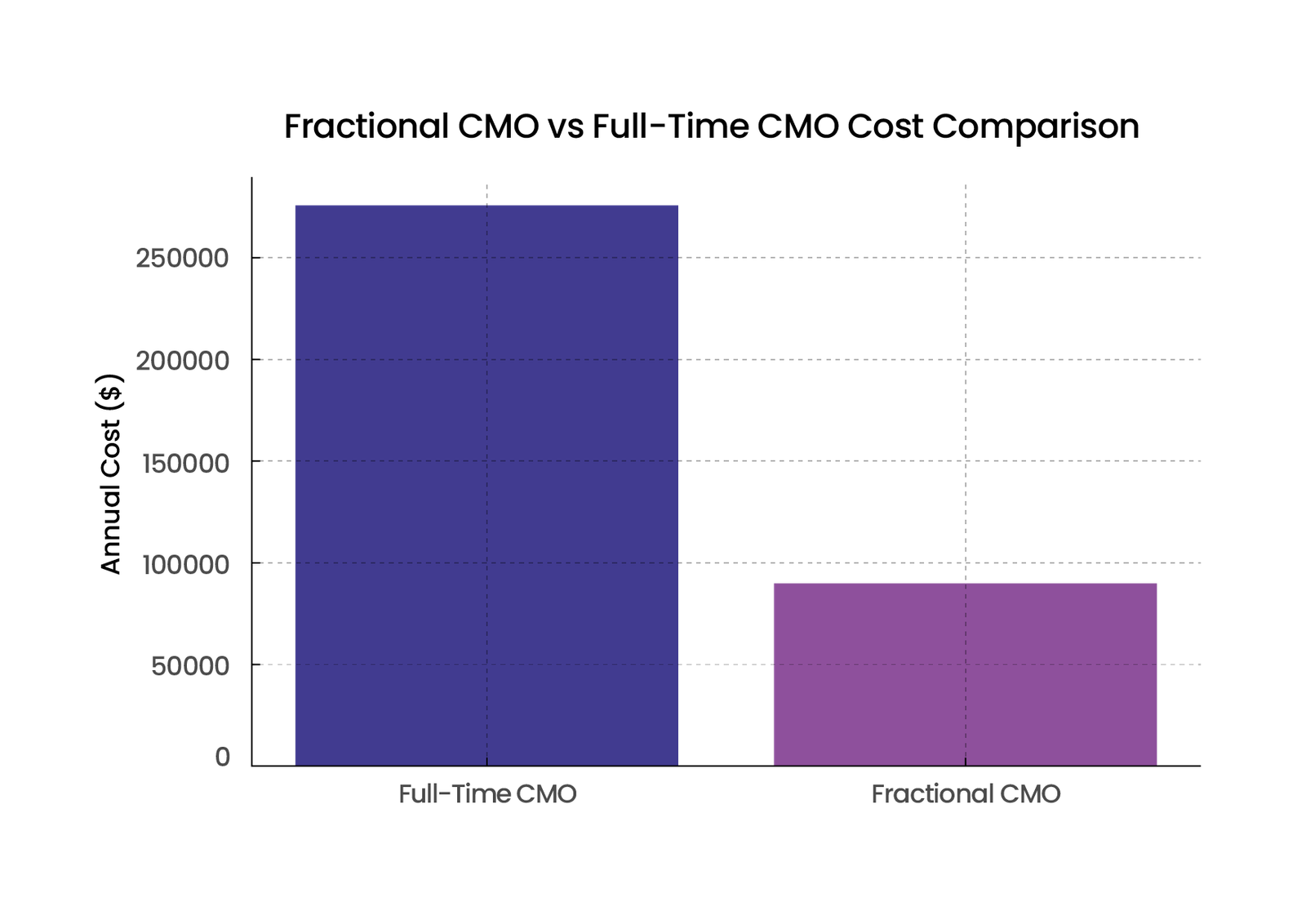
Unlike traditional consultants, a fractional CMO is accountable for outcomes, not just recommendations. The fee structure is designed to provide flexibility while maintaining executive-level responsibility. For most B2B SaaS companies, this model delivers access to experienced leadership at a significantly lower cost than a full-time CMO, while avoiding the long-term risk of an early executive hire.
From a capital efficiency standpoint, fractional CMO fees are best evaluated relative to the revenue impact they enable, not as a standalone expense. The true value lies in accelerating pipeline velocity, improving unit economics, and building a scalable marketing system that supports future growth stages.
What Factors Influence the Cost of Fractional CMO Services?
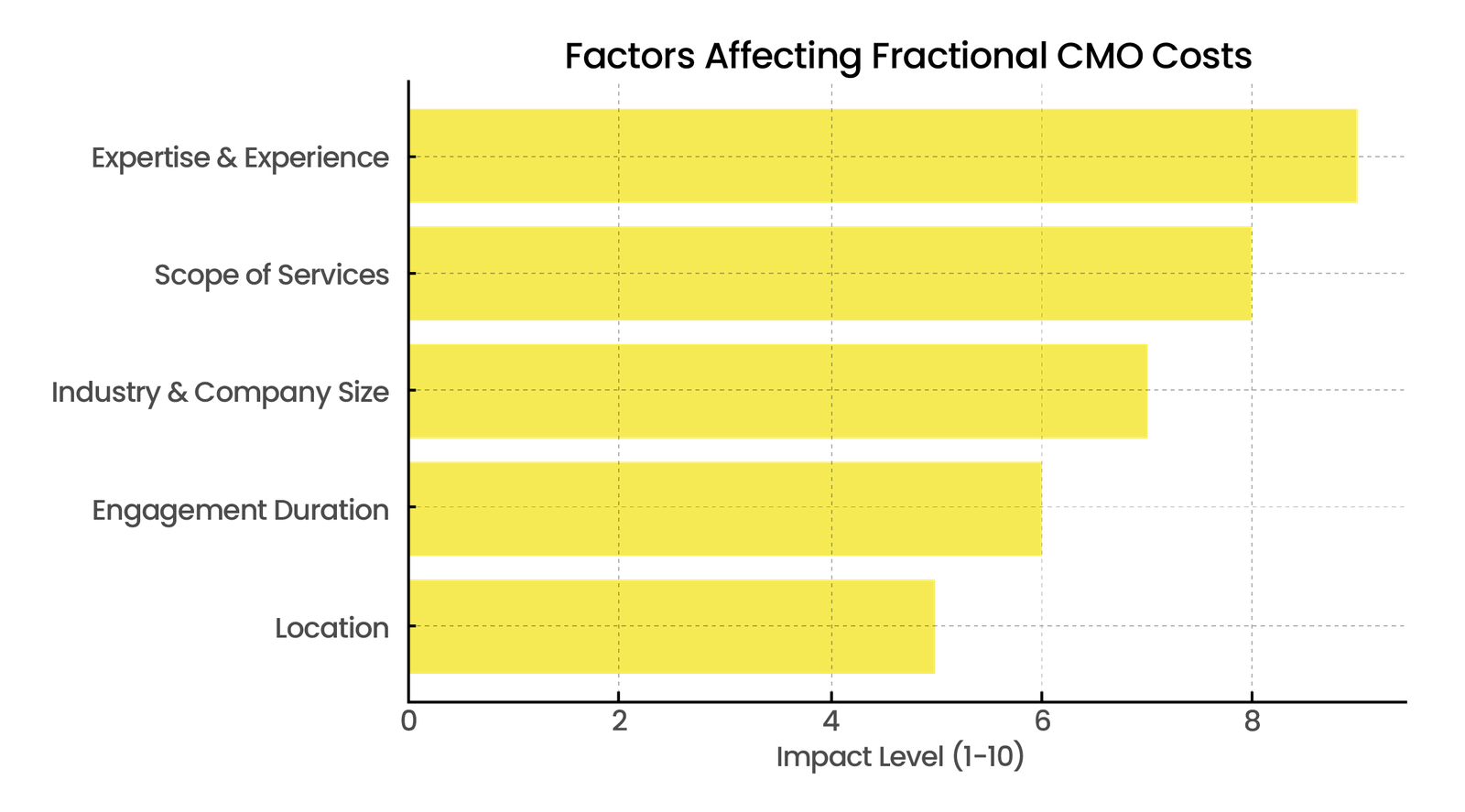
A fractional CMO is a great fit for a company requiring marketing services. However, fractional CMO rates will be quite different from one person to another.
They are great for brands that cannot afford to hire a full-time CMO. Fractional CMOs are a good hire for someone with all the branding and marketing duties.
The fractional CMO retainer depends on various factors:
-
Expertise & track record
-
Scope tied to revenue ownership
-
Company stage (Seed vs Series A)
-
Geographic cost arbitrage
-
Engagement depth (advisor vs operator)
2026 Fractional CMO Pricing Models: Retainer, Hourly, and Outcome-Based
Choosing how to pay a fractional CMO in 2026 involves selecting from three primary models: hourly, monthly retainer, or outcome-based. Each model carries different implications for risk, strategic alignment, and potential ROI.
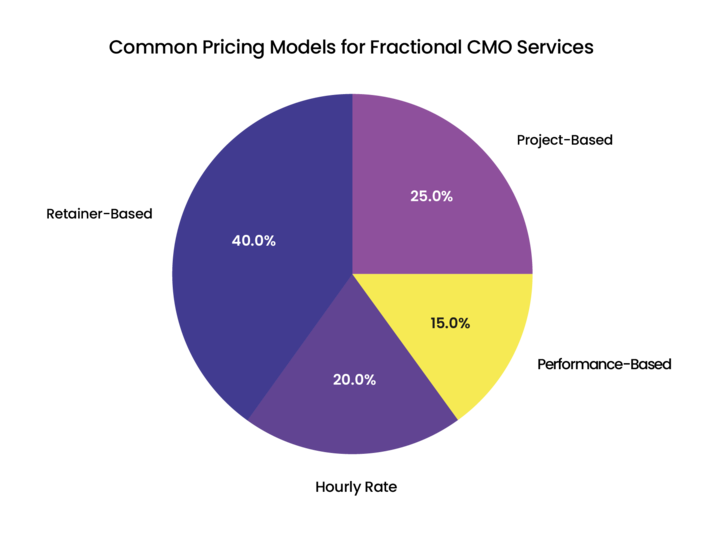
The fractional cmo hourly rate typically falls between $200 and $500. While this model appears flexible for short-term tasks, it often presents a “Hourly Waste” risk for growth-focused startups. Paying for time creates misaligned incentives; it rewards inefficiency rather than speed or impact. Furthermore, the administrative overhead of tracking hours can distract from the primary goal. There is often no direct link between hours billed and business results like MRR growth, making this a higher-risk model for Series A companies.
The Monthly Retainer Model ($5,000-$15,000/mo)
The most common structure for fractional cmo rates is the monthly retainer, ranging from $5,000 to $15,000. This model involves a fixed fee for a defined scope of strategic leadership. The primary advantages include predictable budgeting and the fostering of a deeper partnership where the focus remains on strategy rather than task counting. However, scope creep can become an issue if the deliverables are not well-defined at the outset. This model generally supports fractional cmo pricing that favors long-term stability.
The Outcome-Based Model (Performance-Led)
Outcome based marketing pricing represents a shift toward performance-led engagements. This model typically features a lower base retainer combined with performance bonuses tied directly to KPIs like MRR, MQLs, or pipeline growth. The pros include maximum alignment—the fractional CMO wins when the company wins—and a de-risked investment for the founder. This structure focuses all parties on the metrics that truly matter for scaling.
While hourly rates are easy to compare, they are often a poor measure of strategic value. The right investment level depends heavily on the company’s specific stage, particularly for Series A startups scaling revenue.
How Pricing Models Impact the Overall Marketing Budget
The pricing model used to engage a fractional CMO directly influences how efficiently a marketing budget translates into revenue outcomes. Different models create different incentive structures, which can either reinforce or undermine growth objectives.
Hourly pricing prioritizes time spent, not results. While it may appear flexible, it often leads to fragmented execution and limited strategic ownership. This model makes it difficult to forecast ROI or tie spend directly to metrics like MRR or pipeline growth.
Retainer-based pricing shifts the focus from hours to strategic responsibility. A fixed monthly fee enables long-term planning, deeper integration with the leadership team, and consistent decision-making across channels. This structure supports predictable budgeting and aligns better with the cadence of SaaS growth.
Outcome-based or performance-led pricing has the strongest alignment with business results. By tying compensation to agreed KPIs such as qualified pipeline, revenue growth, or efficiency improvements, this model ensures that marketing leadership is incentivized to prioritize impact over activity.
For B2B SaaS companies, the optimal pricing model is the one that minimizes wasted spend and maximizes accountability. Marketing budgets perform best when leadership incentives are directly connected to measurable business outcomes.
The B2B SaaS Series A Budget Breakdown
For a Series A B2B SaaS company, marketing is not an expense; it’s the primary engine for growth, typically commanding 35-50% of revenue. It is crucial to look past the generic “spend 10% on marketing” myth, which rarely applies to high-growth SaaS environments where velocity is paramount.
The 35-50% Revenue Allocation Rule for Series A
To achieve the growth velocity expected by investors, b2b saas marketing budget series a allocations often need to be aggressive. For companies in the $1M–$5M ARR range, this level of spend fuels the acquisition engines necessary to reach the next valuation milestone.
Table 1: Series A Marketing Spend Benchmarks
| ARR | Annual Marketing Spend (40%) | Monthly Marketing Spend |
|---|---|---|
| $1,000,000 | $400,000 | ~$33,333 |
| $2,500,000 | $1,000,000 | ~$83,333 |
| $5,000,000 | $2,000,000 | ~$166,667 |
Applying the 70/20/10 Rule to Your Budget
When determining saas marketing spend benchmarks 2026, a strategic framework like the 70/20/10 rule helps balance stability with innovation:
- 70% on Proven Channels: These funds go toward core activities with predictable ROI, such as Google Ads, LinkedIn, and Content Marketing. The fractional cmo for startups cost (salary/retainer) typically sits within this bucket, as their leadership ensures the efficiency of these core channels.
- 20% on Emerging Channels: This portion funds new platforms or tactics with strong potential, such as programmatic ads or new social platforms.
- 10% on Experimental Bets: These are high-risk, high-reward tests, including new AI-driven content formats or experimental event marketing.
A Fractional CMO’s cost should be viewed as a critical component of the “70% Proven” budget. Their strategic oversight is often what makes the remaining 90% of the spend effective. But how can you make that 70% spend even more efficient? The answer lies in leveraging AI.
How a Fractional CMO Contributes to Effective Marketing Strategies
A fractional CMO provides strategic clarity and execution alignment across the entire marketing function. Their primary role is to connect business objectives with a cohesive go-to-market strategy, ensuring that every channel, campaign, and investment supports revenue growth.
Rather than focusing on isolated tactics, a fractional CMO establishes positioning, messaging, and prioritization frameworks that guide execution teams. This includes defining the ideal customer profile, clarifying value propositions, and ensuring consistency across paid, organic, and lifecycle channels.
In addition, a fractional CMO brings external perspective and pattern recognition from scaling similar companies. This enables faster decision-making, earlier identification of inefficiencies, and avoidance of common growth-stage mistakes. They also act as the central point of accountability between marketing, sales, and leadership.
Most importantly, a fractional CMO ensures that marketing operates as a revenue function, not a cost center. By aligning strategy, execution, and measurement, they help companies deploy capital more efficiently and build a repeatable engine for sustainable growth.
Fractional CMOs and Lead Generation & Customer Acquisition
Up to 63% of leads will not convert for at least three months. This highlights the importance of sustained engagement strategies, something that a fractional CMO is skilled in. Fractional CMOs provide the agility of an individual fractional service but with a wealth of knowledge and skills.
Marketing experts enable firms to correctly define their target audience and market their target customers with precision. They introduce novelties in the marketing approach, and this helps the firm to stay competitive. Fractional CMOs develop marketing campaigns that are backed by data.
They assess the customer’s behavior and leverage this to market to the customer. Marketing expenditures are also controlled closely to maximize the return on investment. The marketing tactics use marketing resources, with the budgets expended on these services efficiently.
Finally, fractional CMOs ultimately represent an organizational structure. They offer affordable value to increase the number of leads and customers.
Maximizing ROI with a Fractional CMO
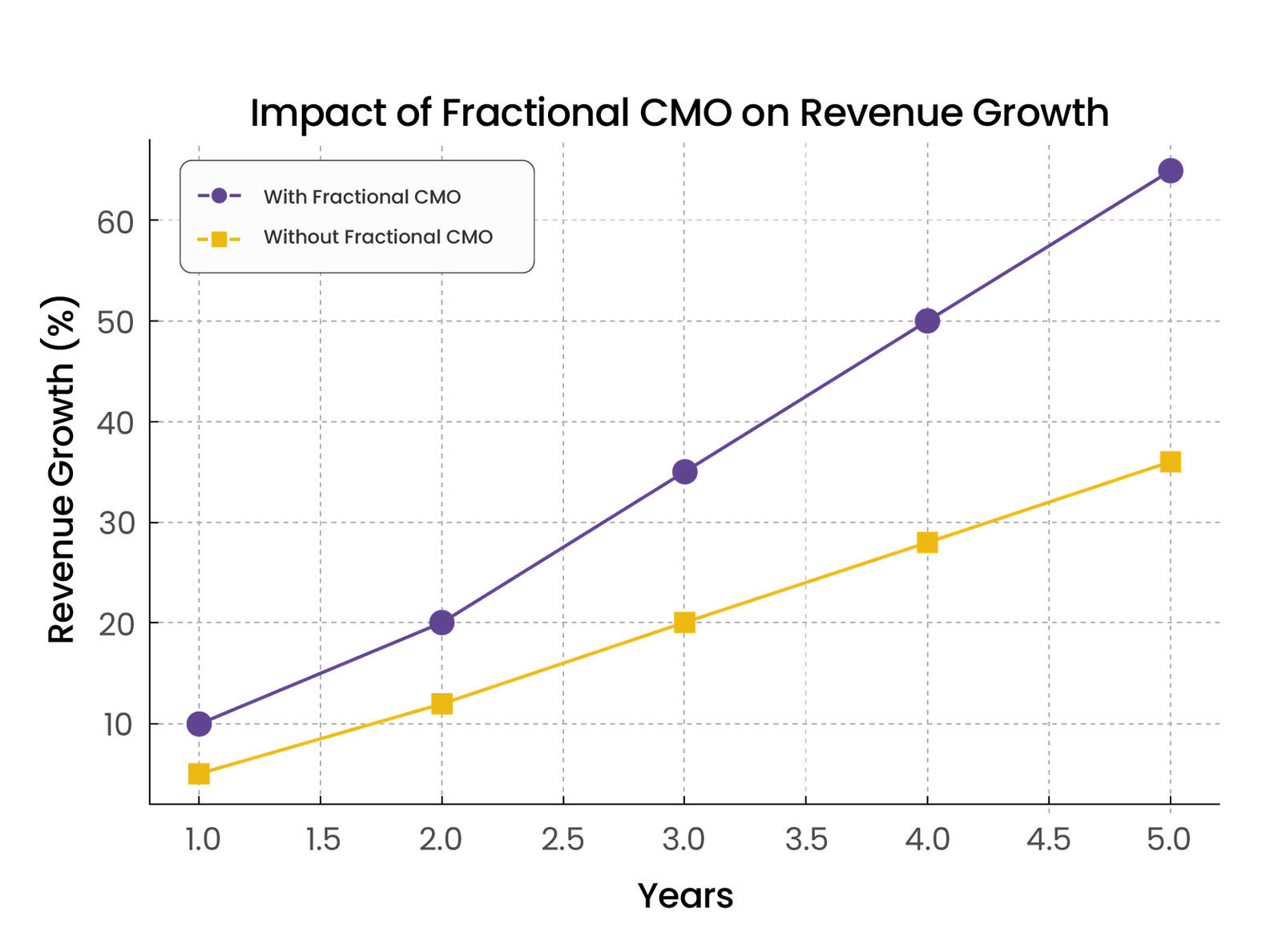
Engaging a fractional CMO is a cost-effective way of getting the best ROI in a company’s marketing initiatives — in fact, CMO-as-a-Service delivers 10x ROI
Fractional CMOs are guiding an organization toward the marketing outcomes it needs.
Here are some ways a fractional CMO can help you maximize ROI:
1.Customized Marketing Strategies
A fractional CMO will always assess your business, your target market, and the industry. They will come up with marketing solutions for projects that are unique to your business.
2.Expertise and Experience
Fractional CMOs have years of marketing experience and insight. This makes a huge difference when it comes to marketing and can save clients billions of dollars in the process.
3.Objective Insights
Fractional CMOs are consultants outside your firm. They are able to offer an objective evaluation of your marketing endeavors and potential changes to increase your return on investment.
4.Cost-Effective
Fractional CMOs are even more affordable than full-time ones. You only pay for hours worked while getting targeted advice without having to hire a new agent altogether.
5.Flexible Engagement
A fractional CMO may be hired on a per-project or a full-time hire. This will suit your organization’s marketing needs and changes in marketing conditions or organizational objectives.
All in all, a fractional CMO can give guidance, experience, and versatility.
Choosing the Right Fractional CMO Service Provider
The right fractional CMO service provider is important for the growth and success of any business.
It becomes difficult to make the right choice due to the many companies and professionals out there.
See our curated list of the top fractional CMO companies in 2025 to help narrow your search.
Here are some essential factors to consider when choosing a fractional CMO service provider:
Need help deciding? Check out our guide on how to choose the right fractional CMO.
1.Industry Experience
Choose one that has worked with companies in your sector to correct weaknesses in your business.
They should have a clear understanding of your industry’s market trends and customers’ preferences.
2.Customization
As of the nature of the role, a great fractional CMO should be in a position to align its service offerings with the existing and desired state of your business.
They should be able to easily change along the new trends that prevail in the market.
3.Strategic Alignment
The service provider must be in a position to synchronize their marketing strategies with your business objectives.
They should be in a position to design full and effective marketing communications strategies that are results-oriented.
4.Expertise
Look for a fractional CMO who has worked in digital marketing, content marketing, and social media marketing previously.
They should also have adequate knowledge of analytical tools used in decision-making.
5. Communication
Communication plays a central role in any and every marketing campaign that is ever to be established.
Opt for a provider that ensures that there is seamless communication between your marketing team and them. Find a person who is willing to take some ideas from you as well.
6. Budget
Look into the prices for the fractional CMO’s services and decide if those prices are within your budget constrictions.
You should select a provider who provides their price structure and informs you of any incremental charge likely to be incurred.
7. Measurable Results
Any good fractional CMO should be able to prove that his plan works through numbers and figures.
Look for testimonials and case studies that demonstrate their effectiveness in generating growth and more value for their clients. Make sure that the fractional CMO service is measurable by agreeing on KPIs.
Regional Cost Analysis: San Francisco vs. Austin vs. New York
For founders in high-cost tech hubs like San Francisco, Austin, and New York, the cost of senior marketing talent is a significant barrier to growth. A remote, AI-powered model provides access to top-tier strategy without the overhead of a local executive.
Full-Time vs. Fractional vs. AI-Empowered Fractional Cost Comparison
When analyzing fractional cmo pricing across major hubs, the savings from a remote, AI-empowered model become clear.
Table 2: Annual Cost Comparison by Region
| Role | San Francisco (Annual Cost) | Austin (Annual Cost) | New York (Annual Cost) | Algocentric AI-Empowered Model (Annual Cost) |
|---|---|---|---|---|
| Full-Time CMO | $350,000+ | $300,000+ | $340,000+ | – |
| On-Site Fractional CMO | $180,000+ ($15k/mo) | $144,000+ ($12k/mo) | $168,000+ ($14k/mo) | – |
| Algocentric (Remote) | – | – | – | $96,000 ($8k/mo avg.) |
The Strategic Advantage for Tech Hub Founders
Founders searching for fractional cmo cost san francisco or fractional cmo cost new york often face inflated market rates due to cost of living. Algocentric offers SF-level strategic thinking at a fraction of the cost by leveraging AI and a remote model. Similarly, for those looking at fractional cmo cost austin, this approach allows a Series A startup to secure a CMO with Bay Area experience without paying the Bay Area cost of living premium. Remote vs on-site fractional cmo price differences can free up nearly $100,000 annually to be reinvested into ad spend or product development.
Geography is no longer a constraint on accessing elite marketing leadership. The smart investment in 2026 is in a model that maximizes talent and efficiency, regardless of location.
Frequently Asked Questions
What is the average hourly rate for a fractional CMO?
The average hourly rate for a fractional CMO is between $200 and $500. However, this model can create misaligned incentives, as it rewards time spent rather than results achieved. For high-growth B2B SaaS companies, a monthly retainer or outcome-based model is often a more strategic choice to ensure the focus remains on key business objectives like MRR growth.
How much does it cost to hire a fractional CMO?
On a monthly retainer, the cost to hire a fractional CMO typically ranges from $5,000 to $15,000. The final price depends on the company’s stage (e.g., Seed vs. Series A), the scope of work, and the required level of involvement. This model is generally preferred over hourly rates for its budget predictability and focus on strategic partnership.
How much is a marketing consultant retainer fee?
A marketing consultant retainer fee can range from $1,000 for junior-level support to over $10,000 for senior strategic leadership. For a fractional CMO focused on B2B SaaS growth, retainers are commonly in the $5,000 to $15,000 per month range, reflecting their C-suite level expertise in driving revenue and managing teams.
How to charge as a fractional CMO?
Fractional CMOs typically charge using one of three models: hourly, monthly retainer, or a hybrid/performance structure. While hourly rates ($200-$500) are an option, most experienced fractional CMOs prefer monthly retainers ($5k-$15k) for predictability. A performance model, which includes a base retainer plus bonuses tied to KPIs like MRR, offers the best alignment with a client’s growth goals.
What is the 70/20/10 rule for marketing budget?
The 70/20/10 rule is a framework for allocating a marketing budget to balance risk and innovation. It suggests dedicating 70% of funds to proven, core marketing activities, 20% to emerging channels with new potential, and 10% to high-risk, experimental strategies. This ensures consistent results while still exploring future growth opportunities.
Is $100 an hour good for consulting?
No, $100 an hour is generally considered low for senior-level B2B SaaS marketing consulting. Rates for experienced fractional CMOs who provide C-level strategy, team leadership, and P&L responsibility typically start at $200-$250 per hour and can exceed $500. A rate of $100/hour is more common for execution-focused freelance marketers or junior consultants.
What is a fractional CMO for B2B SaaS?
A fractional CMO for B2B SaaS is an experienced, C-level marketing executive who works with a company on a part-time or “fractional” basis. They provide strategic leadership, manage the marketing function, and are responsible for driving growth metrics like MRR, but without the cost of a full-time executive salary. This model is ideal for startups needing high-level expertise without the full-time commitment.
How does AI-powered marketing drive MRR growth?
AI-powered marketing drives MRR growth by increasing both efficiency and effectiveness. It automates data analysis to uncover insights faster, personalizes customer journeys at scale, and optimizes ad spend for maximum ROI. This allows the marketing leader to focus on high-impact strategy, ultimately connecting marketing activities more directly to revenue outcomes.
What is the difference between a fractional CMO and a marketing agency?
A fractional CMO is a single strategic leader who becomes part of your executive team, while a marketing agency is an external team of specialists hired to execute tasks. The fractional CMO is responsible for the overall marketing strategy, budget, and team leadership. An agency, in contrast, typically focuses on implementing specific channels like SEO, PPC, or content creation.
How much does a B2B SaaS marketing consultant cost?
A B2B SaaS marketing consultant can cost anywhere from $150 per hour for tactical support to over $15,000 per month for a fractional CMO providing executive-level strategy. The cost depends entirely on the consultant’s experience and the scope of work. For strategic leadership aimed at scaling a Series A company, a monthly retainer is the most common pricing structure.
How to find a fractional CMO for a startup?
To find a fractional CMO for a startup, tap into your professional network, especially VC and investor connections. You can also explore expert marketplaces like Toptal or MarketerHire. Look for individuals with specific experience in your industry (e.g., B2B SaaS) and a proven track record of scaling companies at a similar stage to your own.
What are the key functionalities of a Fractional CMO?
The key functionalities of a Fractional CMO include developing the overall marketing strategy, managing the marketing budget and P&L, leading and mentoring the marketing team, and reporting on performance to the CEO and board. They act as the single point of accountability for marketing’s contribution to business goals, particularly revenue growth.
Conclusion
In 2026, the discussion around fractional cmo cost has shifted from hourly rates to ROI. The true cost is best measured by the value delivered, which is significantly amplified by AI-driven efficiency. For a Series A B2B SaaS company, investing $5,000-$15,000 per month in strategic leadership is not a cost, but a direct investment in the systems that drive MRR growth.
If your focus is on building a scalable revenue engine, not just checking off marketing tasks, then Algocentric Digital’s AI-empowered fractional CMO model is designed for you. We partner with founders to connect every marketing dollar to a business outcome. If you’re ready to move beyond budgeting for hours and start investing in growth, let’s talk.
[Book an MRR Growth Audit]
References
- Stanford HAI. (2025). 2025 AI Index Report.
- U.S. Census Bureau. (2025). Technology Impact Story.
- U.S. Small Business Administration (SBA) Office of Advocacy. (2025). New Advocacy Article Highlights Small Businesses Closing the AI Adoption Gap.
- National Center for Science and Engineering Statistics (NCSES). (2024). Artificial Intelligence in the Business Sector.
- Federal Trade Commission (FTC). (2025). Rule on Unfair or Deceptive Fees.
- Pew Research Center. (2025). Workers’ Views of AI Use in the Workplace.

Sergiy Solonenko is the founder of Algocentric Digital Consultancy, a seasoned digital strategist, and a fractional CMO for B2B SaaS brands undergoing digital transformation. With over a decade of experience, he specializes in scaling demand-generation programs, optimizing account-based marketing, and aligning sales and marketing teams. Sergiy helps B2B SaaS companies enhance lead qualification, improve user experience through personalization, and leverage Martech to accelerate MRR growth.