Why B2B SaaS CMO-as-a-Service at a Fraction of the Price is the new GTM
B2B Start ups are scaling faster than ever at rocket speeds. Achieving T2D3 growth seems to now be done in less than 2 years. Some AI tech startups used to take 5+ years and 10X the amount of people to get to T2D3, but funded and bootstrapped AI startups are getting to 100M+ ARR faster than ever.
While enterprises are rapidly adopting AI and undergoing digital transformation with a sprinkle of AI on top. It’s evident that we have a need for efficient and innovative solutions to help them do just that. AI is pushing the limits beyond anything we’ve seen in terms of scaling, while most marketing leadership is falling behind the wave of innovation that we’re seeing today.
To scale at this pace you need strong marketing executives who have been there and done that at other hyper scale ups. However most B2B SaaS start ups can’t afford full time premium executive help because of the hefty price tag.
Full-Time marketing executives can run you a pretty bill of around 250-400K/year in USD for a full-time marketing executive, not even mentioning the rest of the marketing team like email marketers, PPC marketers, social teams, digital analysts, SEO content teams, ABM teams and so forth. You can explore the typical Fractional CMO service fees and cost comparisons here
The marketing function head count can grow really fast, so what solutions are there? One way to cut costs for rapidly growing companies is to cut the price tag by as much as 70% using fractional CMO agencies or CMO-as-a-service solutions.
CMO-as-a-Service is not a new concept, but has emerged as a critical function in scaling demand generation programs and healthy pipeline for scale ups. The obvious advantage of outsourcing this critical marketing function is to save cost and get specialized industry expertise.
Fractional marketing industry veterans can scale with your business and help you hire the right marketing team functions at the right time.
In this article, we break down why CMO-as-a-Service is the biggest secret competitive advantage.
As you read on, we’ll get into the following topics:
- Real-world case studies,
- Key roles responsibilities,
- Discuss branding,
- Brand development
- Market research,
- Campaign management,
- Timing and scaling marketing team hiring,
- Case studies: successful implementation of CMO-as-a-service
- How to evaluate CMO-as-a-service providers
- When to consider CMO-as-a-Service solution
- Identifying cultural integration challenges
- Measuring success and calculating ROI impact
- Working with CFOs to get promotional funding that drives ROI
- Impactful vs vanity metrics
- The importance of Team OKKRs and setting rhythms
What is CMO-as-a-Service?
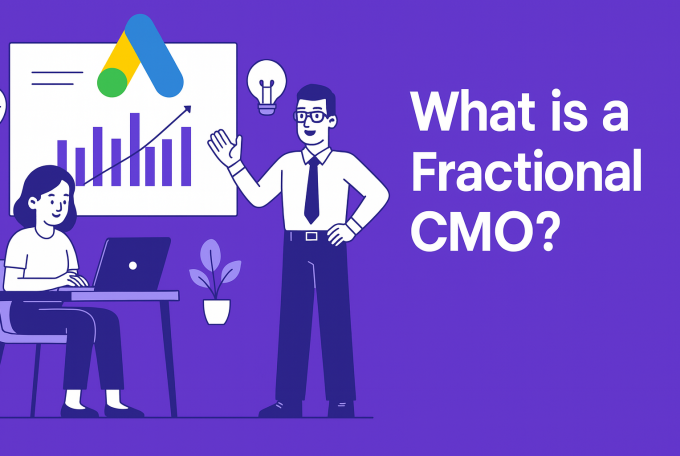
CMO-as-a-Service is an innovative solution that often gets referred to as a Fractional CMO or virtual CMO and it offers businesses access to strategic marketing leadership on a flexible basis Generally speaking it’s a service that’s offered for 1-2 days per week and it’s akin to hiring a full-time CMO on a part-time basis.
This service entirely eliminates the need for a full-time Chief Marketing Officer. It allows tech orgs to engage expert marketing guidance without c-suite bonuses, paid leave time, sick time, bonuses, stock options and other perks typically offered by big tech companies.
The core benefits of CMO-as-a-Service include:
- Tailored marketing strategies,
- Strategic & visionary marketing guidance,
- Market positioning based on Ansoff matrix,
- Aligning pricing strategy with GTM motions and product value,
- Fresh perspective on existing marketing efforts,
- Align marketing initiatives with business objectives,
- Improving customer acquisition and supporting product launches.
The core benefits of hiring a Fractional CMO include
- Flexible Engagement: Customize the level of involvement according to your business needs.
- Cost-Effective: Avoid the expenses associated with a full-time CMO.
- Industry expertise on demand: Access a team of marketing professionals to tackle marketing challenges.
| Benefit | Description |
| Strategic Visionary Marketing Leadership | Aligns marketing strategy with business goals. Sets north star metrics and aligns OKRs to KPIs and works as the strategic glue between product, sales, marketing and finance to set budgets that align with broader company business goals.
Trains marketing teams how to prioritize the marketing activities, and focus on the most important tasks that ladder up to the most impactful KPIs to drive pipeline. |
| Finds and Creates Market Insights for Leverage | Provides and creates valuable insights to reach your target audience with clear messaging and sets a clear GTM brand positioning that’s competitive and compelling. Aligns brand value to the brand’s GTM messaging, to drive real business outcomes. |
| Adaptability & Cultural alignment | Easily integrates with your in-house marketing team. Identifies gaps and friction to set strong operational rhythms for delivering work effectively and error free.
Channels like email, slack, notion documents or loom recordings can be highly efficient channels for communication. Setting clear priorities for marketing teams and teaching them to say “no” when tasks don’t clearly ladder up to major OKRs or KPIs to drive real business revenue. Optimization live meeting time for healthy discussions and clear decision-making that leads to ideation and problem solving rather than “status updates” or simple “readouts” |
| MarTech Upgrades | Finding ways to upgrade MarTech to improve personalization & segmentation with AI. Buyers want tailored messaging and fractional CMOs can deliver that brand experience at scale by learning into MarTech.
Specific AdTech and MarTech if adopted properly can drive business outcomes and provide holistic measurement across media channels. Examples of these platforms include the Google Marketing Platform or the Adobe Cloud, to mention a few among the sea of many others. |
| Manage Marketing Work and freelancers | A fractional CMO brings a structured approach to marketing operations. They can streamline proactive and reactive work, ensuring the team’s capacity is focused on high-impact work that ladders up to specific KPIs and OKRs. These fractional marketing leaders establish robust OKRs and prioritization paths, preventing the “marketing death spiral” of missed goals and lost credibility.
By implementing a clear filtering system, they can triage incoming requests. This way the “sand” which are the small things, don’t get in the way and protect the team’s ability to tackle big strategic initiatives. We refer to the big strategic things as “rocks,”. This triaging helps ensure that valuable resources are not diverted by ad hoc demands. Such demands often don’t align with North Star outcomes and move the team away from achieving the strong ROI. This proactive management of work avoids team overload and treats marketing professionals as strategic partners rather than a “service center”. These fractional marketing leaders establish robust OKRs and prioritization paths, preventing the “marketing death spiral” of missed goals and lost credibility |
| Building leaner teams with AI integration | The rise of the one-person CMO model is unlocking a new operational model for early stage B2B SaaS brands. This model is typically supported by AI automation, freelancers and agencies across different time zones.
Marketing leaders like this have strategic vision, understand the GTM structuring, can guide AI effectively with creative and sales motions (Think Google VEO for creative output and a myriad of other AI tools that plug into tools like clay.com. This can help you drive GTM sales motions effectively across several social channels. |
| Spotting scaling opportunities | Putting up a bill board on time square to prop up your brand value sounds awesome, while showcasing your brand during Superbowl to key audiences with a small budget is innovative and bold.
Great Fractional and virtual CMOs know when to take calculated risks to elevate your B2B SaaS through digital channels and enable the right growth levers. |
Overall, CMO-as-a-Service works like glue across marketing strategy connecting sales and marketing to product and the rest of the c-suite leadership to drive business performance without a dedicated full-time in-house marketing department. The obvious advantage of outsourcing this critical marketing function is to save cost and get specialized industry expertise.
Key Roles and Responsibilities of a CMO-as-a-Service
CMO-as-a-Service is a flexible solution for businesses seeking strategic marketing leadership without the financial commitments of hiring a full-time Chief Marketing Officer.
Unlike a traditional CMO, CMO-as-a-Service works on an as-needed basis, allowing businesses to align their marketing objectives with changing business goals and market conditions.
Key roles and responsibilities of a CMO-as-a-Service.
They focus on:
- Customer acquisition that builds a high converting pipeline,
- Product development,
- Execution of effective marketing initiatives,
CMO-as-a-Service ensures that businesses remain competitive in a dynamic marketplace.
They are a lean weapon for the marketing war. There is no fat, no long-term chains. Just sharp minds. They cut through the noise, sorting rocks from sand. They set proactive work, the big goals and then get to work and get it done. Reactive work, the small, unexpected tasks, are tamed.
They keep the glass “half full” and avoid the overflowing jar of “useless activities” that the board or CEO or the other 100 people on the team have asked for, that don’t lean into the North Star.
They focus only on the work that hits the North Star, that brings real return. The team works on what matters, not just what comes in.
Knowing when it’s time for a MarTech upgrade
They speak the finance man’s language. MarTech upgrades, tricky investments. But the CMO-as-a-Service makes the case. Time saved, money gained. Cost equivalents. They show the top-line push. For the harder-to-measure, like brand building, they give honest estimates, not false promises. They sequence the spend, build confidence slowly, and tell when the payoff will come. No surprises for the money men.
Saying “yes” & “no” when it matters most
Such marketing executives often say no. A hard word, but necessary. They say it early, when plans are made, not after the storm hits.
They use the CARE framework: Context, Anchor, Recommend, Empathize.
Clear words. Direct. Solutions offered, if they exist.
Urgent requests? They vet them.
Is it fire or just smoke? A true crisis gets action.
A false alarm gets a polite, firm “no.” Capacity is protected.
That’s how teams stay focused and the big hairy audacious goals along with strategy gets delivered at the right time and on time.
Strong Branding & Brand Development
In today’s noisy market, standing out is tough. That’s where a CMO-as-a-Service steps in. They help shape a brand’s voice so it actually speaks to the right people.
By bringing in real-world experience and an outside perspective, they look at what’s working and what’s not. This allows them to build a clear, consistent story. It’s a story that ties back to the company’s OKRS and values.
They don’t just tweak logos or taglines. They make sure the brand’s message stays sharp and consistent across every major platform where your brand appears. Over time, this approach is what builds trust. It just sticks in the people’s minds. And it lays the foundation for lasting growth.
Deep Market Research
Smart marketing starts with knowing the user’s choices and the competitive landscape. That’s why market research is a core part of CMO-as-a-Service. Instead of guessing, businesses get real insights about what customers want, where the trends are heading, and how to stay ahead of the curve.
With this service, companies tap into deep analysis and data that highlight what’s working, what’s changing, and where the real opportunities lie. It’s not just research for the sake of it. It’s research that fuels smarter plans and sharper campaigns.
In a fast-moving market, this kind of clarity helps teams adapt quickly and stay relevant. The result? Marketing that hits harder, lasts longer, and actually drives growth.
Media Campaign Management
Smart campaign management starts with understanding the user’s pain in depth and asking them what keeps them up at night.
This is table stakes in the B2B space, especially in tech. That’s why user research through customer surveys is a core part of any CMO-as-a-Service. This intel is typically collected before launching any new campaigns into the advertising market.
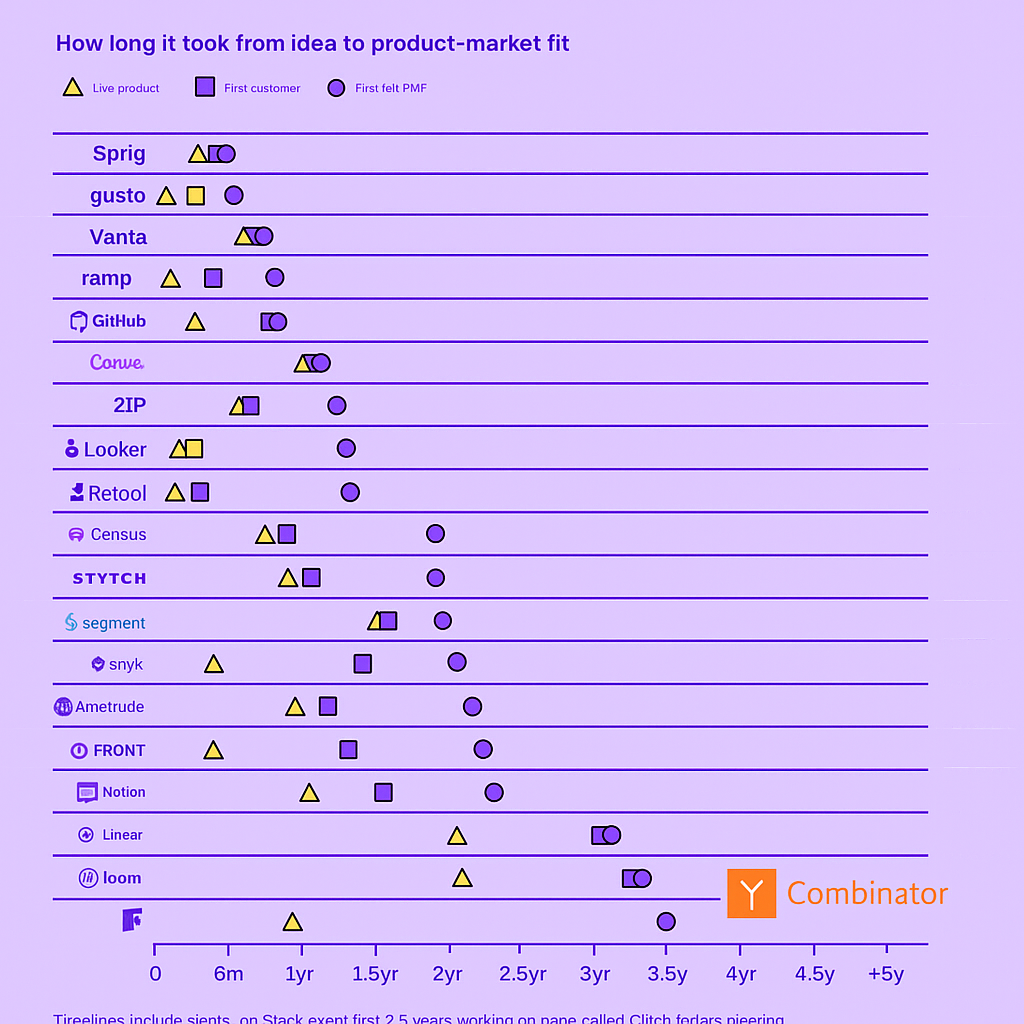
You need to have a crystal clear picture of your ICP and their respective buying drivers. This is a critical part of getting to product market fit and scaling beyond.
You also need to know your competitor’s offerings and how you’re going to stack up your product’s value drivers. Instead of guessing, your virtual CMO should get real insights from customer intelligence. They must know what customers want, to prevent churn and thus prevent sustain ARR growth trajectory.
Who Can Benefit from CMO-as-a-Service?
Not every company needs a full-time Chief Marketing Officer—but many still need high-level marketing direction. That’s where CMO-as-a-Service comes in. It gives growing businesses access to seasoned marketing leadership, without the cost or commitment of a full-time hire.
This setup works well for startups, tech companies, and small to mid-sized businesses looking to sharpen their marketing game. Whether you’re building a go-to-market plan, refreshing your brand, or scaling your lead generation, a Fractional CMO brings the strategic insight to help get it right.
It’s a flexible way to get expert help, tailored to your needs, and designed to support real growth—without locking into long-term overhead.
B2B SaaS Startups
Startups in the B2B SaaS space move fast, but the market moves even faster. Having the right marketing strategy early on can be a game-changer. That’s where CMO-as-a-Service fits in.
Instead of struggling to build a team from scratch, founders get access to proven executive marketing leadership that knows how to scale your B2B SaaS at T2D3 speed.
With a Fractional CMO, B2B SaaS startups can focus on growing their MRR and keeping customers engaged. That’s how you ensure that every marketing dollar counts. From refining product messaging to launching smart content campaigns, the guidance is there to help new ideas gain traction in a crowded space.
Tech Companies
Tech companies often have brilliant products but lack the marketing muscle to get them noticed. If you’re at 750K in ARR, and around 10 people, CMO-as-a-Service helps you start to bridge that marketing leadership gap.
This is a rough milestone, when you should start to think about hiring marketing leaders. It brings in someone who can translate innovation into impact. Thus, turning technical strengths into compelling stories that actually resonate.
Whether it’s shaping campaigns, staying ahead of market trends, or sharpening digital strategy, this kind of support helps tech teams connect the dots. With a clearer message and smarter outreach, your product doesn’t just exist, it stands out and you scale.
Small to Medium Enterprises (SMEs)
SMEs don’t always have the marketing budget for a full-time marketing leader, but they still need direction. That’s why CMO-as-a-Service makes sense. It brings in senior-level expertise without the overhead, helping businesses grow with purpose.
From market positioning to campaign planning, SMEs get the tools and know-how to compete effectively. It’s a way to upgrade your marketing function, gain clarity on where to focus, and make sure your efforts support long-term goals, without stretching resources thin.
Still unsure if it’s the right fit? Here’s why hiring a Fractional CMO is a game-changer for growth-stage businesses.
How to Evaluate CMO-as-a-Service Providers
Bringing in a CMO-as-a-Service can give your business the edge it needs—top-level marketing leadership without the cost of a full-time exec. But not all providers are created equal. Picking the right one matters.
To make the most of this service, look for someone who truly understands your space, offers the right mix of services, and stands behind their results. The goal isn’t just finding help—it’s finding the right fit to drive your growth.
Here’s how to choose the right Fractional CMO based on experience, flexibility, and cultural fit.
Assessing Industry Experience
Marketing isn’t one-size-fits-all. A provider who knows your industry can offer insights others can’t. They’ll understand your customers, your competitors, and what actually works in your space.
They’ve seen the pitfalls—and the playbooks—that matter. This kind of experience means faster execution, smarter strategies, and better results. Look for a track record that proves they can move the needle in businesses like yours.
Analyzing Service Scope
Not every CMO-as-a-Service offers the same level of support. Some focus on strategy, while others help with execution too.
Make sure the provider covers what you need—whether that’s campaign planning, customer acquisition, content, or digital growth.
Bonus points if they can plug into your existing team and help things run smoother across the board. Flexibility is key. Your business will evolve, and your marketing needs to keep up.
Verifying Accountability Measures
Good marketing leadership means owning the outcome. The right provider will help you track results, share insights, and adjust where it’s needed. You can expect very clear metrics, regular check-ins, and transparency at every step.
This is what turns a vendor into a partner. When accountability is baked in, you’ll know where things stand and what’s working. That’s what builds real trust—and real progress.
When to Consider CMO-as-a-Service
Not every business needs a full-time Chief Marketing Officer. But every business needs smart marketing. That’s where CMO-as-a-Service comes in—a flexible way to bring in senior-level marketing leadership without the long-term cost or commitment.
Whether you’re solving short-term challenges or building toward long-term goals, this service gives you access to experienced marketers who help sharpen strategy, uncover growth opportunities, and keep things aligned with your business goals.
Here’s when it really makes sense:
- Project-specific needs
Sometimes, you don’t need a CMO forever. You just need the right one now for the next 6-12 months. Maybe you’re launching a product, planning a major campaign, or reworking your digital strategy. A Fractional CMO can step in, bring fresh ideas, and guide execution where it counts.
They offer focused leadership for one-off projects over 6-12 months, while keeping your marketing efforts aligned with bigger goals. No long-term hire required.
- When you truly need strategic firepower
As your company grows, so do your marketing needs. With growth, things like brand messaging, content strategy, lead funnels, and market positioning become much more complex very quickly. That’s when having a strategic thinker at the helm matters most. They bring strategy and make sure it gets executed.
A CMO-as-a-Service brings the big-picture thinking and hands-on guidance to refine what you’re doing. They steer it in the right direction, based on real experience, not guesswork.
- If you’re short on resources and have limitations
Startups and smaller businesses usually don’t have the budget for a full-time executive team. That doesn’t mean they should settle for less. With CMO-as-a-Service, you get access to a seasoned pro. You could even opt out for a full fractional executive team, completely on your terms.
You get leadership when you need it, without the overhead. It’s a lean, smart way to stay competitive while keeping your finances tight.
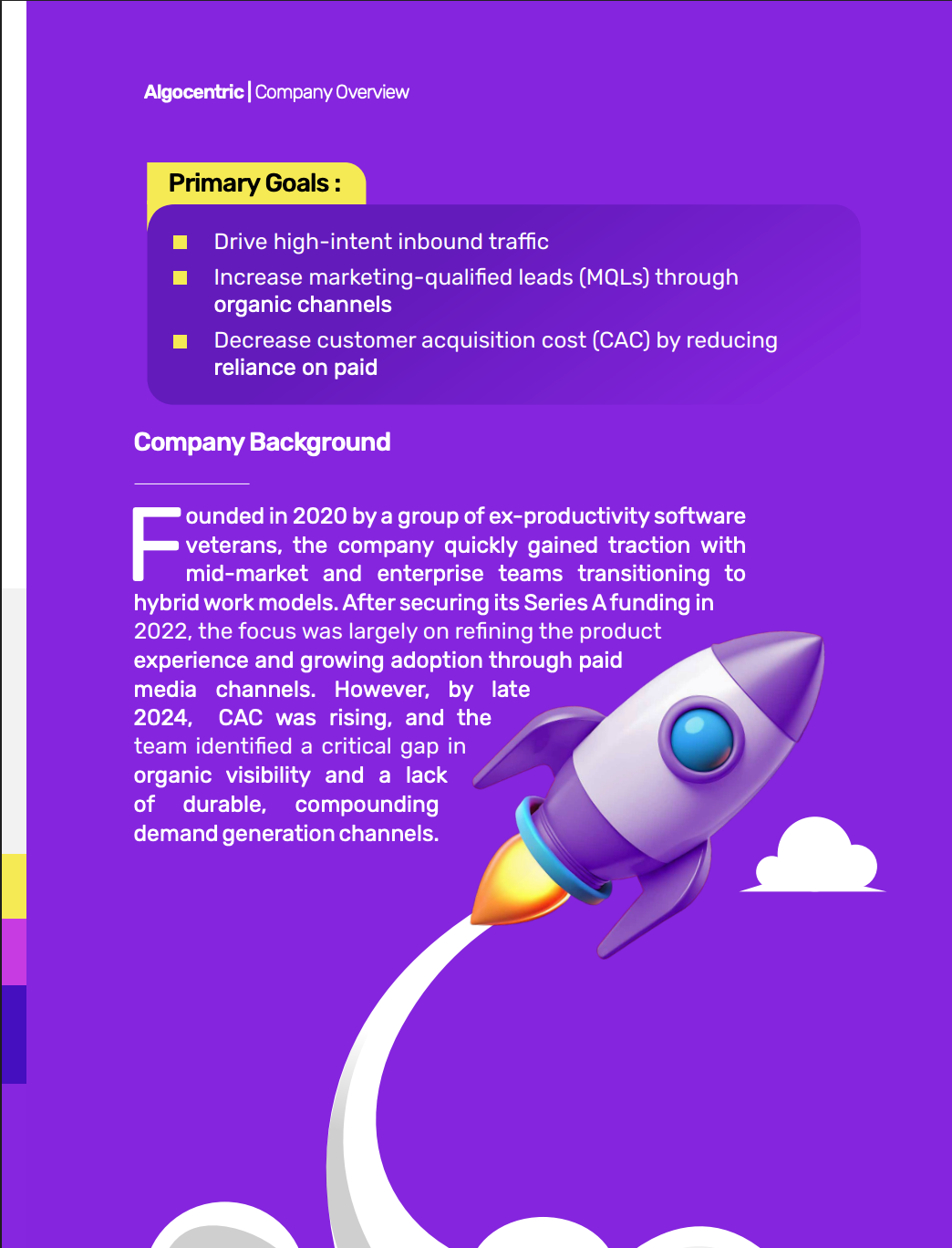
Case Studies: Successful Implementation of CMO-as-a-Service
Despite early success with paid acquisition, our client began to experience diminishing returns. We see this frequently with advertisers who are focused largely on paid channels. In this case they were still delivering top-of-funnel traffic, but conversion rates began falling. To add insult to injury, MQL quality was inconsistent. Their senior leadership team recognized that sustainable growth would require a long-term strategy rooted in brand authority, educational content, and organic discoverability. This opened the door for conversations around SEO visibility.
The executive team also faced pressure from the board. The board had asked to diversify pipeline sources ahead of raising their Series C. Organic search represented a huge opportunity. However their internal resources lacked the technical optimization expertise and strategic SEO leadership to execute content marketing at scale with research backed content briefs.
The company aimed to:
- Triple organic traffic within 24 months
- Double MQLs from organic
- Improve lead quality and velocity
- Build out a content moat aligned with sales enablement
- Establish topical authority using semantic SEO principles
- Reduce CAC by reallocating spend from paid search to SEO
Algocentric Digital Consultancy
Scaling your SaaS company requires a B2B SaaS CMO with both strategic marketing expertise and the willingness to dive into execution. With our CMO-as-a-service model, a fractional CMO seamlessly integrates into your team, bringing deep experience, a proven B2B SaaS marketing playbook, and the T2D3 growth methodology.
Our approach focuses on crafting and implementing a comprehensive marketing strategy tailored to your unique business objectives, ensuring effective growth and measurable results.
An exceptional fractional CMO works hand-in-hand with the in-house marketing team, ensuring that all marketing efforts are tightly aligned with the company’s growth objectives and revenue targets. This partnership creates a seamless blend of strategic marketing leadership and the team’s ongoing initiatives.
By building on what’s already working across channels with a unified approach, the fractional CMO delivers an ROI-Driven B2B SaaS marketing strategy. Following a T2D3 Methodology we deploy a proven framework that scales your B2B faster than other SaaS agencies or SaaS consultants.
How do we know this?
It’s simple, this framework has been battle tested across 100s of B2B SaaS brands and it works.
Potential Cultural Challenges and Solutions
In the evolving digital landscape of AI-Driven strategies, engaging a CMO-as-a-Service model introduces a myriad of potential challenges. They are mostly centered around integration, strategy alignment, and channel performance measurement.
Businesses that adopt this model must address operational integration challenges alongside sustainable growth. The fundamental issues stem from inability to harmonize the external CMO with existing in-house teams. This often comes from creating and adhering to defined marketing objectives, and accurately assessing the ROI that come from marketing activities.
I’ve spent a decade watching marketing teams—inside startups, scaleups, and billion-dollar giants. I’ve worked full-time, on retainer, and as a Fractional CMO. I’ve seen big wins and brutal stalls. And I’ll tell you this: the biggest reason a strategy fails isn’t the plan. It’s the people.
Not talent.
Not even effort.
It’s rhythm, culture and tight integration.
You can bring in a brilliant Fractional CMO. They can have the vision, the experience, the roadmap. But if they clash with how your team works, the results will stall. Not because of what they know, but because no one’s listening.
What’s worse?
No one knows who’s supposed to do what, or when.
Here’s what it can look like: meetings that feel like reruns. Reports that no one reads. Slack threads that spiral into confusion.
A marketing team that says “yes” to everything, but ships nothing of real value.
All of it adds up to the same outcome that I see time and time again.
It’s a lot of wasted time, lost trust, missed goals and budget cuts that eventually result in layoffs.
This can all be prevented with the right cultural settings.
Culture Isn’t Ping Pong Tables—It’s How Work Gets Done
When I walk into a new company, I don’t look at their brand book first.
I look at how they move.
How are decisions made?
Who needs to sign off?
When do teams meet?
What happens when things go wrong?
Every company has a rhythm and the speed at which they move today is critical.
Whether they know it or not. That rhythm is the culture. And it’s usually invisible.
When you drop a new leader into that rhythm, especially one working part-time, you expose every flaw in the system.
If people rely on long meetings to solve basic issues, progress dies. If no one owns decisions, leaders can’t lead. If the CEO steps in and changes direction every week, even the best campaign will crumble.
This is the friction most founders don’t talk about. But it’s the one that stops momentum.
Fractional CMOs Don’t Have Time to “Figure It Out”
When I come in as a Fractional CMO, I usually have 90 days to make a dent. That means I need to build trust fast. I need to know who owns what. I need access to real data, not vanity metrics. I need to know which meetings matter and which ones can die.
But most of all, I need to bring clarity. Fast.
That means asking questions most full-time CMOs are too polite to ask.
- Why do we meet every Monday?
- What’s the purpose of this status report?
- Who’s actually responsible for execution here?
- Why is product launching without marketing in the loop?
If your team can’t answer those, it’s not a leadership problem, it’s a rhythm problem.
Resetting the Beat
Here’s the truth: culture can’t be “fixed.”
But rhythm can.
The best way to integrate a Fractional CMO is to create structure, not control.
That means:
- One weekly sync that matters. Clear agenda. Real decisions.
- Asynchronous updates. Slack, Loom, Notion. Use them. Don’t clog calendars.
- Defined owners. Every campaign needs a DRI—directly responsible individual.
- No “drive-by” requests. All requests go through a central queue. That’s how it is prioritized and then sorted.
When a Fractional CMO sees this in place, they can move fast. They can lead without stepping on toes. They can scale without chaos.
When it’s not in place, they spend half their time untangling confusion, and the other half managing feelings.
Integration Takes Intent
Here’s a mistake I see often: companies treat Fractional CMOs like contractors. They consider them as outsiders. They bring them in, but keep them at arm’s length. That never works.
If you want a Fractional CMO to lead, you need to let them in.
Give them access to your team. Add them to Slack and invite them to leadership stand-ups. Let them read customer feedback, talk to sales, and challenge the roadmap when needed.
Culture doesn’t come from happy hours. It comes from shared decisions. Shared problems lead to shared wins.
When a CMO is treated like part of the team, they act like it. When they’re treated like a vendor, they stay quiet and leave early.
The Real Role: Tuning the System
A good Fractional CMO doesn’t just bring strategy. They tune your operating system. They find inefficiencies. They break bad habits. They clean up the noise so the signal gets through.
They don’t do this by force. They do it by helping your team build better habits. By modeling clarity. By focusing on fewer things and doing them better.
This is true leadership. It’s quiet and steady.
If you want to engage the Fractional CMO service at Algocentric Digital, you can engage with us and fill out our Fractional CMO services form below here.


Sergiy Solonenko is the founder of Algocentric Digital Consultancy, a seasoned digital strategist, and a fractional CMO for B2B SaaS brands undergoing digital transformation. With over a decade of experience, he specializes in scaling demand-generation programs, optimizing account-based marketing, and aligning sales and marketing teams. Sergiy helps B2B SaaS companies enhance lead qualification, improve user experience through personalization, and leverage Martech to accelerate MRR growth.