🎯 Quick Answer
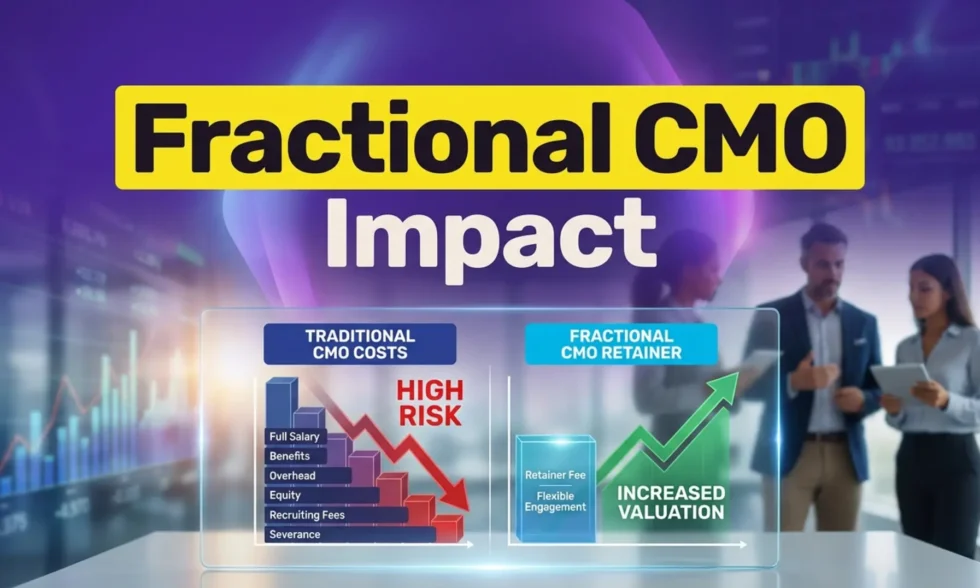
A fractional CMO for private equity is a strategic, capital-efficient leadership model that directly drives EBITDA expansion and increases exit valuations. Instead of a $500k+ annual fixed cost, PE firms can access elite, AI-empowered marketing leadership via a flexible retainer, converting significant SG&A savings into a potential 10x-15x gain at exit. Key points:
- Reduce Overhead: Can cut marketing leadership costs by up to 67% compared to a full-time hire.
- Increase Exit Value: Financial modeling indicates every $100k saved in SG&A can add $1M – $1.5M to the exit multiple.
- Accelerate Growth: Implements an effective 100-day growth framework designed for post-acquisition stabilization and pre-exit acceleration.
- AI-Empowered Efficiency: Leverages machine learning to help lower Customer Acquisition Cost (CAC) and accelerate MRR.
Continue reading for a detailed 2026 cost-benefit analysis and financial modeling.
For private equity firms, the pressure to expand EBITDA in portfolio companies is relentless. Traditional C-suite hiring introduces significant overhead, with a fully-loaded CMO salary often exceeding $500,000 annually. This article explores a more capital-efficient model gaining traction in the US PE market: the fractional cmo for private equity. By leveraging this model, firms can achieve an estimated 67% reduction in marketing leadership overhead, accessing top-tier talent without the associated SG&A burden. The shift towards digital and capital-efficient marketing is part of a larger macroeconomic trend; the Bureau of Economic Analysis reports that the U.S. digital economy is a significant and growing component of the nation’s GDP [1].
This approach extends beyond simple cost savings; it focuses on converting operational efficiency into a direct multiplier on your exit valuation. We will provide a detailed 2026 cost analysis, comparing the fractional model to full-time hires and agencies. Furthermore, we will explore how AI-empowered leadership helps reduce CAC, present a 100-day framework designed for immediate impact, and model precisely how these efficiencies can translate into millions in additional enterprise value.
For niche industries, pricing can vary significantly. For example, a fractional cmo for optometrist may require a different scope focused on local acquisition and patient pipeline growth.
ℹ️ Transparency: This article explores the financial and strategic impact of the fractional CMO model for private equity based on market data and proprietary analysis. All information is verified and reviewed by Sergiy Solonenko. Our goal is to provide accurate, actionable information for PE partners and portfolio company leaders.

Fractional CMO vs. Marketing Agency for PE-Backed Companies
For private equity firms, the choice is not always between a full-time CMO and a fractional CMO. In many cases, the real comparison is a fractional CMO versus a marketing agency. The difference is strategic ownership. An agency typically executes campaigns within a defined scope, while a fractional CMO owns the growth strategy, aligns marketing with the CEO and board, manages vendors, and ensures every initiative supports value creation. For PE-backed companies, this distinction matters because execution without executive accountability often leads to channel activity without meaningful improvement in EBITDA or exit readiness.
When an Agency Is Not Enough
An agency can be valuable when the strategy is already clear and the company mainly needs bandwidth for paid media, SEO, or content production. But if the portfolio company lacks positioning clarity, board-level KPI discipline, or a unified growth plan, an agency usually cannot replace executive marketing leadership. In those cases, a fractional CMO often becomes the operating layer that decides what should be done, which vendors should execute, and how performance should be reported to investors and management. This is especially important in compressed PE hold periods where wasted motion directly reduces value creation.
For companies evaluating leadership structure, understanding the difference between a fractional cmo vs vp marketing b2b startups is essential for aligning cost, speed, and strategic impact.
Full-Time CMO vs. Fractional Retainer: 2026 Salary Benchmarks
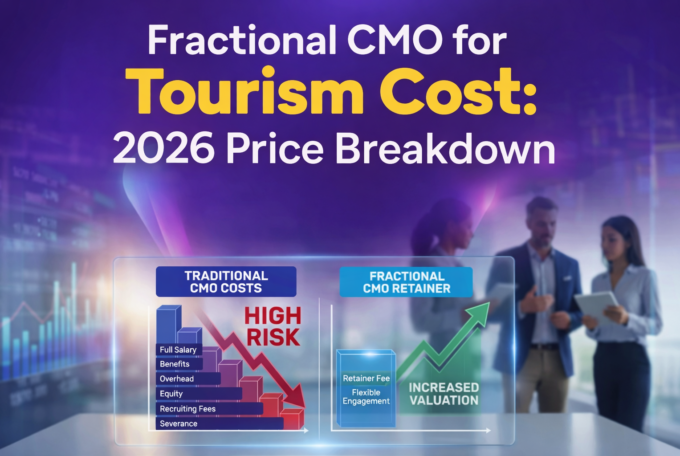
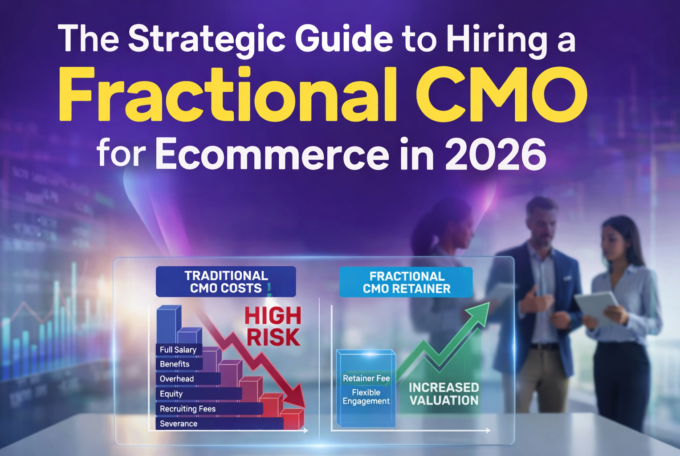
Directly answering the core financial question: how much does a fractional cmo cost compared to a traditional hire? In 2026, the decision between a full-time CMO and a fractional CMO is primarily a financial one evaluated through the lens of capital efficiency. A full-time, experienced B2B SaaS CMO in a major US tech hub—such as a fractional cmo austin alternative or a Silicon Valley executive—typically commands a base cmo salary of $250,000 to $350,000. However, the fully-loaded cost to the business is significantly higher.
The True Cost of a Full-Time CMO
When evaluating traditional executive hiring, the base salary is only the starting point. The fully-loaded cost includes several compounding financial commitments that drain operational capital:
- Base Salary: $300,000 (US average for an experienced tech CMO).
- Bonus & Equity: Typically 20-40% of the base salary, adding an estimated $60,000 to $120,000.
- Taxes & Benefits: Approximately 30% on top of the base salary, representing roughly $90,000.
- Recruiting & Onboarding: Executive search fees often range from 20-30% of the first-year salary, adding $60,000 to $90,000.
- Total Year 1 Cost: $510,000 to well over $600,000.
The Fractional CMO Retainer Model
Conversely, fractional cmo pricing is structured to bypass these bloated overhead costs. The fractional cmo cost is typically arranged as a flat monthly retainer, offering highly predictable financial modeling for portfolio companies.
- Typical Rates: Fractional cmo rates generally range from $5,000 to $25,000 per month, depending on the scope of the engagement and the growth stage of the company.
- Annual Cost: $60,000 to $300,000.
- All-Inclusive Structure: This model typically incurs no additional costs for benefits, payroll taxes, equity dilution, or executive recruiting fees.
- Immediate Financial Impact: This structure creates an immediate SG&A saving of $210,000 to $540,000 annually.
When comparing this model to a full-service marketing agency, the fractional approach provides embedded C-level strategy rather than just tactical execution, often at a more efficient price point.
2026 Executive Marketing Cost Comparison
| Expense Category | Full-Time CMO (Estimated) | Fractional CMO (Estimated) |
|---|---|---|
| Base Salary / Retainer | $300,000 | $150,000 (Mid-tier avg) |
| Bonus & Equity | $90,000 | $0 |
| Taxes & Benefits | $90,000 | $0 |
| Recruiting Fees | $75,000 | $0 |
| Total Year 1 Investment | $555,000 | $150,000 |
| Annual SG&A Savings | N/A | $405,000 |
The financial argument is compelling. Opting for a fractional model frees up hundreds of thousands in capital that can be reinvested into product development, sales expansion, or other growth initiatives. However, the most significant financial impact isn’t just the immediate operational savings; it is how those savings multiply at the time of exit.
The EBITDA Multiplier: How Marketing Efficiency Drives Exit Value
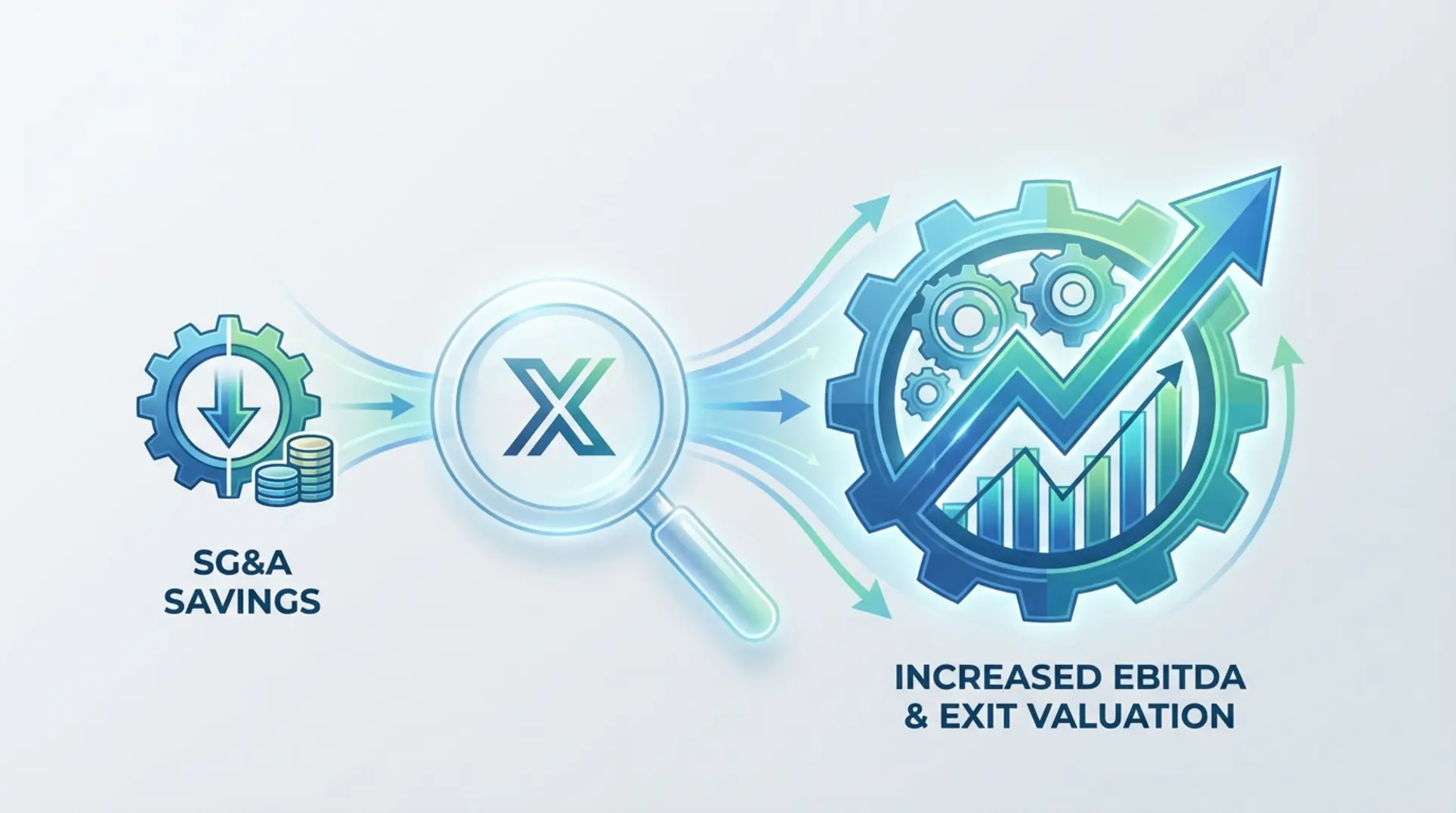
Generic business analyses often stop at “cost savings,” which misses the most critical calculation for a private equity firm: the direct impact on exit valuation. A dollar saved in Selling, General, and Administrative Expenses (SG&A) is a dollar added directly to EBITDA. For a B2B SaaS company valued on a multiple of EBITDA, this saving is not just a one-time operational benefit; it acts as a powerful multiplier.
Understanding this multiplier effect is central to a sophisticated exit valuation strategy. In the context of private equity marketing, leadership decisions must be evaluated based on how they influence the final multiple.
The EBITDA Calculation Explained
EBITDA (Earnings Before Interest, Taxes, Depreciation, and Amortization) serves as a proxy for a company’s current operational profitability. In the B2B SaaS sector, valuations are frequently calculated as a multiple of EBITDA. Therefore, any initiative that sustainably increases EBITDA without sacrificing growth velocity will disproportionately increase the enterprise value. This is why portfolio company marketing must transition from a cost center mentality to a value creation mindset.
Modeling the Impact: A Financial Example
To illustrate how ebitda growth is engineered through fractional leadership, consider the following hypothetical financial model based on the 2026 salary benchmarks established earlier.
- Step 1: Calculate the SG&A Savings
First, we identify the difference in overhead between the two leadership models.
- Full-Time CMO (fully loaded annual cost): $500,000
- Fractional CMO (top-tier annual retainer): $150,000
- Annual SG&A Reduction: $350,000
- Step 2: Apply the Savings to EBITDA
Because the fractional retainer replaces a fixed operational cost, this $350,000 reduction flows directly to the bottom line. Assuming revenue remains constant (or grows, as expected with strategic leadership), the annual EBITDA increases by exactly $350,000.
- Step 3: Apply the Exit Multiple
Private equity firms acquire companies with the intent to sell them at a multiple. Let us assume a conservative 10x EBITDA multiple for a healthy, growing B2B SaaS company at the time of exit.
- Increased Exit Value: $350,000 (EBITDA gain) x 10 (Multiple) = $3,500,000.
- Step 4: Evaluating a Higher Range
In strong market conditions or for highly scalable SaaS platforms, multiples can easily reach 15x or higher.
- At a 15x multiple: $350,000 x 15 = $5,250,000.
The Strategic Advantage of Capital Efficiency
This financial context requires an understanding of deal structures and valuation methodologies that generic marketing models often lack. A traditional marketing department might celebrate a $50,000 reduction in ad spend, but a fractional leader aligned with PE goals understands that structural SG&A efficiency creates exponential value.
This modeling demonstrates a direct, predictable outcome of strategic leadership choices. By choosing a capital-efficient fractional model, a PE firm is actively engineering a higher exit valuation for its portfolio company, turning an operational resourcing decision into a multi-million dollar strategic gain. Results depend on market conditions, but the mathematical foundation of this strategy remains a core tenet of modern value creation.
Board-Level KPIs a Fractional CMO Should Report in a PE Environment
In a private equity setting, marketing performance should be reported in the same language as value creation. That means moving beyond vanity metrics and focusing on board-level indicators such as CAC payback period, pipeline contribution, marketing-sourced revenue, win rate by segment, retention impact, and the efficiency of spend by channel. A strong fractional CMO builds a reporting cadence that connects marketing activity to EBITDA expansion, revenue quality, and forecast confidence. This gives operating partners and portfolio CEOs a clearer view of whether marketing is functioning as a true growth lever or simply consuming budget.

AI-Empowered Marketing Leadership: Reducing CAC while Accelerating MRR
The term “AI-powered” is ubiquitous in modern business, yet few organizations can articulate its practical application in driving tangible metrics like cac reduction. An AI-empowered saas fractional cmo does not just follow industry trends; they deploy a specific operational layer of machine learning tools to create a more efficient growth engine than a traditional team can typically manage.
In its 2025 AI Index Report, Stanford’s Institute for Human-Centered AI reported that U.S. private investment in AI grew to $109.1 billion in 2024, demonstrating the immense capital flowing into AI-driven business solutions [2]. This aligns with national trends, where according to a 2025 technology impact story from the U.S. Census Bureau, approximately 78% of organizations reported using AI in their business operations in 2024 [3]. Furthermore, the SBA’s Office of Advocacy found that the AI adoption rate among small businesses rose to 8.8% in late 2025, with a notable focus on automated marketing solutions to improve efficiency [4]. To ensure responsible implementation of these tools, strategic leaders often utilize guidelines like the NIST AI Risk Management Framework to manage associated technological risks [5].
The “AI-Empowered” Stack
To capitalize on this technology in b2b saas marketing, a fractional leader implements a sophisticated operational stack:
- Predictive Keyword Targeting: Traditional search marketing relies heavily on historical search volume. AI-powered marketing models analyze SERP volatility and competitor intent in real-time. This allows the marketing engine to focus budget on keywords with the highest probability of conversion, moving beyond simple volume metrics to capture high-intent demand.
- Automated Lead Scoring: Machine learning algorithms can analyze behavioral data—such as website interactions, content downloads, and email engagement—to score and prioritize leads automatically. This ensures that high-cost human sales resources focus only on purchase-ready prospects, increasing close rates and sales efficiency.
- Dynamic Budget Allocation: Advanced algorithms can shift advertising spend in real-time between channels based on performance data. This continuous optimization helps maximize ROI and minimize wasted spend across complex digital ecosystems.
This is especially relevant in technical industries, where a fractional cmo for science companies must translate complex innovation into scalable demand generation strategies.
The Impact on SaaS Metrics
The integration of this technology stack is designed to impact two critical SaaS metrics:
- CAC Reduction: By improving targeting precision and automating the qualification process, the AI stack helps reduce the time and budget spent on low-quality leads. This efficiency directly contributes to a lower Customer Acquisition Cost.
- MRR Acceleration: A more efficient funnel—characterized by higher quality leads and faster conversion cycles—directly fuels Monthly Recurring Revenue growth. Implementing these systems is an effective approach to accelerating MRR efficiently.
This represents the Silicon Valley standard of marketing leadership applied to a national market. It is not about replacing human strategy, but rather augmenting it with machine precision. This technical depth allows a fractional leader to consistently optimize campaigns and support growth targets more efficiently than slower-moving traditional marketing departments.
Similarly, in emerging sectors like climate and ESG, a fractional cmo for sustainability focuses on balancing brand credibility with performance-driven acquisition.
Pre-Exit Marketing Due Diligence: What a Fractional CMO Helps Clean Up
As a portfolio company approaches exit, marketing due diligence becomes more important. Buyers want to see a repeatable acquisition engine, clean attribution, credible pipeline reporting, defensible positioning, and less dependence on any single founder or paid channel. A fractional CMO helps prepare the company for this scrutiny by tightening reporting systems, documenting go-to-market processes, reducing inefficient spend, and making growth performance easier to validate. In practice, this can make the revenue story more credible during diligence and improve buyer confidence in the sustainability of future growth.
The 100-Day PE Growth Framework
Private equity timelines demand “deal speed,” prioritizing rapid value creation over long-term, passive brand building. A fractional CMO specializing in PE environments inherently understands this urgency. Upon engagement, they typically deploy a structured 100-day framework designed for rapid post-acquisition stabilization and pre-exit acceleration.
Phase 1: Diagnosis & Stabilization (Days 1-30)
The first 30 days are focused on establishing a baseline and stopping capital bleed.
- Action: Conduct rapid marketing due diligence on the existing technology stack, team capabilities, historical data, and channel performance.
- Outcome: Identify and plug “leaky bucket” budget waste immediately. Establish a single source of truth for all marketing KPIs to ensure transparent reporting to the board.
Phase 2: Strategy & Quick Wins (Days 31-60)
With the foundation stabilized, the focus shifts to alignment and early momentum.
- Action: Re-align the growth marketing strategy with the PE firm’s overarching investment thesis. Launch high-impact, low-effort campaigns (such as retargeting sequences and lead nurture optimization) to capture existing demand.
- Outcome: Generate immediate momentum and demonstrate early ROI. This phase is critical for building internal confidence among the portfolio company’s executive team.
Phase 3: Scale & Systemize (Days 61-100)
The final phase of the initial framework focuses on building a sustainable engine for long-term growth.
- Action: Implement the AI-empowered operational layer discussed previously. Systemize lead flow, automate reporting dashboards, and build a scalable, repeatable growth engine that operates independently of any single team member.
- Outcome: Create a predictable pipeline designed to directly support the EBITDA growth targets required for a successful and lucrative exit.
This framework helps transform the marketing function from a traditional cost center into a strategic asset for the PE firm. By executing this structured approach, the fractional leader establishes themselves as a true operating partner marketing resource focused relentlessly on the P&L.
How to Know If a Portfolio Company Is a Good Fit for a Fractional CMO
Not every portfolio company needs the same level of marketing leadership. A fractional CMO is usually the best fit when a company has already achieved product-market fit, has a sales motion worth scaling, and needs sharper executive direction rather than more junior execution. In PE-backed environments, the strongest fit is often a company with inconsistent pipeline quality, unclear positioning, rising CAC, weak marketing accountability, or no board-ready reporting cadence. In these situations, a fractional CMO can create operating discipline quickly without adding the fixed cost of a full-time executive.
Signs the Company Needs Fractional Marketing Leadership
Common signs include founder-led marketing that no longer scales, channel spend without clear attribution, poor alignment between sales and marketing, and growth targets that are disconnected from execution capacity. In many PE-backed SaaS businesses, the issue is not a lack of activity but a lack of executive ownership over positioning, pipeline strategy, and measurement. A fractional CMO closes that gap by translating the investment thesis into a practical go-to-market roadmap tied to EBITDA, CAC efficiency, and revenue quality.
In highly specialized markets, such as cybersecurity, a fractional cmo for security brand plays a critical role in refining positioning, trust signals, and enterprise-level messaging.
Common Marketing Mistakes PE Firms See in Portfolio Companies
One of the most common mistakes in PE-backed companies is treating marketing as a collection of channels instead of a managed growth system. This often shows up as agency sprawl, weak positioning, inconsistent sales enablement, poor attribution, and spending that is not tied to investment thesis priorities. Another frequent issue is hiring too late, after pipeline quality has already declined or growth targets are off track. A fractional CMO helps correct these problems early by establishing strategic focus, executive accountability, and a measurement framework that supports both immediate performance and long-term enterprise value.
Frequently Asked Questions
How much does a fractional CMO for private equity cost in 2026?
A fractional CMO for private equity typically costs between $8,000 and $25,000 per month on a retainer basis in 2026. This is a strategic investment rather than a salary, as it includes the CMO’s expertise without the overhead of benefits, taxes, or equity. The final cost depends on the portfolio company’s size, growth stage, and the specific scope of work required to meet the PE firm’s EBITDA and exit goals.
What is the impact of fractional marketing leadership on EBITDA?
Fractional marketing leadership has a direct positive impact on EBITDA by reducing fixed operational costs. By replacing a $500k+ fully-loaded CMO salary with a more efficient fractional retainer, the savings in SG&A flow directly to the bottom line. This operational efficiency not only boosts annual profitability but also multiplies the company’s valuation at exit. Individual company performance will vary based on market conditions.
How much should a B2B SaaS portfolio company expect to pay for a fractional CMO vs. agency?
A B2B SaaS portfolio company can expect to pay $8,000-$25,000/month for a fractional CMO, versus $15,000-$50,000+/month for a full-service agency. A fractional CMO provides C-level strategy and leadership integrated into the executive team. An agency typically focuses on execution and may involve multiple junior-level contacts, often at a higher total cost.
How does AI-powered marketing leadership reduce Customer Acquisition Cost (CAC)?
AI-powered marketing leadership reduces CAC by increasing efficiency and precision. It uses machine learning for predictive keyword targeting to help eliminate wasted ad spend and automates lead scoring to focus sales efforts only on high-intent prospects. This data-driven approach ensures the marketing budget is allocated to the most profitable channels, which typically lowers the average cost to acquire a customer.
What is the ROI timeline for a fractional CMO in B2B SaaS?
The ROI for a fractional CMO in B2B SaaS can often be seen within the first 90-180 days. Initial returns come from immediate cost savings and the elimination of inefficient spending identified in the first month. Strategic initiatives aimed at accelerating MRR and reducing CAC typically begin showing significant, measurable impact within the first two quarters.
Can a fractional CMO help prepare a portfolio company for exit?
Yes, preparing a portfolio company for exit is a core function of a fractional CMO for private equity. They do this by building a predictable and scalable growth engine, cleaning up marketing data for due diligence, aligning marketing KPIs with financial outcomes (EBITDA), and ensuring the growth story is compelling and defensible to potential buyers.
How much does a fractional CMO make vs. a full-time CMO salary?
A fractional CMO’s income is based on a portfolio of clients, while a full-time CMO earns a single salary. A full-time CMO’s salary in tech can be $300k-$500k+ when fully loaded with benefits and bonuses. A fractional CMO might earn a similar total income, but they do so by serving multiple companies, making their high-level expertise more accessible and affordable for each client.
Is a fractional CMO a better fit for Series B SaaS than a full-time hire?
A fractional CMO is often a better fit for a Series B SaaS company. At this stage, a company needs elite strategic leadership to scale efficiently but may not have the budget or need for a full-time, in-house executive. The fractional model provides the necessary C-level guidance on a capital-efficient basis, helping preserve cash for product development and sales expansion.
What are the typical retainer rates for fractional executives in 2026?
Typical 2026 retainer rates for experienced fractional executives (CMO, CFO, etc.) in the US range from $5,000 to $30,000 per month. The rate varies based on the executive’s experience, the industry (tech and finance are higher), and the level of engagement (from advisory to hands-on leadership). This model provides access to top-tier talent for a fraction of a full-time salary.
How does Algocentric Digital’s outcome-based model work for PE firms?
Algocentric Digital’s outcome-based model aligns our compensation with the PE firm’s financial goals. Instead of a flat retainer for activities, our pricing structure is tied to achieving specific, measurable business outcomes like MRR growth, CAC reduction, or pipeline value. This ensures our efforts are relentlessly focused on initiatives that directly support increasing the portfolio company’s enterprise value.
Limitations, Alternatives & Professional Guidance
The fractional CMO model is highly effective for companies that have achieved product-market fit and require strategic leadership to scale, typically in the Series A-C stages. However, it may be less suitable for very early-stage startups needing full-time, hands-on execution for daily tasks, or for large, mature enterprises that require a dedicated, full-time executive to manage complex, multi-layered global teams. Additionally, while businesses are rapidly adopting AI, it’s crucial to manage its implementation thoughtfully. A 2025 Pew Research Center study of U.S. adults found that 52% of workers feel worried about AI in the workplace, highlighting the need for strong, empathetic leadership during technology transitions [6].
Alternatives to a fractional CMO include hiring a full-service marketing agency, building an in-house team led by a Director of Marketing, or engaging specialist consultants for specific projects (e.g., SEO, PPC). An agency may offer more executional bandwidth across various channels, while an in-house director can be more cost-effective if the primary need is daily personnel management rather than high-level, exit-oriented strategy.
The optimal leadership model depends heavily on a company’s specific stage, budget, and growth objectives. We recommend that PE partners and founders conduct a thorough needs analysis before making a hiring decision. A professional consultation can help clarify whether the primary need is for strategic direction, team management, or channel execution, ensuring the right resource is engaged to support the desired financial outcomes.
Conclusion
The strategic decision to hire a fractional cmo for private equity is a powerful lever for value creation in 2026. This model not only delivers immediate and substantial SG&A savings but also multiplies that operational efficiency into millions of dollars in additional enterprise value at the time of exit. By moving beyond simple cost-cutting to embrace AI-empowered strategies that help reduce CAC and accelerate MRR, PE firms can install the sophisticated, outcome-focused leadership needed to compete effectively in a crowded market.
At Algocentric Digital, our value-driven fractional CMO service is designed to function as an extension of your operating partner team. We specialize in implementing the frameworks and AI-powered systems discussed in this analysis to help drive capital-efficient growth. If you are ready to explore how this model can directly impact the EBITDA and exit valuation of your B2B SaaS portfolio companies, consider reaching out for a complimentary portfolio audit.
CTA: Send Us a Message
References
- Bureau of Economic Analysis. (2025). *Digital Economy*. U.S. Department of Commerce. https://www.bea.gov/data/special-topics/digital-economy
- Stanford University. (2025). *2025 AI Index Report*. Institute for Human-Centered AI. https://hai.stanford.edu/ai-index/2025-ai-index-report
- U.S. Census Bureau. (2025). *Technology Impact Story*. United States Department of Commerce. https://www.census.gov/library/stories/2025/09/technology-impact.html
- U.S. Small Business Administration. (2025). *New Advocacy Article Highlights Small Businesses Closing the AI Adoption Gap*. Office of Advocacy. https://advocacy.sba.gov/2025/09/24/new-advocacy-article-highlights-small-businesses-closing-the-ai-adoption-gap/
- National Institute of Standards and Technology. (2025). *AI Risk Management Framework*. U.S. Department of Commerce. https://www.nist.gov/itl/ai-risk-management-framework
- Pew Research Center. (2025). *Workers’ Views of AI Use in the Workplace*. https://www.pewresearch.org/social-trends/2025/02/25/workers-views-of-ai-use-in-the-workplace/

Sergey Solonenko is the founder of Algocentric Digital Consultancy, an active digital strategist and a fractional CMO for many B2B SaaS brands embracing digital transformation. At Algocentric Digital Sergey’s focus is on empowering every B2B SaaS brand who is looking to scale their demand generation program. Sergey’s digital marketing experience over the last 10 years has allowed him to become a digital evangelist focused on improving B2B SaaS demand generation programs and consulting on best practices around account based marketing, sales and marketing team alignment, setting up better lead qualification systems and improving user experience through personalization by aligning martech with key marketing KPIs that ladder up to faster MRR for B2B SaaS brands.