So you want to hire a fractional executive?
There’s a quiet revolution happening in business leadership.
And no, it’s not about tech CEOs in hoodies or billionaires tweeting from space.
It’s about a different kind of executive.
One who’s not on your payroll full-time but still drives your company forward like they’ve been there since Day One.
This is the world of fractional leadership. And it’s shaking up how modern businesses think about strategy, scale, and success.
But here’s the catch: no strategy, fractional or otherwise, survives contact with reality unless it’s delivered with discipline.
The Modern Marketing Leader’s Dilemma
Back in 2019, Google and Deloitte spoke with board members from Fortune 1000 companies. Their conclusion?
Today’s CMO isn’t just a marketer.
They’re a strategist, data analyst, brand builder, and cultural antenna.
All rolled into one. Sounds poetic. Sounds powerful.
But let’s be honest – it sounds exhausting too.
And that’s the truth: marketing leadership is high-stakes, high-pressure work.
Get the strategy wrong, and you could blow the budget and lose customers in one fell swoop.
But get it right, and you can unlock growth, trust, and long-term competitive edge.
Why Strategy Falls Apart & And How to Stop the Spiral
Crafting a marketing strategy is one thing.
Delivering it?
That’s where the battle begins.
You might write up a beautiful plan — full of vision, pillars, channels, and tactics. But then reality kicks in. Priorities shift. Execs fire off Slack requests. The product team has emergencies. The CEO wants growth now.
This is how great strategies die, not from bad thinking, but from lack of execution discipline.
The “Marketing Death Spiral”
Kieran Anini, SVP at Callaway Golf, coined a term that’s stuck with many leaders: the Marketing Death Spiral. It’s what happens when you can’t deliver. You miss targets. Budgets shrink. You lose team confidence. Eventually, your seat at the table disappears. And good luck clawing your way back.
Read more on how fractional executives stop the marketing death spiral
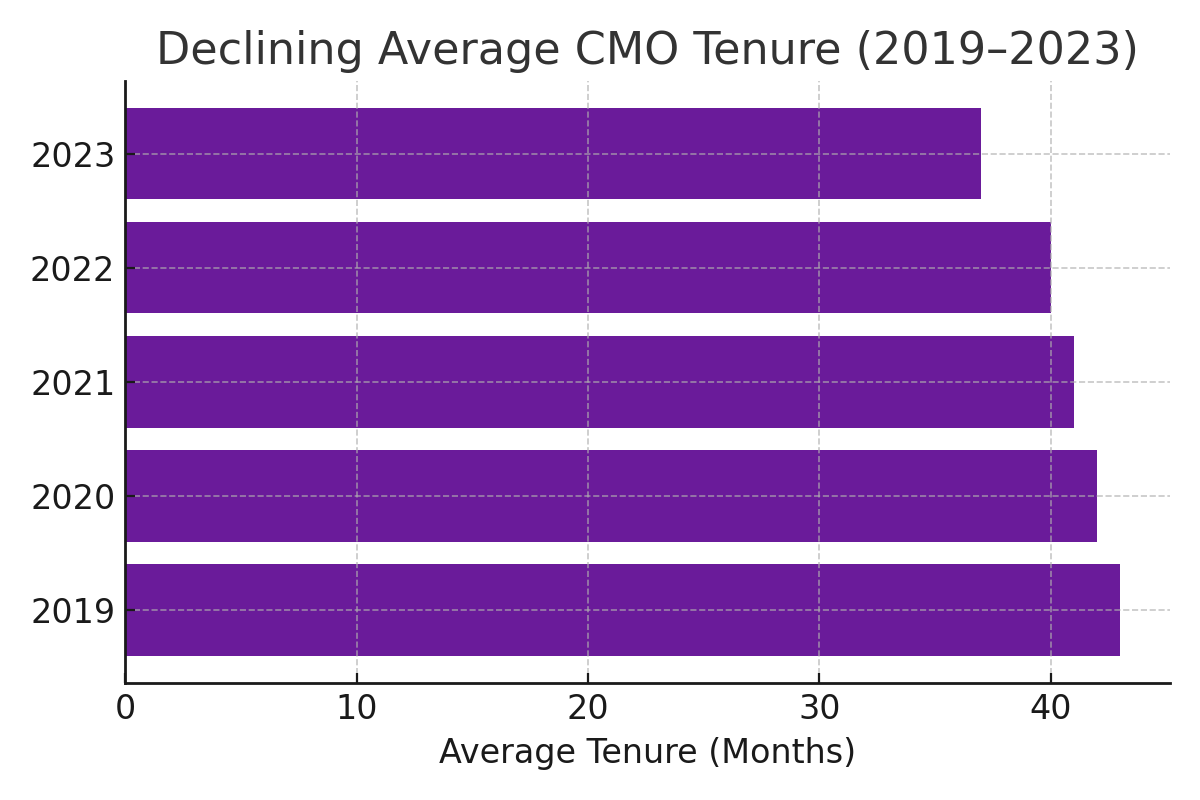
In fact, CMO tenure has hit historic lows — averaging just 40 months, according to one of the best fractional executive firms, Spencer Stuart.
But there’s a way out. A better one.
It starts with mastering four core disciplines:
1. Managing the Work: Rocks, Sand, and the Overflowing Jar
Imagine your team’s capacity as a glass jar.
- Rocks are strategic priorities — campaign launches, brand revamps, demand-gen initiatives.
- Sand is the constant flow of small, reactive asks — one-off emails, “urgent” ideas, or crisis comms.
Fill the jar with sand first? No room left for rocks.
The job of a marketing leader is to protect the jar. Say “no” when it matters. Say “not yet” more often than “sure.” And say “yes” only when the outcome matches the strategy.
Use OKRs as a Shield — Not a Mandated Slogan
OKRs (Objectives and Key Results) are your first line of defense. When used right, they’re not paperwork. They’re alignment tools. The goal is simple: connect every task to an outcome that pushes the company forward.
Bad OKRs focus on vanity — like “growing Twitter followers.” Good ones connect to North Star metrics — like weekly active users, trial signups, or revenue per lead.
Set stretch goals that challenge the team but don’t break them. And check in regularly, not just once a quarter.
2. Managing the Money: Making the Case for Marketing
Fractional leaders, especially Fractional CMOs, often walk into companies with ambitious strategies but small budgets. And finance teams? They want proof, forecasts, models, ROI, before greenlighting ad-spend.
But marketing isn’t always clean-cut like that. Brand investments take time. Awareness isn’t always measurable. That doesn’t mean they’re not critical.
The trick is translating marketing into a language finance understands.
- Don’t say “we want to invest in brand building.” Say: “We expect this campaign to increase unaided brand recall, which correlates with conversion lift of X% within Y months.”
- Use leading indicators (like engagement rate) and lagging results (like pipeline growth) to show progress.
Your credibility with finance determines how much room you’ll have to run. Defend the budget like it’s your life. Because it kind of is.
See how CMO-as-a-Service delivers 10x ROI
3. Evolving the Org: Building for What’s Next
Marketing isn’t static. Your org structure can’t be either.
As your strategy evolves — maybe you’re moving into ABM, product-led growth, or international markets — your team needs to evolve too. That means:
- Spotting skills gaps early.
- Hiring with clarity.
- Developing leaders internally.
Hiring mistakes in marketing are costly. There’s a wide range of roles — from brand and content to growth and RevOps. If you don’t define what success looks like for each role, you risk hiring great people for the wrong problems.
As Kevin Lee from Oyster says: “You’ve got to drive impact now, while thinking six months ahead.” That balancing act is what makes marketing leadership so damn tough — and so valuable.
4. Developing the Talent: Grow People, Not Just Metrics
Most marketing leaders weren’t trained to be coaches. But if you want retention, loyalty, and performance, you’ll need to become one.
That means:
- Offering clear career pathways.
- Giving structured, timely feedback.
- Encouraging self-driven growth while removing blockers.
When people understand what’s possible for them, they stay. When they’re treated like order-takers, they leave.
If your best talent walks out the door, so does your ability to deliver strategy.
Simple as that.
Why This Matters for Fractional Leadership
All of this — managing work, budgets, orgs, and talent — applies doubly to fractional c-suite executive roles.
Why?
Because fractional leaders step into chaos. They’re hired to bring focus, clarity, and results fast. But they don’t always get full control. They have to build trust while navigating politics, org confusion, and skepticism.
That’s why the most successful fractional executives don’t just define strategy. They operationalize it.
A Real-World Example
Take a mid-market B2B SaaS company struggling with churn. They bring in a Fractional CMO. Instead of starting with rebranding, she audits the customer journey, maps retention pain points, and builds a lifecycle marketing motion tied to product usage data.
She sets quarterly OKRs around reducing churn and boosting feature adoption. She aligns with product, sales, and success teams. She defends the need for a better email stack and hires a lifecycle manager.
Three quarters later? Net revenue retention is up 14%. That’s the power of delivering strategy, not just talking about it.
5. How to Implement Fractional Leadership in Your Business
Thinking of hiring a fractional executive? Here’s how to make it work:
- Define the outcome, not the title. Don’t just say “We need a CMO.” Say, “We need someone to fix our demand-gen funnel and build a roadmap for PLG.”
- Set the scope. Fractional doesn’t mean part-effort. It means laser focus. Be clear on expectations and decision-making power.
- Support the process. Give them tools, access, and internal champions. Otherwise, you’re setting them up to fail.
- Track real impact. Tie their work to strategic outcomes, not vanity metrics.
Strategy Is Only as Good as Its Execution
Fractional leadership, especially in marketing, gives businesses a faster, smarter path to results. But it’s not a shortcut.
It’s a commitment.
- A commitment to clarity.
- A commitment to ruthless prioritization.
- A commitment to leading without excuses.
As Kieran Anini says: “If you aim for the stretch goal, on average, you’ll beat your base.” That’s how you avoid the death spiral. That’s how you build momentum.
And that’s how you deliver a strategy that actually works.
6. How Operating Rhythms Bring Strategy to Life
Even the best strategies die in silence. Not because they were flawed on paper — but because no one was watching when they started to fail. That’s where operating rhythms come in. For fractional executives, these rhythms are lifelines.
What’s an Operating Rhythm?
It’s not just meetings. It’s the flow — how information moves, how progress is tracked, and how risks are surfaced before they become problems.
Slack threads, dashboards, 1:1s, weekly check-ins, monthly OKR reviews. All of it builds your communication infrastructure.
When it’s intentional, this rhythm becomes the foundation of execution. When it’s ad hoc, it becomes noise.
Why Fractional Leaders Rely on Rhythm
Full-time executives might have more time to catch problems informally. But fractional leaders need a reliable system to surface what matters, fast.
With a few hours a week to steer the ship, they must prioritize signal over noise. That means codifying rituals:
- Weekly metric reviews
- Bi-weekly initiative updates
- Monthly OKR deep dives
- Quarterly business reviews
This isn’t bureaucracy. It’s clarity.
It’s leadership with a clock ticking louder than usual.
7. The Three Pitfalls of Poor Operating Rhythms
1. Unclear Ownership
When meetings become crowded and responsibility is fuzzy, things fall through. You hear phrases like:
“I thought product owned that.”
“I wasn’t sure if that was a priority anymore.”
A good fractional CMO or fractional COO quickly identifies these cracks and tightens decision-making. They use rhythms to assign roles, set agendas, and clarify what gets escalated.
2. Status Over Substance
Another red flag: meetings become status updates — information that could’ve been a Loom or Notion doc. There’s no real-time problem-solving. No friction. No urgency.
The solution? Define the purpose of each meeting:
- Are we unblocking?
- Are we making a decision?
- Are we reviewing performance?
If the answer is “none of the above,” cancel it or make it async.
3. Complacency
Rhythms decay. What worked six months ago may be a waste of time now. As a fractional leader, part of the fractional executive service is to constantly evolve the rhythm — not just run it.
Look for symptoms:
- People multitask during meetings
- No clear next steps after discussions
- KPIs slip without triggering action “x”
When that happens, it’s time to retool. Strip back. Rebuild. Keep it lean and focused.

8. Building an Issue Identification Culture
In high-functioning teams, problems don’t hide.
But in too many marketing orgs, issues go unnoticed until they’ve snowballed.
Why?
Because no one’s incentivized to speak up early.
Or worse, no one’s listening.
Fractional Leaders Create Safe Escalation Paths
Whether it’s a fractional CEO, fractional COO, or a fractional CMO, the best ones create a culture where people aren’t punished for raising red flags. They reward curiosity, not silence.
Here’s how:
- In all-hands, ask: “What’s not working that we’re afraid to talk about?”
- Normalize failure post-mortems without blame
- Privately check in with ICs closer to the work
- Include “emerging risks” as an agenda item in strategy reviews
Part time c-suite fractional executives often step in precisely after that blowup. But the best ones make sure it never happens again.
9. Managing “Urgent” Requests Without Burning Out
Every fractional executive knows this one:
You log in. There’s a Slack from the CEO. “This needs to go live by EOD.”
Your calendar is full. Your strategy work is in motion. But now the fire drill begins.
Here’s the truth: Not everything “urgent” is truly urgent.
Urgency is often a label, not a fact. It’s our job to sort fact from fiction.
How to Vet an Urgent Request
Ask yourself:
- Does it impact a key business outcome if we delay?
- Will ignoring this harm our customers or brand reputation?
- Is this a time-sensitive opportunity we can’t repeat later?
If the answer is yes to any of these, it’s probably urgent.
If not, it belongs in one of three buckets:
- Do: If it’s aligned and urgent
- Explore: If it’s unclear or speculative
- Don’t Do: If it’s out of scope or distracting
Fractional leaders communicate these trade-offs clearly. They loop in stakeholders and share the cost of context switching, so it’s not invisible labor.
10. From Strategy to Rhythm: High Growth B2B SaaS Example
Let’s make this real.
High growth B2B SaaS acquisition team, a high-velocity, performance-driven machine — has three rhythm layers:
- Daily/Weekly Metrics Reviews
- Campaign performance
- Adjustments in real time
- Creative pivots on the fly
- Monthly Strategic Syncs
- Senior stakeholders and department leads
- Focused on what to keep, stop, or start doing
- Quarterly OKR Reviews
- Used to set the next big bets
- Reset direction if needed
Fractional c-level executives love this setup.
Why?
Because it gives visibility, accountability, and timing, without micromanaging.
11. Celebrating Big Wins as part of your culture: Fuel for the Climb
This might sound fluffy, but it’s not.
Every high-performing team needs outlook points — those moments where they pause, look back, and say, “Damn, we did that.”
Fractional executives bake celebration into the rhythm:
- Monthly team huddles with shoutouts
- Async Slack kudos
- Personal DMs acknowledging above-and-beyond effort
Why? Because motivation is compounding. And celebration is a catalyst.
12. Strategic Benefits of Fractional Leadership
Let’s zoom out.
Why choose fractional leadership over traditional models?
Because the future of work demands flexibility, focus, and speed – not full-time headcount for the sake of it.
Here’s what fractional executives offer:
- Cost-effective senior leadership without long-term risk
- Fresh eyes on stale problems
- Hyper-focus on defined outcomes
- Faster impact with less onboarding time
They’re not a replacement for internal teams. They’re the lever to pull when you need precise fractional execs to show that truly impactful leadership.
Whether you’re scaling, pivoting, or weathering change — a fractional executive brings clarity and accountability fast.
Read about the benefits of hiring a fractional CMO
13. How to Implement Fractional Marketing Leadership Fast
Hiring a fractional C-suite executive isn’t just a cheaper version of hiring full-time. It’s a different model.
Step 1: Define the Gap
Don’t hire a fractional leader for “general help.”
Hire one to solve a specific problem:
- Is growth stalled?
- Is churn too high?
- Is the brand misaligned?
Step 2: Set a 90-Day Scope
Start small. Aim for impact in 90 days.
Measure it. Make it outcome-based, not activity-based.
Step 3: Integrate and Empower
Don’t sideline them. Give them access, decision rights, and visibility.
The biggest mistake companies make?
Treating fractional leaders like outsiders.
They can only lead if they’re trusted.
Final Takeaway: Strategy Lives in Execution
You can have the best plan in the world. But without rhythms, role clarity, and urgency filters, it’ll collect dust.
Fractional leadership works not because it’s part-time, but because it’s hyper-focused. Because it forces discipline. And because it demands results.
If you’re tired of strategy decks with no follow-through, maybe it’s time to bring in someone who thrives in the messy middle, where strategy meets action.
Someone fractional from Algocentric Digital.


Sergiy Solonenko is the founder of Algocentric Digital Consultancy, a seasoned digital strategist, and a fractional CMO for B2B SaaS brands undergoing digital transformation. With over a decade of experience, he specializes in scaling demand-generation programs, optimizing account-based marketing, and aligning sales and marketing teams. Sergiy helps B2B SaaS companies enhance lead qualification, improve user experience through personalization, and leverage Martech to accelerate MRR growth.