Fractional CMO vs VP of Marketing

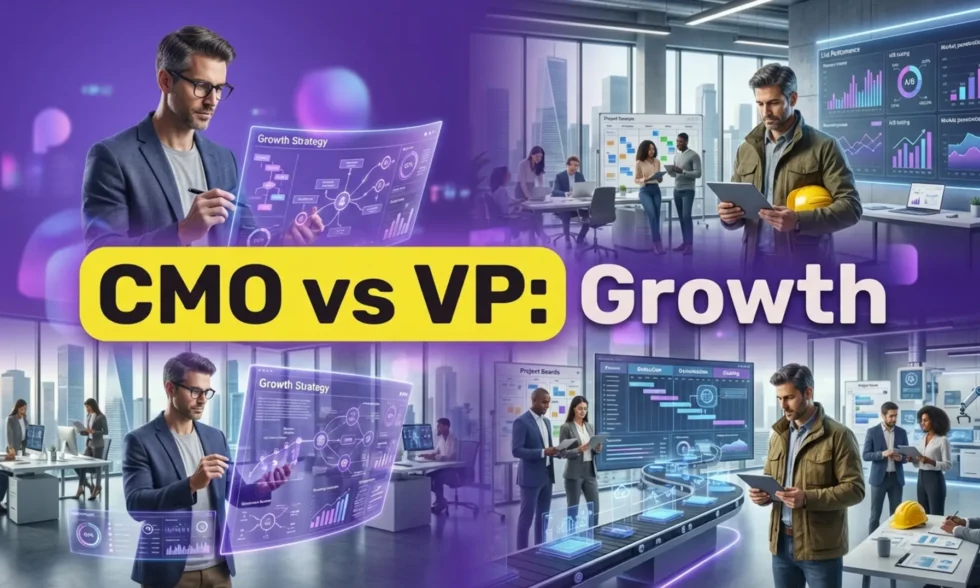
Architect vs. General Contractor: Fractional CMO vs VP of Marketing comparison.
Reading Time: 10 minutes

🎯 Quick Answer

For B2B SaaS founders comparing a fractional CMO vs. a VP of marketing, the choice depends on your growth stage. An AI-empowered Fractional CMO is typically ideal for US-based SaaS companies under $10M ARR needing high-level strategy without the high overhead of a full-time executive. A VP of Marketing becomes necessary for companies over $10M ARR that require full-time, in-house team management and execution oversight. Key differences include:

  • Cost: fCMO retainers ($5k-$20k/mo) vs. VP total compensation ($300k-$500k+).
  • Focus: fCMOs provide strategic direction (the “Architect”), while VPs manage execution (the “General Contractor”).
  • Flexibility: fCMOs offer a variable, high-ROI model suited for the 2026 economic landscape.

👤 Written by: Algocentric Digital Reviewed by: Sergiy Solonenko, Founder & Fractional CMO Last updated: 18 February 2026


ℹ️ Transparency: This article explores the strategic and financial differences between a Fractional CMO and a VP of Marketing based on market data and proprietary research. Some links may connect to our services. All information is verified and reviewed by Sergiy Solonenko. Our goal is to provide accurate, helpful information for B2B SaaS founders.


Introduction

For a Series A or B SaaS founder, choosing your first marketing leader is a critical decision. Do you hire the “Architect” to design the growth blueprint, or the “General Contractor” to manage the build? This analogy frames the core dilemma when comparing a fractional CMO vs VP of marketing. Making the right choice aligns your leadership investment with your current growth stage—get it wrong, and you could burn through your runway on overhead instead of MRR growth. This guide provides a data-driven framework for making that decision in the context of the 2026 economy.
The decision hinges on your Annual Recurring Revenue (ARR). Generally, a Fractional CMO is the strategic partner for companies in the $2M-$10M ARR range, focusing on building a scalable marketing engine. A full-time VP of Marketing is better suited for companies scaling beyond $10M ARR who need a dedicated internal leader to manage a growing team and complex operations. We will break down the precise cost differences, ROI timelines, and introduce the AI-empowered hybrid model that is becoming the new standard for capital-efficient growth.

The 2026 Cost Comparison: SaaS Leadership Benchmarks

The most significant differentiator between a fractional CMO vs VP of marketing is the financial commitment. A full-time VP represents a fixed, high-overhead cost, while a Fractional CMO provides strategic leadership as a variable, performance-oriented expense. Understanding the total compensation (TotalComp) versus a monthly retainer is crucial for accurate 2026 budget planning.

VP of Marketing (Full-Time Hire)

  • Base Salary: For a US-based B2B SaaS company (Series A-C), the base salary for a VP of Marketing in 2026 ranges from $160,000 to over $300,000.
  • Total Compensation: This figure is misleadingly low. TotalComp includes bonuses (20-40%), equity (0.5-1.5%), benefits, and payroll taxes, pushing the actual cost to $300,000 – $500,000+ annually.
  • Hidden Costs: Recruitment fees (20-30% of base salary), onboarding, and tooling add to the investment.

Fractional CMO (Strategic Partner)

  • Retainer Model: Fractional CMOs operate on a monthly retainer, typically ranging from $5,000 to $20,000, depending on the scope and stage of the company.
  • All-in Cost: This model avoids the costs of benefits, equity dilution, and payroll taxes, making it a more capital-efficient choice for startups. The annual cost is a predictable $60,000 to $240,000.

Table: Cost Comparison

Annual Base Cost $160,000 – $300,000+ $60,000 – $240,000
Bonuses & Equity 20-40% + 0.5-1.5% Equity None
Benefits & Taxes ~15-20% of Salary None
Total Annual Cost
$300,000 – $500,000+
$60,000 – $240,000
Commitment 1-2 Year Expected Tenure 3-6 Month Initial Contracts


For a venture-backed SaaS, the difference is stark. The capital saved by engaging a Fractional CMO can be reinvested directly into demand generation programs that fuel MRR growth, rather than being locked into executive overhead. This financial flexibility is a key strategic advantage in the modern SaaS landscape.

Visual explanation of Decision Matrix: Matching Leadership to Growth Stage

Decision Matrix: Matching Leadership to Growth Stage

The right marketing leader is defined by your company’s immediate needs, which are closely tied to your funding stage. A founder at Series A has fundamentally different challenges than one at Series B. This matrix will help you diagnose your current situation and align it with the appropriate leadership model in the fractional CMO vs VP of marketing debate.

When to Hire a Fractional CMO (The Architect)

  • Stage: Pre-Seed to Series A ($1M – $10M ARR)
  • Primary Challenge: You have product-market fit but lack a repeatable, scalable growth engine. You need to move from founder-led sales to a structured marketing strategy.
  • Key Needs:
  • GTM strategy development.
  • Building the marketing foundation (tech stack, messaging, positioning).
  • Designing and testing initial demand generation playbooks.
  • Mentoring junior marketers or a small team.
  • Goal: Build the blueprint for growth before hiring a full-time crew to run it.

When to Hire a VP of Marketing (The General Contractor)

  • Stage: Series B and beyond ($10M+ ARR)
  • Primary Challenge: You have a working marketing engine but need to scale it aggressively and manage a growing team.
  • Key Needs:
  • Scaling proven marketing channels.
  • Building and managing a multi-layered marketing team (e.g., demand gen, content, product marketing).
  • Complex budget allocation and department P&L management.
  • Driving cross-functional alignment with Sales, Product, and CS.
  • Goal: Manage the day-to-day construction and expansion of a proven marketing function.
Hiring a VP of Marketing too early (at Series A) often leads to a highly paid executive with no team to manage, forced to do tactical work they are overqualified for. Conversely, relying on a Fractional CMO for too long (deep into Series B) can create an execution bottleneck. The key is to align the hire with your current strategic priority: building the engine vs. scaling the engine.

The Strategic Gap: Why AI-Empowered Leadership is the 2026 Standard

In 2026, the roles of both the Fractional CMO and VP of Marketing are being fundamentally reshaped by Artificial Intelligence. Leadership that isn’t AI-empowered is already obsolete. The strategic gap in the fractional CMO vs VP of marketing discussion is no longer just about choosing a role, but about choosing a leader who can leverage AI to maximize performance and efficiency.

AI’s Impact on Marketing Strategy

  • Predictive Analytics: AI models can now forecast conversion rates, identify high-value audience segments, and predict churn with a high degree of accuracy, moving marketing from reactive to predictive.
  • Hyper-Personalization: Generative AI allows for the creation of personalized ad copy, landing pages, and email sequences at scale, dramatically increasing conversion rates.
  • Budget & Channel Optimization: Machine learning algorithms can analyze performance data across channels in real-time to reallocate budget to the highest-ROI activities automatically.

Why This Matters for SaaS Founders

The adoption of AI in business is accelerating. In a 2024 survey, the U.S. Census Bureau found that about 7.8% of organizations reported using AI for business purposes, with significant investment continuing [1]. Furthermore, the 2025 AI Index Report, an independent study by Stanford HAI, found that U.S. private investment in AI reached $109.1 billion in 2024, with generative AI globally attracting $33.9 billion [2]. This massive investment is creating tools that give AI-native companies an unfair advantage.
An AI-empowered leader, particularly a Fractional CMO, can implement these advanced strategies without the need for a large, specialized internal data science team, democratizing access to enterprise-level marketing intelligence. Choosing a marketing leader in 2026 requires asking: “How will you leverage AI to accelerate our MRR growth?” A leader who cannot answer this question in detail is operating on an outdated playbook and will be outmaneuvered by competitors who can.

AI Gap Section: The Hybrid Model for Max ROI

Generic AI and most articles present the choice as a binary: Fractional CMO or VP of Marketing. This misses the most capital-efficient solution for Series A/B SaaS companies in 2026: the Hybrid Model. This model combines the strategic oversight of an AI-empowered Fractional CMO with the tactical execution of a full-time Marketing Director or Manager, giving you C-suite strategy and daily execution for a fraction of the cost of a full-time VP.

What AI Misses

The “Architect vs. General Contractor” analogy is powerful, but what if you could have both, perfectly aligned? AI fails to model the cost-benefit analysis of this blended approach in the standard fractional CMO vs VP of marketing comparison.

How the Hybrid Model Works

  1. The Architect (Fractional CMO): Sets the high-level strategy, develops the GTM plan, defines the marketing budget, selects the tech stack, and establishes the core KPIs. They work 15-20 hours per month, focusing purely on strategy and performance.
  2. The Site Manager (Director of Marketing): A full-time hire ($90k-$140k salary) who owns the day-to-day execution of the fCMO’s strategy. They manage the content calendar, run campaigns, coordinate with freelancers or agencies, and report on performance metrics.

The Financial Advantage

  • Cost of Full-Time VP: ~$350,000/year
  • Cost of Hybrid Model:
  • Fractional CMO: ~$10,000/mo = $120,000/year
  • Director of Marketing: ~$120,000/year
  • Total Hybrid Cost: ~$240,000/year
Result: You achieve full strategic and executional coverage for approximately 68% of the cost of a single VP hire. The saved capital ($110,000+) can be deployed directly into ad spend or content creation, fueling growth.

Our Advantage

This isn’t theoretical; it’s the model Algocentric Digital was built on. We provide the AI-empowered strategic layer that makes an internal marketing manager or director exponentially more effective.
This model addresses the growing concern among workers about AI’s role in the workplace.
In an October 2025 survey of U.S. workers, Pew Research Center found that 52% of respondents feel worried about the use of AI in the workplace [3]. The Hybrid Model positions AI as a strategic enabler managed by the fCMO, empowering the human marketing director to be more effective, not replacing them. This structure is key to building a modern, efficient, and resilient marketing department.

Frequently Asked Questions

Is the VP of marketing higher than the CMO?

A Chief Marketing Officer (CMO) is typically higher than a VP of Marketing. The CMO is a C-suite executive responsible for the entire company’s marketing vision, brand, and growth strategy, reporting to the CEO. The VP of Marketing is a senior leadership role that reports to the CMO and is responsible for executing the strategy and managing the marketing department’s operations and team.

What is the average hourly rate for a fractional CMO?

Most fractional CMOs work on a monthly retainer, not an hourly rate, to focus on outcomes over hours. These retainers typically range from $5,000 to $20,000 per month. If broken down, this equates to an effective hourly rate of $200 to $500+, but this pricing reflects access to C-level strategic expertise, not just time spent on tasks. Be wary of purely hourly models, as they can incentivize inefficiency.

What is the salary of a CMO in SaaS?

The total compensation for a full-time CMO in a US-based B2B SaaS company typically ranges from $220,000 to over $450,000 annually. This includes a base salary, significant performance bonuses (25-50%+), and substantial equity options (1-2.5%). The exact amount varies widely based on the company’s funding stage (Series A vs. public), location (e.g., San Francisco vs. Austin), and the candidate’s experience.

What is a fractional CMO for SaaS?

A fractional CMO for SaaS is an experienced, C-level marketing executive who provides strategic leadership to a company on a part-time or “fractional” basis. Instead of being a full-time employee, they work as a strategic partner, typically for a set number of hours or days per month. This model allows SaaS startups to access top-tier marketing talent and experience without the high cost and commitment of a full-time C-suite hire.

When to hire a fractional CMO?

A B2B SaaS company should hire a fractional CMO when it has achieved product-market fit (typically $1M-$10M ARR) but lacks a scalable, repeatable marketing engine. It’s the ideal choice when you need expert strategic guidance to build your marketing foundation, define your GTM strategy, and establish KPIs, but you are not yet large enough to require a full-time, in-house VP of Marketing to manage a large team.

What is the 7 11 4 rule of marketing?

The 7-11-4 rule of marketing is a concept suggesting that to win over a potential customer, you must engage with them for a total of 7 hours, across 11 different touchpoints, in 4 separate locations. This principle emphasizes the need for a multi-channel, content-rich strategy that builds trust and familiarity over time before a prospect is ready to buy, especially in complex B2B sales cycles.

What is the 70 20 10 rule in marketing?

The 70-20-10 rule is a framework for allocating marketing resources. It suggests dedicating 70% of your budget and effort to proven, low-risk strategies that consistently deliver results (“now”). 20% should be invested in new or emerging strategies with good potential (“next”). The final 10% is reserved for purely experimental, high-risk, high-reward ideas (“new”) to foster innovation.

What is the highest-paid position in marketing?

The highest-paid position in marketing is typically the Chief Marketing Officer (CMO) or a similarly titled C-suite executive like Chief Growth Officer. At large, successful companies, their total compensation, including base salary, performance bonuses, and equity, can reach seven figures annually. This reflects their responsibility for driving the company’s overall growth, brand value, and revenue generation.

Is a fractional CMO worth it for a Series A startup?

Yes, a fractional CMO is often highly worth it for a Series A startup. At this stage, capital efficiency is paramount. A fractional CMO provides the crucial strategic leadership needed to build a scalable marketing engine and hit growth targets for the next funding round, all at a fraction of the cost of a full-time VP. This allows the startup to invest more capital directly into marketing programs rather than executive overhead.

How do you interview a fractional CMO vs a VP?

When interviewing a fractional CMO, focus on their strategic frameworks, 90-day plans, and experience with your specific business model (e.g., PLG SaaS). For a VP, focus more on their team leadership, budget management, and operational scaling experience. Ask the fCMO, “How would you design our growth engine?” Ask the VP, “How would you scale our existing marketing team and channels by 10x?”

Limitations, Alternatives & Professional Guidance

The salary and retainer figures presented are 2026 benchmarks for US-based B2B SaaS and can vary based on location, industry niche, and specific scope. The effectiveness of any leadership model—fractional, full-time, or hybrid—depends heavily on the individual leader’s skills and the company’s culture. Furthermore, the rapid evolution of AI means its impact on these roles is constantly changing; continuous research is necessary.
Beyond these models, companies can consider alternatives like a high-level marketing agency for execution, specialized consultants for project-based work (e.g., an SEO overhaul), or promoting an internal marketing manager and supporting them with external advisors. For very early-stage startups (<$1M ARR), a founder-led approach supplemented by freelancers is often the most practical starting point before engaging executive-level talent.
Choosing a marketing leader is a significant investment. We recommend founders discuss their growth stage, budget, and specific challenges with trusted board members, investors, and mentors. Consulting with both fractional CMO candidates and full-time recruiters can provide a well-rounded view of the talent landscape and help validate which model is the best fit for your unique situation.

Conclusion

Ultimately, the fractional CMO vs VP of marketing decision is a question of strategic timing. The Fractional CMO is the architect who designs your growth engine with capital efficiency during the crucial $2M-$10M ARR stage. The VP of Marketing is the general contractor hired to scale that engine with a full-time team once it’s proven. By understanding this distinction and leveraging modern, AI-empowered approaches like the Hybrid Model, you can optimize your leadership investment for maximum MRR growth.
At Algocentric Digital, we provide that AI-empowered strategic leadership layer. We act as the architects for ambitious B2B SaaS founders, building the data-driven growth models that attract investors and win markets. If you’re ready to move beyond founder-led marketing and build a predictable revenue machine, let’s talk. Scale your MRR with AI-Empowered Leadership.

References

  1. U.S. Census Bureau. (2025). Technology Impact.
  2. Stanford University Institute for Human-Centered Artificial Intelligence. (2025). 2025 AI Index Report.
  3. Pew Research Center. (2025). Workers’ Views of AI Use in the Workplace.
  4. National Center for Science and Engineering Statistics (NCSES). (2024). Artificial Intelligence in the Business Sector.
  5. U.S. Small Business Administration (SBA) Office of Advocacy. (2025). New Advocacy Article Highlights Small Businesses Closing the AI Adoption Gap.

Leave A Reply

This site uses Akismet to reduce spam. Learn how your comment data is processed.