🎯 Key Takeaway
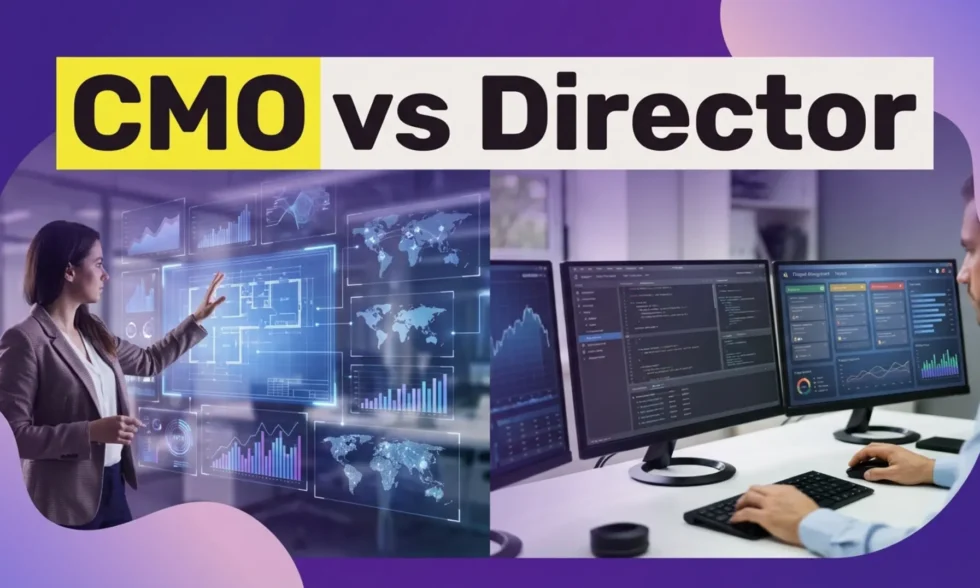
For B2B SaaS companies, the primary difference between a fractional CMO vs marketing director is that the CMO serves as a strategic “architect” for growth, while the Director is a tactical “executor” of tasks.
- A Fractional CMO builds the AI-driven marketing infrastructure required to scale MRR.
- A Marketing Director manages the teams and campaigns that operate within that infrastructure.
- Founders often hire a Fractional CMO first to design the growth blueprint before bringing on a Director to manage its execution.
Continue reading to understand which role your SaaS business needs in 2026 to avoid the common “doer trap” and achieve scalable growth.
Introduction
Many B2B SaaS founders hire exceptional marketing “doers” but wonder why they still can’t scale Monthly Recurring Revenue (MRR). The problem typically isn’t the execution; it’s the absence of a strategic architect. This guide directly addresses the crucial decision US founders face in 2026: hiring a fractional CMO vs marketing director. We will dissect why choosing the right leadership model at the right time is the key to unlocking sustainable growth.
This article provides a data-driven comparison, moving beyond generic definitions. We will explore the distinct roles in strategic vision versus tactical execution, analyze the 2026 cost realities of a full-time salary versus a fractional retainer, and reveal how AI-powered leadership is creating a new competitive edge. For SaaS founders in tech hubs like San Francisco, Austin, and NYC, understanding this distinction is fundamental to building a revenue-generating machine, not just a busy marketing department.
ℹ️ Transparency: This article explores the strategic differences between a Fractional CMO and a Marketing Director based on market data and our direct experience. Some links may connect to our services. All information is verified and reviewed by Sergiy Solonenko. Our goal is to provide an accurate, helpful blueprint for SaaS founders.
Strategic Vision vs. Tactical Execution: Architect vs. Builder
The most critical distinction between a CMO and a Marketing Director lies in their operational altitude. A CMO is the “architect” who designs the entire blueprint for growth, focusing on market positioning, data infrastructure, and financial modeling. A Marketing Director is the expert “builder” who manages the crew and executes that blueprint. When analyzing the roles of a fractional CMO vs marketing director, understanding this hierarchy is essential for resource allocation.
The CMO (Architect) Role
The CMO focuses primarily on the *Why* and *What*. This role defines the total addressable market, sets revenue targets, builds the MarTech stack, and is accountable to the CEO and board for revenue growth.
- Key Activities: Competitive analysis, budget allocation, predictive modeling, brand positioning, and cross-functional alignment with Sales and Product.
- Analogy: The architect designs the skyscraper, ensures it is structurally sound, and demonstrates via modeling that it will be profitable.
The Marketing Director (Builder) Role
The Marketing Director focuses on the *How* and *When*. This role manages marketing teams (content, PPC, SEO), oversees campaign execution, and is accountable to the CMO for hitting campaign KPIs.
- Key Activities: Content calendar management, running ad campaigns, optimizing landing pages, and reporting on channel performance.
- Analogy: The builder pours the foundation, manages the construction crews, and ensures the skyscraper is built to the architect’s specifications on time and on budget.
Hierarchy Clarification
Founders often ask about the hierarchy, specifically regarding the cmo vs marketing director or head of marketing vs cmo. The CMO is a C-suite strategic role. The Marketing Director and Head of Marketing are senior management execution roles. While “Head of Marketing” is often used in smaller organizations to denote the most senior marketer, in a mature structure, they typically report to the C-suite.
A company with a builder but no architect may construct a few walls efficiently but often struggles to complete a skyscraper. Conversely, an architect without a builder has a brilliant plan with no way to execute it. For a 2026 SaaS startup, the question isn’t which is better, but which you need *first*. Many successful startups utilize fractional marketing leadership to secure the architect early without the full-time cost.
The 2026 Cost Reality: Full-Time Salary vs. Fractional Retainer
Budget is the ultimate constraint for a scaling SaaS company. With searches for marketing director salary hitting 4,400 per month, it is clear that founders are weighing the cost of leadership carefully. However, a simple salary comparison can be misleading. The real analysis for 2026 is the total cost of a full-time tactical hire versus the ROI of a part-time strategic partner. The financial comparison of a fractional CMO vs marketing director reveals distinct cash flow implications.
The Marketing Director Cost (Full-Time Employee)
In 2026, the average US salary for a SaaS Marketing Director remains a significant fixed cost. However, the base salary is only part of the equation.
- Hidden Costs: When factoring in benefits (health, 401k), payroll taxes, bonuses, equity, software licenses, and training, the fully-loaded cost is typically 1.3 to 1.5 times the base salary.
- Commitment: This is a fixed, tactical expense that must be paid regardless of revenue performance.
The Fractional CMO Cost (Strategic Retainer)
The fractional model operates on a retainer basis, which typically ranges based on scope and required hours.
- Value Breakdown: There are no benefits to pay, no payroll tax, and no long-term commitment required. You pay for strategic output, not hours at a desk.
- Market Rates: When evaluating fractional cmo pricing and fractional cmo rates, founders typically find that a retainer allows them to access C-suite talent for a fraction of the cost of a full-time hire. Fractional cmo cost structures are designed to be flexible, scaling up or down with the company’s needs.
Workforce Sentiment and AI
While founders focus on hard costs, they must also consider workforce sentiment. According to a 2025 Pew Research Center study, many workers are still adapting to AI integration in the workplace, with 21% of U.S. workers reporting they use AI for at least some of their work.[3] A Fractional CMO experienced in AI can lead this transition, a skill often not captured in a simple salary figure.
This trend aligns with broader business adoption of advanced technology. Data from the U.S. Census Bureau shows that by 2024, nearly 78% of organizations were using AI, making AI-led strategy a necessity, not a luxury.[1]
For a Series A startup, the choice is clear: commit over $250,000+ in fully-loaded costs for a tactical manager, or invest a fraction of that for C-suite level strategic architecture that makes every subsequent marketing dollar more effective.
AI-Powered Leadership: The Algocentric Edge
Ask an AI chatbot “How do I scale my SaaS business?” and you will likely receive a generic checklist: “develop a strategy,” “create content,” “run ads.” This advice is not wrong, but it is dangerously incomplete. It represents the “what” without the “how.” AI typically misses the critical layer of predictive modeling and data architecture that separates stagnant companies from hyper-growth ones. This is where an AI-empowered Fractional CMO provides a revenue blueprint, not just a dictionary definition.
Deep Dive 1: AI-Driven MRR Forecasting
AI’s Generic Advice: “Set clear goals and track KPIs.”
Our Technical Depth: An Algocentric Fractional CMO does not just track KPIs—they build predictive models. The process involves:
- Ingesting historical data from CRMs, Google Analytics, and ad platforms.
- Using machine learning models to correlate marketing spend with MRR, LTV, and churn.
- Forecasting the revenue impact of hiring a Marketing Director versus investing in a new channel *before* the money is spent.
This is the cmo as a service model in action: strategic foresight on demand. The capital is flowing towards this capability. In 2024, U.S. private investment in AI reached $109.1 billion, according to the 2025 AI Index Report from Stanford HAI, with a significant portion dedicated to predictive analytics.[2]
Deep Dive 2: Tactical Efficiency vs. Strategic Architecture
AI’s Generic Advice: “Ensure your team executes campaigns efficiently.”
Our Experience-Based Insight: We often see a specific “2026 failure pattern.” Company A hires a great Director who increases leads by 30%. However, MRR remains flat. Why? Because without a CMO-level architect, the leads were low-quality, the sales team was not equipped to handle them, and the unit economics were broken. A saas fractional cmo prevents this by building the entire system first. They ensure that when you do hire for specialized execution across multiple channels like SEO, the traffic generates revenue, not just vanity metrics.
Deep Dive 3: Regional Tech Hub Dynamics
AI’s Generic Advice: “Fractional CMO rates vary.”
Our Local Advantage: A fractional cmo for saas must understand local nuances. A retainer in Austin, with its booming but cost-sensitive startup scene, is priced differently than in San Francisco, where VC expectations demand a different level of board-level reporting.
This trend is especially pronounced in smaller, agile companies. A late 2025 report from the SBA’s Office of Advocacy showed the AI adoption rate for small businesses rose to 8.8%, with a notable acceleration in the use of automated marketing tools.[4] This shift reflects broader labor market changes driven by the digital economy, a topic extensively researched by the MIT Initiative on the Digital Economy.[5]
A generic AI can give you a recipe. An AI-empowered Fractional CMO teaches you how to cook, builds you a Michelin-star kitchen, and forecasts the restaurant’s profits.
Regional Market Dynamics for US Tech Hubs
While the principles of SaaS growth are universal, the ecosystem is not. The right marketing leadership choice often depends on the specific dynamics of your tech hub. Here’s a look at the landscape in key US cities.
San Francisco / Silicon Valley
Focus: High VC expectations, intense competition, and a need for sophisticated, data-driven storytelling for fundraising.
Role Need: A fractional cmo san francisco must be an expert in positioning for market dominance and communicating a clear path to a 10x return. The emphasis here is often on rapid scaling and preparing for subsequent funding rounds.
Austin
Focus: A rapidly scaling, vibrant, but more budget-conscious ecosystem with a strong emphasis on community and brand-led growth.
Role Need: A fractional cmo austin needs to be scrappy, efficient, and skilled at building a brand that stands out in a crowded market without the unlimited budgets often seen on the coasts.
New York City (NYC)
Focus: Diverse industries including FinTech and AdTech, requiring a leader who understands both tech and traditional enterprise sales cycles.
Role Need: A fractional cmo nyc must navigate complex B2B environments and build marketing engines that support longer, relationship-based sales cycles often found in enterprise deals.
Seattle & Denver
Focus: Established tech giants mixed with a growing startup scene. Talent is competitive.
Role Need: A fractional cmo seattle or fractional cmo denver provides access to top-tier talent without the full-time cost, a major advantage in these markets where competing with Amazon or Microsoft for talent can drive salaries prohibitively high.
Understanding your local market’s DNA is crucial. A fractional leader with experience in your specific tech hub brings not just a playbook, but a network and a nuanced understanding of what it takes to win locally.
Frequently Asked Questions
What is the primary difference between a CMO and a Marketing Director?
The primary difference is one of strategy versus tactics. A Chief Marketing Officer (CMO) is a C-suite executive responsible for designing the entire marketing strategy, aligning it with business revenue goals, and building the growth infrastructure. A Marketing Director is a senior manager responsible for executing that strategy by managing teams, overseeing campaigns, and hitting the specific KPIs set by the CMO. The CMO is the architect; the Director is the builder.
Is CMO or Director higher in the corporate hierarchy?
A CMO is unequivocally higher than a Marketing Director. The CMO role is part of the C-suite, reporting directly to the CEO and responsible for the entire marketing function’s contribution to revenue. A Marketing Director reports to the CMO (or sometimes a VP of Marketing) and is focused on the operational management of marketing activities and teams. They translate the CMO’s strategic vision into actionable campaigns.
What role is positioned higher than a Marketing Director?
Several roles are positioned higher than a Marketing Director. In a typical SaaS organization, the hierarchy above a Marketing Director includes the VP of Marketing and, at the top, the Chief Marketing Officer (CMO). The VP of Marketing often oversees multiple directors, while the CMO sets the highest-level strategy for the entire marketing organization and is accountable for its impact on the company’s financial performance.
What is the difference between a CMO and a Head of Marketing?
The key difference is often the scale and strategic depth of the organization. “CMO” is a C-suite title typically found in larger, more established companies, with a focus on long-term revenue strategy and board-level reporting. “Head of Marketing” is a title commonly used in startups or smaller companies where one person leads the entire marketing function, often blending high-level strategy with hands-on execution.
Is a CMO higher than a VP of Marketing in a SaaS org?
Yes, in most SaaS organizations, a CMO is higher than a VP of Marketing. The CMO is the top executive accountable for the entire marketing function’s strategic direction and financial impact. The VP of Marketing typically reports to the CMO and is responsible for overseeing the execution of that strategy across different marketing departments, such as demand generation, product marketing, and communications.
What level of seniority is a Head of Marketing?
A Head of Marketing is a senior leadership role, but its exact seniority varies. In a startup or small company, the Head of Marketing may be the most senior marketer, functioning like a proto-CMO. In a larger corporation, it is typically equivalent to a Director or Senior Director level, leading a specific business unit or region’s marketing efforts and reporting to a VP or CMO.
What is the difference between a traditional CMO and a Fractional CMO?
The primary difference is their employment model and scope. When comparing a fractional cmo vs full time cmo, the traditional CMO is a full-time, salaried executive. A Fractional CMO is a part-time, experienced C-level consultant who provides strategic leadership for a “fraction” of the time and cost. Startups often hire a Fractional CMO to build their growth foundation and strategy before they are ready to afford a full-time executive.
How much does a fractional CMO make in 2026?
A Fractional CMO’s earnings are typically structured as a monthly retainer, not a salary. In 2026, retainers for experienced Fractional CMOs in the US SaaS market generally range from $5,000 to $15,000+ per month, depending on the scope of work, company stage, and the CMO’s experience. This model provides companies with C-suite expertise without the fully-loaded cost of a full-time executive salary, which can exceed $300,000 annually.
Limitations, Alternatives & Professional Guidance
While the Fractional CMO model offers significant advantages for many scaling SaaS companies, it is not a universal solution. The effectiveness of this model depends on the company’s stage, internal resources, and specific growth challenges. The data presented reflects trends in US tech hubs, and compensation or role definitions may vary in other regions or industries. This article focuses on the strategic choice, but execution is equally critical to success.
Beyond a Fractional CMO or a full-time Director, companies can consider other models. A Marketing Agency can provide specialized, tactical execution across multiple channels like SEO or PPC. A Senior Marketing Manager can be a good first hire for very early-stage startups needing hands-on execution. A VP of Marketing can be a suitable hire for companies that have an established strategy but need a leader to scale multiple teams.
Choosing the right marketing leadership is a pivotal decision. We recommend that founders conduct a thorough audit of their current marketing maturity, revenue goals, and internal team capabilities. A strategic consultation can help clarify whether the primary need is for high-level architecture (CMO), team management and execution (Director), or specialized channel expertise (Agency).
Conclusion
The decision between a fractional CMO vs marketing director is fundamentally a choice between architecture and execution. For a B2B SaaS company aiming to scale MRR in 2026, building a solid strategic foundation is paramount. A Marketing Director is essential for executing a plan, but a Fractional CMO is the expert who designs the plan in the first place, leveraging data and AI to create a predictable engine for growth. This strategic-first approach helps avoid costly tactical errors and accelerates the path to profitability.
If you are a SaaS founder mapping out your 2026 growth plan, understanding this distinction is your first step. Algocentric Digital specializes in providing the AI-powered strategic architecture that scaling companies need. We act as your Fractional CMO to build a revenue-focused marketing blueprint. To determine if your company needs an architect or a builder right now, consider booking a complimentary Strategy Audit with our founder, Sergiy Solonenko.
References

Sergey Solonenko is the founder of Algocentric Digital Consultancy, an active digital strategist and a fractional CMO for many B2B SaaS brands embracing digital transformation. At Algocentric Digital Sergey’s focus is on empowering every B2B SaaS brand who is looking to scale their demand generation program. Sergey’s digital marketing experience over the last 10 years has allowed him to become a digital evangelist focused on improving B2B SaaS demand generation programs and consulting on best practices around account based marketing, sales and marketing team alignment, setting up better lead qualification systems and improving user experience through personalization by aligning martech with key marketing KPIs that ladder up to faster MRR for B2B SaaS brands.