🎯 Quick Answer
A fractional cmo for real estate companies provides high-level marketing leadership on a flexible, part-time basis to build and execute a growth strategy tied directly to MRR.
• Integrates complex MarTech stacks, including MLS and AI-powered CRMs. • Operates on a value-driven model, focusing on outcomes like pipeline growth, not just hours worked. • Aligns brokerage marketing efforts with the unique needs of high-commission sales agents.
Continue reading for a step-by-step guide to auditing your current strategy and implementing this executive-level service.
The real estate industry is undergoing a critical shift, moving away from prioritizing sheer lead volume toward demanding predictable, scalable Monthly Recurring Revenue (MRR) growth. For Series A-C founders and brokerage CEOs, a common and costly pain point is managing disjointed marketing efforts that fail to impact the bottom line. When campaigns are siloed and technology stacks are fragmented, generating a consistent return on investment becomes incredibly difficult. To solve this, many organizations are turning to outsourced marketing leadership for hire. A 2025 SBA report highlighted that the AI use rate among small businesses rose to 8.8%, indicating they are actively closing the adoption gap with larger enterprises, particularly in areas like automated marketing.[1]
A fractional cmo for real estate companies is an experienced marketing executive who embeds within your company to build and run your entire growth engine, from MarTech audits to sales alignment, without the cost of a full-time hire. This model, often referred to as CMO as a service, allows growing brokerages to access C-suite expertise precisely when they need to scale. The BEA’s “U.S. Digital Economy” estimates show the increasing contribution of digital services and e-commerce to national GDP, providing a macroeconomic basis for investing in advanced digital marketing leadership.[2] This guide will cover the implementation process, from a 90-day onboarding plan to navigating regional market complexities in hubs like California and Texas.
Why Real Estate Companies Hire a Fractional CMO
Real estate companies often reach a stage where lead generation alone is no longer the primary challenge. Instead, the real problem becomes building a predictable and scalable pipeline that consistently converts leads into closed transactions. Without executive-level marketing leadership, brokerages frequently rely on fragmented campaigns, disconnected technology stacks, and short-term promotional tactics that fail to produce long-term growth.
Hiring a fractional CMO allows brokerages and PropTech companies to introduce structured strategic leadership into their marketing operations. Rather than experimenting with isolated tactics, companies gain a dedicated executive responsible for aligning marketing strategy with revenue goals, improving agent productivity, and ensuring that marketing investments generate measurable business outcomes.
ℹ️ Transparency: This article explores the strategic implementation of Fractional CMO services based on extensive industry data and research. Some links may connect to our services. All information is verified and reviewed by Sergiy Solonenko. Our goal is to provide accurate, actionable information for real estate and PropTech leaders.

Strategic Audit: Integrating MLS, CRM, and Your Real Estate MarTech Stack
A generic “use a CRM” recommendation is often insufficient for the highly specialized real estate sector. The core challenge for most brokerages and PropTech firms lies in synchronizing real-time Multiple Listing Service (MLS) data with an AI-driven CRM to enable predictive lead scoring and automated nurturing. Without this integration, data remains siloed, and agents are left chasing cold leads. This section provides the technical audit framework a Fractional CMO typically uses to evaluate and optimize your real estate marketing automation infrastructure.
The Audit Checklist
A comprehensive audit begins by examining the foundational layers of your technology stack, ensuring that data flows seamlessly from the market to your sales team.
MLS Integration Points: How does your local MLS feed data into your systems? A Fractional CMO will evaluate whether you are relying on outdated manual exports or utilizing modern WebAPI connections. They will assess data refresh rates, field mapping accuracy, and compliance limitations. Understanding these constraints is critical for maintaining accurate property statuses and pricing in your marketing materials.
CRM Readiness: Can your current CRM handle custom data objects imported directly from the MLS? Standard CRM setups often lack the architecture needed for real estate crm marketing automation. The audit determines if your system has lead-scoring capabilities that can be customized with AI models, allowing you to track not just contact information, but complex property interactions and timeline indicators.
AI Layer Analysis: What tools are you currently using for predictive analytics? The audit reviews whether your predictive tools are generic or specifically trained on real estate datasets. Utilizing industry-specific AI layers can significantly improve the accuracy of identifying which leads are most likely to convert in the near term.
The Workflow Blueprint
Once the audit is complete, the Fractional CMO designs a workflow blueprint to optimize lead flow optimization real estate processes.
- Map MLS Data Fields: The first step involves mapping critical MLS data fields—such as ‘days on market’, ‘price reduction’, and ‘status change’—directly to CRM contact properties. This ensures that when a property’s status changes in the MLS, the corresponding lead’s profile in the CRM is instantly updated.
- Define Triggers for AI Lead Scoring: Next, the strategy involves defining behavioral and data-driven triggers. For example, a high score might be assigned to a property listed by a homeowner who previously viewed your ‘selling tips’ page or engaged with a recent market report email.
- Build Predictive Models: The final step details how to build and refine a model that helps predict high-intent sellers before they list publicly. By analyzing historical data, search patterns, and engagement metrics, the AI model can surface opportunities to your agents before competitors are even aware of them.
Regional Nuances
This technical integration process often differs significantly between regional markets. For instance, data availability and compliance rules in California, governed heavily by the California Regional Multiple Listing Service (CRMLS), require strict adherence to specific display and data-sharing regulations. In contrast, the Texas market, heavily influenced by the Houston Association of Realtors (HAR), presents different API structures and buyer behavior patterns. A tailored approach is required to navigate these localized data environments effectively.
Ultimately, this level of technical integration and proptech marketing sophistication is a primary function of a specialized Fractional CMO. The “Artificial Intelligence in the Business Sector” report (Dec 2024) provides official statistics on AI R&D, business usage, and its impact on employees, validating the strategic importance of integrating advanced AI into core business functions like marketing.[3]
Common Marketing Mistakes in Real Estate Companies
Many real estate companies struggle with marketing not because they lack activity, but because their efforts are fragmented and reactive. Without centralized strategy and leadership, brokerages often invest in disconnected campaigns that fail to produce sustainable growth.
Common mistakes include relying heavily on low-quality lead marketplaces, running paid advertising campaigns without clear conversion tracking, neglecting long-term organic channels such as SEO, and failing to integrate marketing tools with the brokerage’s CRM and MLS data. A fractional CMO addresses these challenges by creating a structured marketing system where technology, messaging, and agent workflows operate within a unified growth framework.
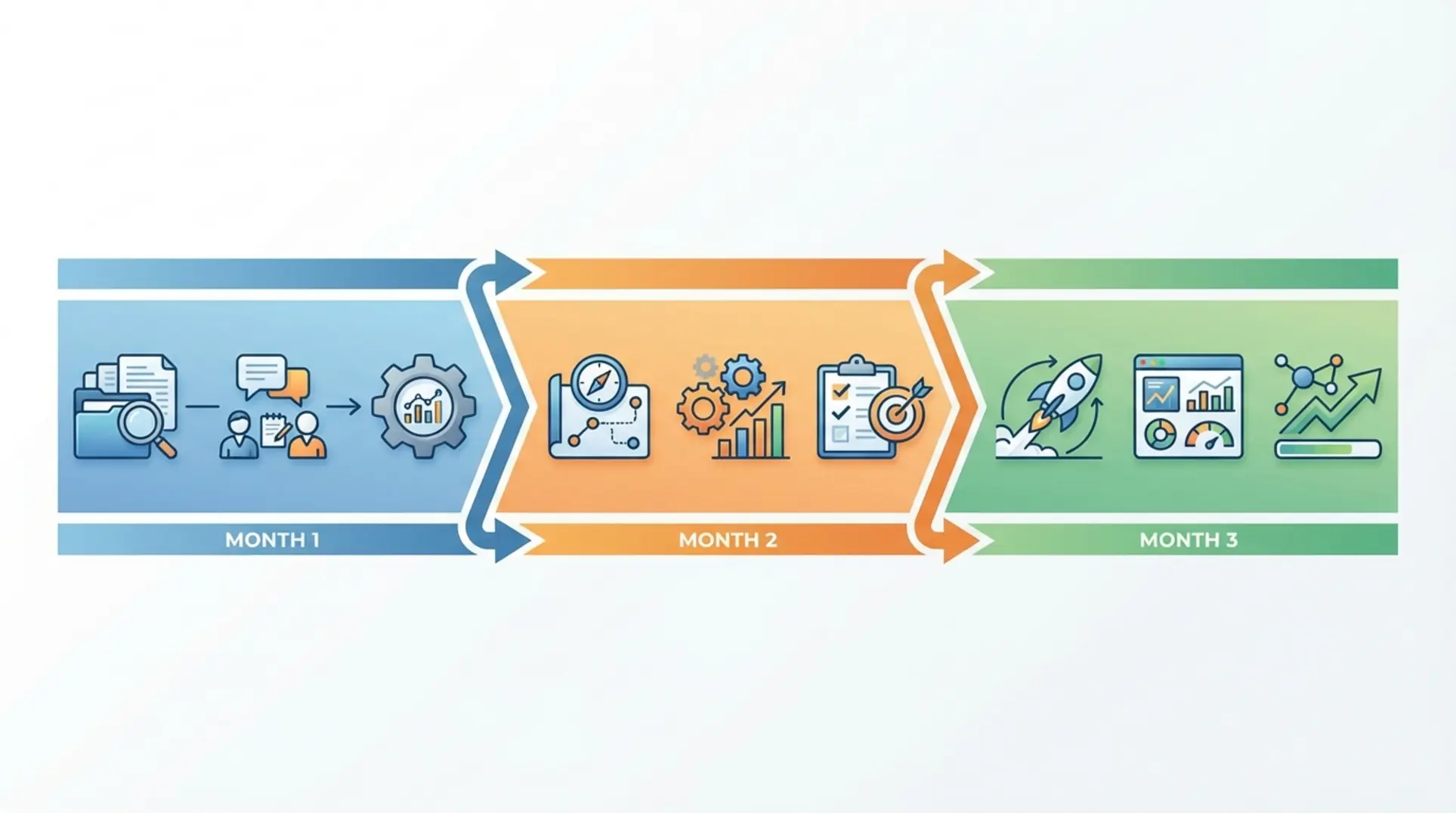
The 90-Day Onboarding Checklist for a Real Estate Marketing Executive
A successful executive engagement starts with a clear, transparent 90-day plan. Here are the typical 90-day goals for a fractional marketing leader to establish a predictable growth engine.
Month 1: Immersion & Auditing (Days 1-30)
The first thirty days are dedicated to understanding the current state of the business, identifying bottlenecks, and gathering the data necessary to formulate a robust marketing strategy for real estate.
Full MarTech Stack Audit: The executive conducts the deep-dive technical audit detailed in the previous section, analyzing CRM readiness, MLS integrations, and existing automation workflows.
Pipeline Analysis with the Sales Team: The CMO reviews historical sales data, conversion rates, and lead quality metrics alongside sales leadership to identify where leads are dropping out of the funnel.
Stakeholder Interviews: Thorough interviews are conducted with key stakeholders, including founders, top-performing agents, and operations staff, to understand brand perception, operational friction, and immediate needs.
Competitive and Market Analysis: An initial review of local competitors, market share, and digital footprint is completed to identify immediate opportunities for differentiation.
Month 2: Strategy & Quick Wins (Days 31-60)
With a clear understanding of the landscape, the focus shifts to strategic planning and capturing immediate value.
Present the Growth Strategy: The Fractional CMO presents the full growth strategy and marketing plan, outlining specific KPIs, budget allocations, and channel strategies tied to MRR goals.
Launch Quick Win Campaigns: To build momentum, the CMO launches one or two “quick win” campaigns. This often includes implementing a targeted lead nurturing sequence designed to re-engage aged or dormant leads currently sitting in the database.
AI Model Refinement: Initial deployment and refinement of AI lead scoring models begin, ensuring the sales team starts receiving prioritized, high-intent lead data.
Month 3: Implementation & Optimization (Days 61-90)
The final month of the onboarding phase focuses on full-scale execution and establishing long-term reporting rhythms.
Full Rollout: The core real estate growth strategy is fully deployed across chosen channels, including paid media, content marketing, and automated email workflows.
Establish KPI Dashboards: Customized reporting dashboards are finalized, providing leadership with real-time visibility into marketing performance, cost per acquisition, and pipeline velocity.
Sales and Marketing Alignment Meeting: The first major alignment meeting is held to review initial campaign results, gather feedback from agents, and refine the lead handoff process.
This structured onboarding ensures that the Fractional CMO’s efforts are aligned with business objectives from day one.
Core Marketing Channels for Real Estate Companies
A fractional CMO typically prioritizes a small number of high-impact marketing channels that consistently generate qualified buyers and sellers for real estate companies. Instead of spreading marketing budgets across dozens of tactics, the strategy focuses on building a repeatable acquisition system aligned with regional demand and agent specialization.
Common channels include search engine optimization (SEO) for high-intent property searches, paid search campaigns targeting buyers actively looking for homes, local content marketing that builds authority within specific neighborhoods, and automated email nurturing campaigns that keep potential sellers engaged over time. When coordinated through a unified strategy, these channels help transform sporadic lead generation into a predictable flow of qualified opportunities.

How to Choose the Right Fractional CMO for Your Real Estate Company
Choosing the right fractional CMO is a strategic decision that directly affects the long-term growth of a brokerage or PropTech company. Unlike hiring an agency for isolated campaigns, selecting a fractional executive means bringing in a leader responsible for designing the entire marketing system.
Companies should evaluate candidates based on experience with real estate marketing technology, familiarity with MLS data environments, ability to align marketing with sales teams and agents, and proven experience building scalable acquisition systems. The ideal fractional CMO should also demonstrate strong analytical capabilities, experience with AI-driven marketing tools, and the ability to translate market insights into measurable revenue growth.
Fractional CMO vs. Marketing Director: Which is Right for Your Brokerage?
Choosing the right marketing leadership is a critical decision that can significantly impact your growth trajectory. This section breaks down the key differences between a fractional cmo and a full-time Marketing Director for a real estate brokerage.
| Feature | Fractional CMO | Full-Time Marketing Director |
|---|---|---|
| Primary Focus | Strategic Growth & ROI | Team Management & Execution |
| Cost Model | Retainer (part-time) | Full-time Salary + Benefits |
| Key Activities | MarTech Audits, P&L, Sales Alignment | Campaign Execution, Content Calendar |
| Best For | Series A-C needing executive strategy | Established firms needing a team leader |
The true difference between these roles lies in the outcome-based model. While a Marketing Director focuses primarily on internal execution, a fractional executive focuses on designing the entire growth system and aligning marketing investment with revenue outcomes. This strategic distinction is similar to the broader comparison between leadership-driven marketing models and agency-based execution, which we explore in detail in our guide on fractional CMO vs agency for SaaS marketing.
According to U.S. Census Bureau data on technology’s impact, only 3.3% of businesses using AI reported a decrease in workers’ skill levels, suggesting that technology is augmenting, not just replacing, workforce capabilities.[4] A fractional executive utilizes this technology to maximize efficiency, allowing them to deliver full-time value on a part-time schedule.
The right choice ultimately depends on your stage of growth. If you need to build the engine and define the real estate brokerage marketing strategy, a Fractional CMO is often ideal. If you already have a proven, documented strategy and simply need someone to manage the team running that existing engine, a Marketing Director may be the better fit.
Agent-Centric Demand Gen: Aligning Sales & Marketing in High-Commission Environments
Generic sales and marketing alignment advice often fails in the real estate sector due to the inherent friction between independent, high-commission agents and centralized brokerage marketing departments. To solve this, a fractional executive will typically implement a blueprint for “Agent-Centric Demand Gen.
The Core Problem
Real estate agents operate essentially as independent entrepreneurs. They often resist top-down marketing initiatives that focus purely on brand awareness if those initiatives do not directly and visibly fill their individual pipelines. When brokerages fail to align sales and marketing in brokerages, agents may abandon the company’s CRM in favor of their own tools, leading to fractured data and inconsistent brand messaging.
The Solution Blueprint
Centralized Brand, Decentralized Execution: The most effective approach involves the brokerage providing a strong, centralized brand identity, the underlying MarTech infrastructure, and the overarching proptech demand generation strategy. However, the execution is decentralized, allowing agents to leverage these assets in ways that suit their specific farm areas.
AI-Powered Lead Distribution: A Fractional CMO implements a sophisticated system that scores and routes high-intent leads to the right agents based on specialty, location, and historical performance. Utilizing real estate lead generation ai, the system ensures that the most valuable opportunities are handed to the agents most likely to close them, increasing overall brokerage revenue.
Empowerment through Tools: Rather than forcing agents to adopt rigid corporate campaigns, the marketing department provides agents with co-branded marketing templates, automated nurturing sequences, and social media assets that they can easily deploy themselves.
This model empowers agents to build their individual books of business while ensuring brand consistency and strategic alignment across the organization—a key organizational outcome driven by a Fractional CMO.
Key Marketing Metrics for Real Estate Growth
Real estate marketing success should be measured using revenue-driven metrics rather than vanity indicators such as website traffic or social media engagement. Because property transactions involve long decision cycles and multiple touchpoints, marketing leaders must focus on metrics that indicate real buying or selling intent.
Important performance indicators include qualified buyer and seller leads, speed-to-lead response time, listing conversion rates, cost per acquisition, and agent productivity metrics. For PropTech companies and brokerages operating subscription-based services, monthly recurring revenue (MRR) and pipeline velocity also become critical indicators of marketing performance. A fractional CMO ensures that all marketing efforts are aligned with these measurable outcomes.
Geographic Strategy: Navigating California and Texas Real Estate Markets
A generic, national marketing strategy is rarely enough in the highly localized real estate industry. A successful Fractional CMO must deeply understand the nuances of key growth markets like California and Texas to drive meaningful results.
California (Tech & Luxury)
The California market requires a highly specialized approach. A real estate marketing agency california strategy must often balance the fast-paced PropTech scene in San Francisco with the highly visual, relationship-driven luxury market in Southern California. Marketing in this region demands exceptional digital branding, high-end content production, and a deep understanding of how to navigate strict CRMLS data regulations. Privacy laws and data compliance are also paramount when deploying AI and automation in this state.
Texas (Growth & Investment)
Conversely, a fractional cmo texas strategy often focuses on high-growth, high-volume corridors like Austin and the booming commercial real estate sectors in Dallas and Houston. Buyer behaviors here may lean more heavily toward investment potential and rapid relocation. Furthermore, marketing strategies must be built around the specific data structures and rules of the HAR MLS, which operates differently than its California counterparts. A real estate marketing consultant austin will typically prioritize aggressive lead generation and rapid speed-to-lead automation to capitalize on the market’s high velocity.
This localized intelligence allows a Fractional CMO to tailor proptech marketing agency san francisco or Texas-based strategies that consistently outperform generic national campaigns.
Frequently Asked Questions
What does a fractional CMO for real estate actually do?
A fractional CMO for real estate develops and executes the high-level marketing strategy for a brokerage or PropTech company on a part-time basis. Their responsibilities include auditing the MarTech stack (MLS, CRM), aligning sales and marketing teams, managing the marketing budget against revenue goals, and building a predictable growth engine. They focus on strategic outcomes rather than daily task management.
How does a fractional CMO differ from a full-time Marketing Director?
A fractional CMO focuses on high-level strategy and business outcomes, while a Marketing Director typically manages a team and day-to-day execution. The fractional executive works part-time, offering C-level guidance on budget, technology, and revenue growth without the cost of a full-time salary. A Marketing Director is an employee focused on implementing an existing strategy.
How much does a fractional CMO for real estate cost?
The cost of a fractional CMO for real estate typically ranges from $5,000 to $15,000 per month, depending on the scope of work and company size. This is significantly less than the fully-loaded cost of a full-time executive CMO, which can exceed $300,000 annually. Pricing models are often value-based, tied to performance milestones rather than hourly rates.
What is the 80/20 rule for real estate marketing?
The 80/20 rule in real estate marketing suggests that 80% of your results (like qualified leads or sales) will come from 20% of your marketing activities. A fractional CMO’s role is to identify that critical 20%—whether it’s a specific lead source, marketing channel, or agent group—and focus the majority of the budget and effort there to help maximize ROI.
What are the 4 P’s of marketing specifically for real estate?
The 4 P’s of marketing for real estate are Product (the properties or services), Price (listing price, commissions), Place (location, digital presence), and Promotion (advertising, content marketing). A fractional CMO adapts this framework by using technology and data to optimize each element, such as using AI to inform pricing strategies or defining the digital “place” where target clients are most active.
When is the right time for a brokerage to hire a fractional CMO?
A brokerage should hire a fractional CMO when they need executive-level marketing strategy but are not yet ready for a full-time C-suite hire. This is common for Series A-C PropTech firms or brokerages transitioning from founder-led marketing to a more structured, scalable growth model. It is well-suited for organizations that need to build the marketing engine, not just operate it.
What is the 3-3-3 rule in real estate marketing?
The 3-3-3 rule is a guideline for agent prospecting, suggesting they contact 3 past clients, 3 new prospects, and 3 members of their sphere of influence daily. A fractional CMO can support this by implementing marketing automation systems that provide agents with quality leads and create automated nurturing sequences, making it easier for them to execute the 3-3-3 rule consistently.
How does AI-powered lead generation drive MRR in PropTech?
AI-powered lead generation can help drive MRR by identifying and prioritizing leads with the highest probability of converting. Instead of treating all leads equally, AI models analyze data from MLS, CRM, and website behavior to score leads based on their intent. This allows sales teams to focus on revenue-ready opportunities, which may shorten the sales cycle and increase monthly recurring revenue.
What does a real estate marketing executive for hire manage daily?
A fractional real estate marketing executive for hire focuses on strategic oversight rather than daily tasks. Their time is typically spent analyzing performance data, refining the marketing budget, meeting with sales leadership to ensure alignment, and directing the marketing team or agencies on key priorities. They manage the overall growth engine, not individual campaign components.
How do you audit a real estate MarTech stack?
To audit a real estate MarTech stack, you must evaluate how effectively your core systems—like the MLS, CRM, and marketing automation platform—are integrated. The audit assesses data flow, identifies bottlenecks in lead nurturing, and determines if the technology is capable of supporting advanced strategies like AI-powered lead scoring. The goal is to ensure your tools work together to support revenue generation.
What are the typical 90-day goals for a fractional marketing leader?
Typical 90-day goals include completing a full audit of the current marketing program, presenting a data-backed growth strategy, and launching initial “quick win” campaigns. By the end of the first 90 days, the fractional leader should have established clear KPIs, a reporting dashboard, and a strategic roadmap for the next 6-12 months that is fully aligned with the company’s revenue targets.
How do fractional CMOs align sales and marketing in brokerages?
Fractional CMOs align sales and marketing by creating a unified strategy focused on revenue, not vanity metrics. They implement a shared CRM, establish a common definition of a qualified lead, and build systems that empower agents with marketing tools while maintaining brand control. This helps ensure both teams are working towards the same pipeline and revenue goals.
Limitations, Alternatives & Professional Guidance
While the adoption of marketing technology is growing rapidly, its application in the real estate sector is still evolving. Performance data for AI-driven lead scoring can vary significantly based on the quality, hygiene, and volume of a brokerage’s proprietary data. In 2024, 78% of organizations reported using AI, marking a significant increase in adoption, and U.S. private investment in AI grew to $109.1 billion, underscoring the technology’s economic importance.[5] However, integrating these advanced systems requires clean data; brokerages with outdated or fragmented databases may need to invest in data cleanup before realizing the full benefits of predictive modeling.
There are alternative approaches to consider depending on your company’s maturity. For brokerages with an existing, well-defined strategy that simply lacks execution bandwidth, hiring a specialized marketing agency for specific tasks (like SEO or PPC) or promoting an internal marketing manager may be a more appropriate route. These alternatives are often well-suited for companies that do not require high-level strategic pivots or complex MarTech overhauls.
Before engaging an executive, leadership teams should conduct an internal assessment of their strategic needs versus executional needs. We recommend scheduling a professional consultation or a “Growth Audit” to diagnose specific operational gaps. This helps ensure that the fractional leadership model is the right fit for your current stage of growth and that your organization is prepared to implement strategic changes.
Conclusion
Ultimately, a fractional cmo for real estate companies is more than a part-time marketer; they are a value-driven executive who architects a company’s entire growth engine. As the industry shifts toward demanding predictable MRR and pipeline growth, having strategic leadership becomes a competitive necessity. This role is uniquely suited to navigate the complex technical challenges of MarTech and MLS integration, solve the friction of agent-centric sales alignment, and tailor strategies to regional market nuances. By shifting the focus from measuring hours worked to measuring tangible business outcomes, brokerages can scale efficiently.
Algocentric Digital operates at the intersection of AI integration and real estate marketing strategy, providing outcome-driven fractional CMO services designed to help brokerages and PropTech companies build scalable growth systems.
References
- SBA Office of Advocacy: New Advocacy Article Highlights Small Businesses Closing the AI Adoption Gap (2025)
- Bureau of Economic Analysis (BEA): U.S. Digital Economy Estimates
- National Center for Science and Engineering Statistics (NCSES): Artificial Intelligence in the Business Sector (Dec 2024)
- U.S. Census Bureau: Technology’s Impact on Workforce (2025)
- Stanford Institute for Human-Centered Artificial Intelligence (HAI): 2025 AI Index Report

Sergey Solonenko is the founder of Algocentric Digital Consultancy, an active digital strategist and a fractional CMO for many B2B SaaS brands embracing digital transformation. At Algocentric Digital Sergey’s focus is on empowering every B2B SaaS brand who is looking to scale their demand generation program. Sergey’s digital marketing experience over the last 10 years has allowed him to become a digital evangelist focused on improving B2B SaaS demand generation programs and consulting on best practices around account based marketing, sales and marketing team alignment, setting up better lead qualification systems and improving user experience through personalization by aligning martech with key marketing KPIs that ladder up to faster MRR for B2B SaaS brands.