🎯 Key Takeaway
Deciding between a Fractional CMO vs VP of Marketing for B2B Startups often comes down to balancing strategic needs with capital efficiency. A Fractional CMO is a flexible, cost-effective marketing executive for B2B startups, offering strategic leadership for $5k-$15k/month, while a full-time VP of Marketing provides dedicated internal leadership but at a significantly higher cost of $25k+/month plus equity. Key differences for founders are:
- Cost: Fractional CMOs offer executive expertise without the high overhead of a full-time salary.
- Speed: A Fractional CMO can typically be integrated in days, versus the 4-6 month hiring process for a VP.
- AI Expertise: AI-Empowered Fractional CMOs bring diverse, cross-industry MarTech and AI governance experience that siloed VPs often lack.
Continue reading for a detailed framework to help decide which leadership model is well-suited for your startup’s funding stage and MRR goals.
Quick Decision Guide: Fractional CMO vs VP of Marketing
Choose a Fractional CMO if:
• You are pre-Series B and need capital efficiency
• You want fast execution and immediate strategic impact
• You lack a defined GTM strategy
Choose a VP of Marketing if:
• You have a validated marketing engine
• You are scaling a team of 8+ marketers
• You need full-time internal leadership
For B2B SaaS founders approaching or navigating a Series A funding round, the leadership dilemma becomes critical when deciding between hiring a full-time VP or working with a b2b fractional cmo for saas companies. This decision has significant implications for capital efficiency, speed, and long-term growth.
This guide provides a clear framework for evaluating a Fractional CMO vs VP of Marketing for B2B Startups, moving beyond simple cost analysis to evaluate speed-to-impact, strategic value, and the crucial role of AI proficiency in 2026.
ℹ️ Transparency: This guide is designed to provide an objective comparison between fractional and full-time marketing leadership models. While Algocentric Digital provides fractional CMO services, the cost data, frameworks, and strategic recommendations are based on industry standards, government data, and established B2B SaaS growth methodologies.
The Decision Framework: Funding Stage vs. MRR Goals
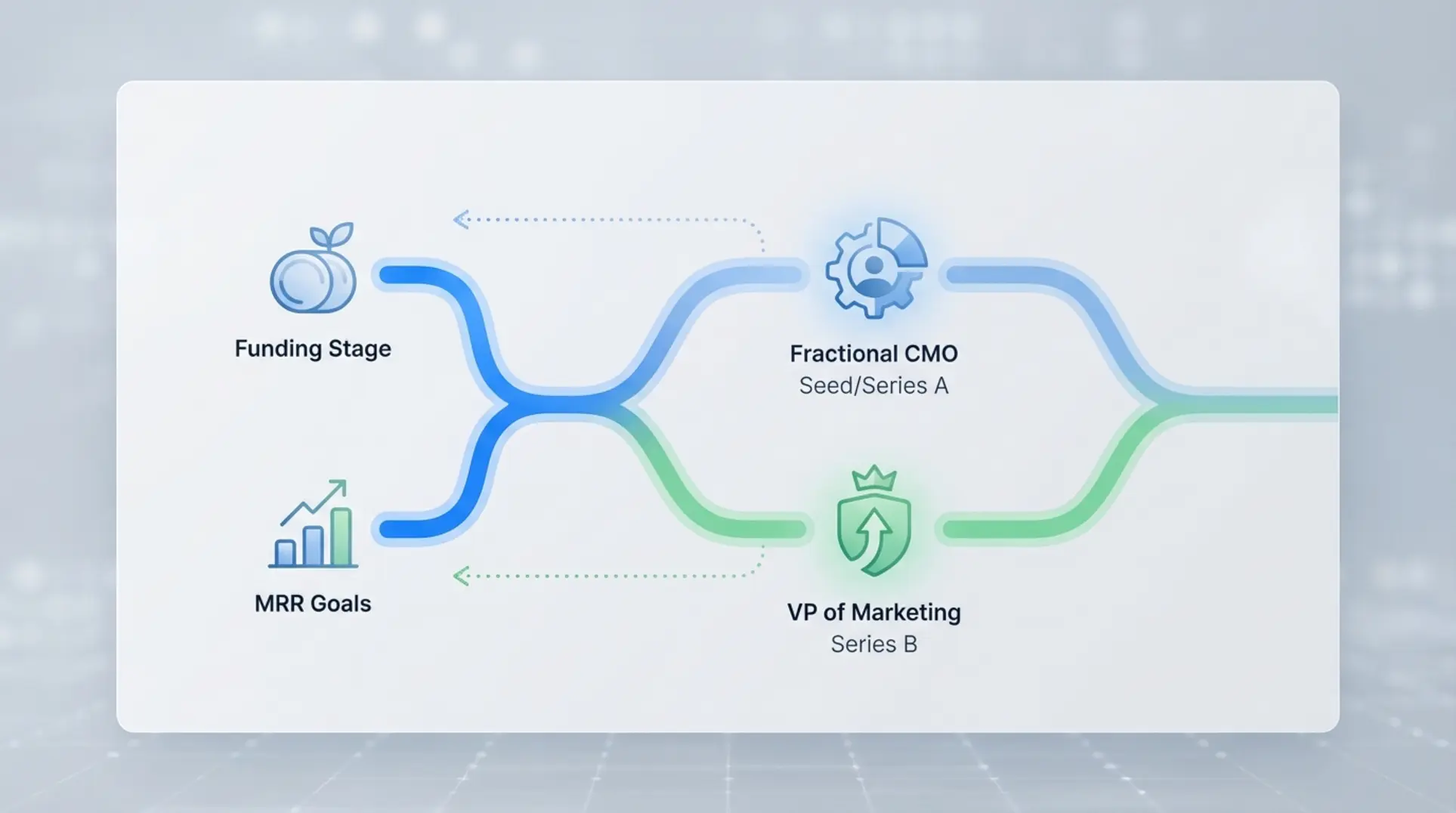
Knowing when to hire a VP of marketing versus a fractional leader is not a one-size-fits-all scenario; it depends directly on your funding stage and revenue goals. Using the wrong leadership model at the wrong time can burn capital and stall growth, as illustrated in our decision matrix frameworks.
- Seed Stage (Pre-Product-Market Fit): Focus is typically on experimentation and finding a repeatable sales motion. A Fractional CMO is often an effective choice here, providing high-level strategy and process implementation without the cost of a full-time executive. They help build the foundational marketing engine required for early traction.
- Series A (Scaling & Predictable Revenue): At this stage, you likely have product-market fit and need to scale MRR efficiently. An AI-Empowered Fractional CMO can build a scalable demand generation program, implement a MarTech stack, and prepare the team for a future VP. This is the primary battleground for the “Fractional vs. Full-time” decision, where capital efficiency is paramount.
- Series B (Expansion & Market Leadership): With a proven marketing engine and a growing team of 10+, a full-time VP of Marketing often becomes necessary. Their role is to optimize the established machine, manage a larger team, and drive market expansion. The Fractional CMO may stay on in an advisory capacity during the transition to ensure continuity.
Aligning your leadership choice with your growth stage helps ensure you have the right expertise at the right cost, which may maximize your runway and accelerate your journey to the next funding milestone.

Cost Comparison: Fractional Retainers vs. Executive Salaries
For most startups, the most immediate difference when evaluating a Fractional CMO vs VP of Marketing for B2B Startups is the financial commitment. The financial gap is substantial and goes far beyond base salary.
- Full-Time VP of Marketing (~$25,000+/month):
- Base Salary: In tech hubs, a VP of marketing salary startup founders must pay commands a base of $220,000 – $300,000+.
- Total Compensation: This doesn’t include bonuses (20-30%), equity (0.5-2%), benefits, payroll taxes, and recruiting fees, pushing the total annual cost closer to $350,000-$400,000.
- Fractional CMO ($5,000 – $15,000/month):
- Retainer Model: Fractional CMOs operate on a fixed monthly retainer, providing 20-60 hours of strategic leadership per month. This Fractional CMO cost model offers predictable expenses without any of the overhead of a full-time employee.
- No Hidden Costs: There are typically no benefits, equity grants, bonuses, or severance packages involved. The Fractional CMO cost retainer covers all strategic leadership functions. A Fractional CMO San Francisco equivalent can cost a fraction of a local full-time hire.
- ROI Calculation: While the VP is 100% dedicated, their ramp-up time can be 3-6 months. A Fractional CMO often delivers strategic value from day one, which may help generate a positive ROI within the first quarter by optimizing existing spend and identifying new growth channels.
Table 1: Cost & Feature Comparison: Fractional CMO vs. VP of Marketing
| Feature | Fractional CMO | VP of Marketing |
|---|---|---|
| Monthly Cost | $5,000 – $15,000 | $25,000+ |
| Total Annual Cost (incl. overhead) | $60,000 – $180,000 | $350,000 – $400,000+ |
| Time to Hire | 1-2 Weeks | 4-6 Months |
| Equity Requirement | None | 0.5% – 2.0% |
| Strategic Focus | High (Executive Level) | High (Executive Level) |
| Execution Focus | Low (Relies on team/agency) | Medium/High (Manages internal team) |
| Industry Experience | Broad (Cross-pollinated across SaaS) | Deep (Focused on one company) |
The fractional model allows startups to access top-tier executive talent for a fraction of the cost, preserving capital for other critical growth areas like product development and sales.
Real Example: Fractional CMO vs VP Impact
A Series A SaaS startup generating $40k MRR faced a decision between hiring a VP or engaging a fractional CMO.
• VP hiring timeline: 4 months
• Estimated total cost: $350k+ annually
Instead, they hired a Fractional CMO at $10k/month.
Results within 4 months:
• MRR grew from $40k to $95k
• CAC reduced by 28%
• Sales cycle shortened by 25%
This demonstrates how speed-to-impact often outweighs full-time commitment at early stages.
Pros and Cons: Fractional CMO vs VP of Marketing
Fractional CMO Pros:
• Lower cost and no long-term commitment
• Faster onboarding and execution
• Access to cross-industry experience
Fractional CMO Cons:
• Limited availability (not full-time)
• Requires execution team support
VP of Marketing Pros:
• Full-time focus and internal alignment
• Strong team leadership and execution control
VP of Marketing Cons:
• High cost and long hiring process
• Slower time-to-impact

AI-Powered Leadership: The 2026 Competitive Advantage
In 2026, marketing leadership is no longer just about strategy; it’s about technology and data literacy. An AI-powered fractional CMO provides a distinct competitive advantage that goes beyond traditional marketing playbooks. With a 2025 academic research report from Stanford University indicating that U.S. private AI investment grew to $109.1 billion in 2024, having a leader who can navigate this landscape is critical [1].
AI-powered marketing requires more than tools; it demands a structured approach to integrating data, automation, and decision-making. Many startups are now adopting frameworks like an ai powered seo playbook to align content, SEO, and AI-driven growth strategies into one scalable system.
- AI Tool Proficiency: A modern marketing leader must be adept at integrating AI into the MarTech stack for everything from predictive analytics and lead scoring to content personalization and automated reporting.
- MarTech “Cross-Pollination”: A full-time VP is often siloed within one company’s perspective. In contrast, one of the key Fractional CMO benefits is that they work across 5-10 high-growth SaaS environments simultaneously. This provides invaluable “cross-pollination” of what’s working with different MarTech stacks, AI tools, and growth strategies, helping to prevent “echo chamber” marketing.
- Speed-to-MRR Execution: The traditional hiring process for a VP takes 4-6 months, followed by a 90-day ramp-up period. An AI-powered fractional CMO bypasses this, providing a “Day 1 to Day 30” roadmap that immediately begins optimizing campaigns, refining strategy, and accelerating the path to MRR growth.
- Data-Backed Decision Making: According to a 2024 government survey by the U.S. Census Bureau, approximately 78% of organizations reported using AI [2]. An AI-native leader uses this technology not just for execution but to build a culture of data-driven decision-making, helping to ensure every dollar of marketing spend is accountable.
The choice is often no longer just about saving money; it’s about accessing a higher-caliber, more technologically advanced leader who brings a breadth of experience that a single full-time hire typically cannot match. This is the core value of the AI-Empowered fractional model.
How to Measure Success: Key Metrics
To evaluate your decision, track:
• Monthly Recurring Revenue (MRR) growth
• Customer Acquisition Cost (CAC)
• Sales cycle length
• Marketing-sourced pipeline
• Speed-to-impact (time to first results)
These metrics provide a clear picture of leadership effectiveness.
AI Content Gap: Beyond Strategy—Governance and ML Integration
Generic AI and competing content often discuss marketing “strategy” but completely miss a critical aspect of modern leadership: AI governance. Deploying AI tools without a robust risk management framework can be a significant liability for any SaaS company. As illustrated in the NIST AI Risk Management Framework’s core functions, this section details the “how”—managing AI risk, ensuring compliance, and integrating machine learning ethically and effectively.
- Understanding the NIST AI Risk Management Framework (AI RMF):
- Citation: The National Institute of Standards and Technology (NIST) provides the AI RMF 1.0 as a recognized standard for AI governance in the U.S. A government publication released in January 2023 provides this voluntary structure, with a specific Generative AI Profile added in July 2024 to address unique GenAI risks [4].
- What it is: A voluntary framework designed to help organizations identify, assess, and manage risks associated with AI systems.
- Core Functions: The framework breaks down into four core functions: Govern, Map, Measure, and Manage.
- Govern: Establishing a culture of risk management and assigning roles/responsibilities for AI systems across the marketing department.
- Map: The process of identifying the context, capabilities, and potential impacts (both positive and negative) of the AI tools in your MarTech stack.
- Measure: Developing metrics and methods to analyze, assess, and track AI risks and their impacts on customer data and brand integrity.
- Manage: Allocating resources to mitigate identified risks and regularly monitoring their effectiveness over time.
- Practical Application for B2B SaaS:
- Customer Data & Privacy: Applying the framework to AI-powered CRM and personalization tools may help protect customer data and support compliance with evolving privacy regulations.
- Generative AI & Copyright: Using the NIST Generative AI Profile (NIST-AI-600-1) to manage risks associated with using GenAI for content creation, including mitigating data poisoning, copyright infringement, and brand voice inconsistency.
- Algorithmic Bias: Auditing AI-driven ad platforms and lead scoring models for potential biases that could inadvertently exclude viable customer segments.
An AI-Empowered Fractional CMO doesn’t just use AI; they govern it. This expertise is crucial, especially as a 2025 government report from the SBA Office of Advocacy notes that the AI use rate among small businesses rose to 8.8% in late 2025 [3]. Furthermore, an October 2025 survey by the Pew Research Center found that 52% of workers feel worried about the rise of AI in the workplace, highlighting the importance of responsible and transparent AI implementation by leadership to build trust [5]. Implementing a framework like NIST’s helps ensure that your startup innovates responsibly and avoids the significant legal and reputational risks of ungoverned AI deployment.
Common Mistakes When Hiring Marketing Leadership
• Hiring a VP too early without product-market fit
• Expecting a Fractional CMO to execute instead of lead
• Not aligning marketing KPIs with revenue goals
• Ignoring AI and MarTech capabilities in leadership selection
Avoiding these mistakes can significantly improve ROI and reduce wasted budget.
Frequently Asked Questions
What is the difference between a fractional CMO and a marketing agency?
A Fractional CMO provides high-level strategic leadership and acts as a single, accountable executive on your team. They focus on building the marketing strategy, managing the team, and owning the results. A marketing agency, in contrast, provides execution support across channels like SEO and paid ads but typically does not offer executive-level ownership. For a deeper breakdown, see fractional cmo vs agency for saas marketing.
Is a CMO higher than a VP of marketing?
Yes, a Chief Marketing Officer (CMO) is typically a C-suite executive who is senior to a Vice President (VP) of Marketing. The CMO is responsible for the company’s overall marketing vision, brand strategy, and revenue contribution, often reporting directly to the CEO. A VP of Marketing usually reports to the CMO or CEO and is focused on executing the marketing strategy and managing the day-to-day operations of the marketing department.
How much does a B2B SaaS marketing consultant cost?
The cost of a B2B SaaS marketing consultant varies widely based on experience and scope, but typically falls into two models. Project-based consultants may charge anywhere from $5,000 to $50,000+ for a specific deliverable like a marketing plan. A Fractional CMO, who acts as a long-term strategic consultant, typically charges a monthly retainer between $5,000 and $15,000 for ongoing executive leadership.
What is a fractional CMO for B2B startups?
A fractional CMO for B2B startups is an experienced, part-time marketing executive who provides strategic leadership without the cost and commitment of a full-time hire. This model is also widely used in fractional cmo for small business scenarios where companies need flexible growth leadership without long-term overhead.
How does AI-powered marketing drive MRR growth?
AI-powered marketing drives MRR growth by using data to increase efficiency and effectiveness. It enables hyper-personalization of messaging at scale, predicts which leads are most likely to convert, automates repetitive tasks, and optimizes ad spend in real-time. This often leads to a lower Customer Acquisition Cost (CAC), higher conversion rates, and ultimately, more predictable and scalable Monthly Recurring Revenue (MRR).
When should a startup hire their first VP of Marketing?
A startup should consider hiring its first VP of Marketing when it has achieved product-market fit and needs to scale a proven, repeatable marketing and sales engine. This typically occurs around the Series B funding stage when the company has a marketing team of 8-10+ people and requires a dedicated, full-time leader to manage complexity, optimize processes, and drive market expansion.
What is the 70/20/10 rule in marketing budget allocation?
The 70/20/10 rule is a framework for allocating a marketing budget to balance proven tactics with innovation. 70% of the budget is allocated to core, proven marketing activities (the “now”). 20% is dedicated to new strategies with promising potential (the “next”). The final 10% is reserved for experimental, high-risk, high-reward ideas (the “new”). This balances predictable returns with future growth opportunities.
When Neither Option is the Right Fit
In some cases, neither a Fractional CMO nor a VP is the right choice:
• If you lack product-market fit
• If your sales process is undefined
• If you need execution rather than strategy
In these situations, hiring specialists or agencies may be more effective.
Limitations, Alternatives & Professional Guidance
It’s important to acknowledge the limitations of both models. A Fractional CMO is rarely a full-time, in-the-weeds operator; they provide strategic oversight and leadership but rely on an existing team or agency for heavy execution. Conversely, a full-time VP of Marketing represents a significant cash burn and may lack the broad, cross-industry perspective that a fractional leader gains from working with multiple companies.
For startups at a very early stage or those with specific, project-based needs, a marketing agency can be a viable alternative. An agency provides a team of specialists for execution (e.g., running ad campaigns or writing blog posts) but does not typically offer the strategic, C-level leadership of a Fractional CMO. Another alternative is to hire specialized consultants for short-term projects before committing to a leadership model.
The appropriate choice depends entirely on your startup’s unique stage, goals, and internal resources. We recommend discussing your specific situation with an experienced advisor who understands the B2B SaaS growth journey to determine a capital-efficient path forward. Results may vary based on your stage and execution capabilities.
Conclusion
Choosing between a Fractional CMO vs VP of Marketing for B2B Startups is a pivotal decision for any growing company. For many early-stage SaaS companies, the “Fractional First” approach offers an effective balance: C-suite strategic expertise without the executive-level cost. This B2B SaaS fractional CMO model provides the speed, diverse AI-powered knowledge, and financial flexibility needed to build a scalable marketing engine and accelerate MRR growth, paving the way for a full-time VP when the time is right.
At Algocentric Digital, we specialize in delivering high-impact fractional cmo services tailored for B2B SaaS companies ready to scale. Our outcome-based model ensures that strategy is directly aligned with measurable growth and MRR expansion. If you’re ready to explore how strategic, data-driven leadership can transform your marketing, we invite you to connect with our team. Send Us a Message to start the conversation.
References
- Stanford University: 2025 AI Index Report (Academic Research, 2024 Data)
- United States Census Bureau: Technology Impact (Government Survey, 2024 Data)
- U.S. Small Business Administration: Closing the AI Adoption Gap (Government Research, 2025 Data)
- National Institute of Standards and Technology: AI Risk Management Framework (Government Standard, 2023-2024)
- Pew Research Center: Workers’ Views of AI Use in the Workplace (Survey Research, October 2025)
- Bureau of Economic Analysis: Digital Economy (Government Economic Data, Ongoing)

Sergey Solonenko is the founder of Algocentric Digital Consultancy, an active digital strategist and a fractional CMO for many B2B SaaS brands embracing digital transformation. At Algocentric Digital Sergey’s focus is on empowering every B2B SaaS brand who is looking to scale their demand generation program. Sergey’s digital marketing experience over the last 10 years has allowed him to become a digital evangelist focused on improving B2B SaaS demand generation programs and consulting on best practices around account based marketing, sales and marketing team alignment, setting up better lead qualification systems and improving user experience through personalization by aligning martech with key marketing KPIs that ladder up to faster MRR for B2B SaaS brands.