Introduction
For many Series A-C B2B SaaS companies, the path to the next funding round is paved with difficult leadership decisions. In hyper-competitive US tech hubs like San Francisco and New York City, securing the right marketing leader is often a critical factor for survival. Founders frequently face a pivotal choice: should they hire a fractional CMO vs growth consultant? The wrong decision can lead to stagnant Monthly Recurring Revenue (MRR), wasted capital, and a runway that shrinks faster than anticipated.
This guide provides a definitive answer to that dilemma. We will move beyond generic definitions to explore the crucial differences in P&L accountability, contract structures, and the integration of AI-driven frameworks. You will learn not just the difference between a leader and an advisor, but how to vet for the one who can truly deliver scalable, predictable growth in the demanding US venture-backed ecosystem. Whether you need someone to build the engine or simply tune a part of it, understanding these distinctions is the first step toward accountable growth.
ℹ️ Transparency: This article explores the differences between growth leadership models based on market data and direct industry experience. Some links may connect to our services. All information is verified and reviewed by Sergiy Solonenko. Our goal is accurate, helpful information for SaaS founders.
Which One Do You Need in 2026? (Buyer’s Checklist)
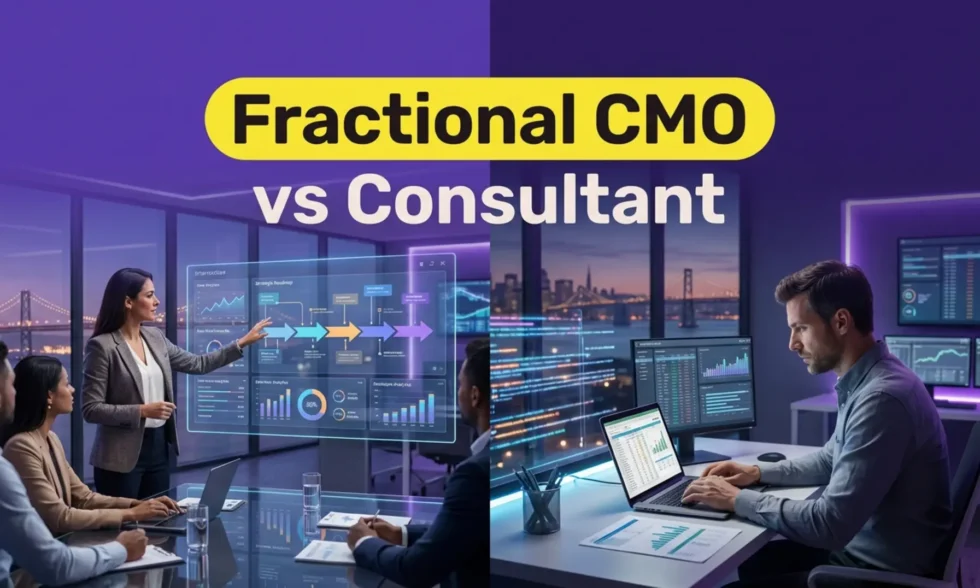
Choosing between a fractional CMO vs marketing consultant or deciding whether to hire a growth consultant vs fractional CMO often comes down to one core question: Do you need advice, or do you need accountability for results?
Both roles can add value, but they operate very differently inside an organization. A consultant typically provides strategic recommendations or specialized expertise for a defined project. A fractional CMO, on the other hand, becomes embedded in your leadership team and is responsible for driving measurable marketing performance.
For companies navigating competitive digital markets in 2026, this distinction matters more than ever.
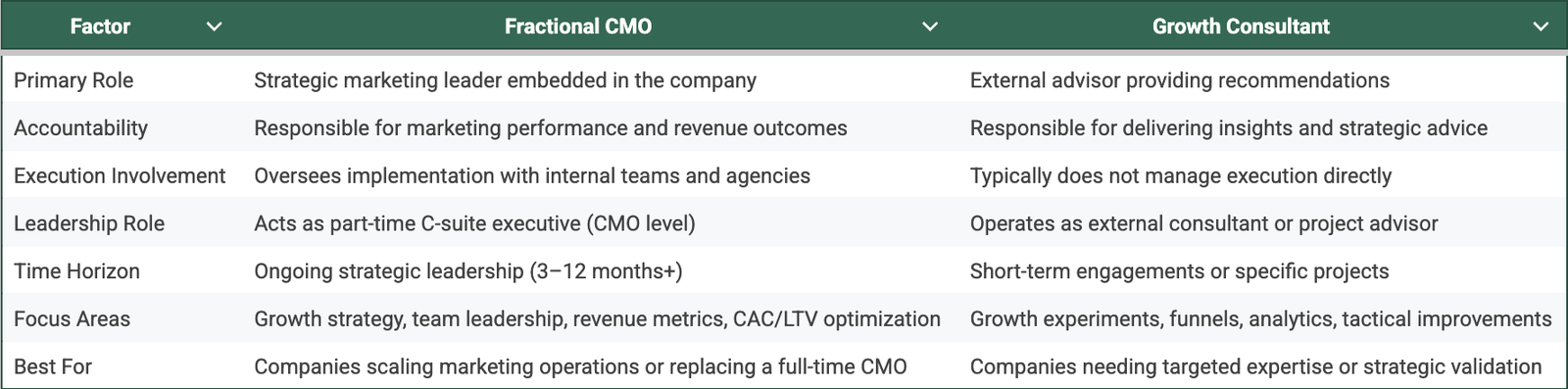
Fractional CMO vs Growth Consultant: Key Differences
Quick Buyer’s Checklist
If you’re deciding between hiring a growth consultant vs fractional CMO, ask yourself these questions:
You likely need a Fractional CMO if:
-
Your company lacks senior marketing leadership
-
Marketing initiatives feel fragmented across channels
-
You need someone accountable for revenue growth and marketing ROI
-
Your team needs leadership, hiring guidance, and strategic direction
-
You are preparing for scale, fundraising, or aggressive expansion
A Growth Consultant may be the better choice if:
-
You already have a strong marketing leader in place
-
You need help solving a specific growth challenge (conversion, funnel optimization, experimentation)
-
Your internal team will implement the recommendations
-
You want external validation for an existing strategy
The Key Difference: Ownership vs Advice
A consultant typically delivers recommendations and frameworks.
A fractional CMO owns the marketing strategy, leads execution, and is accountable for revenue outcomes.
Strategic Leadership vs. Tactical Execution: Defining the Roles
A Fractional CMO provides strategic, P&L-focused leadership as part of your executive team, while a Growth Consultant offers tactical, project-based execution as an external advisor.
The Fractional CMO: The Accountable Leader
The Fractional CMO is designed to fill the gap of a full-time executive without the full-time headcount cost. Their primary mandate is ownership. Unlike an advisor who suggests a path, a fractional CMO walks the path with you, owning the marketing P&L and remaining accountable for MRR growth.
This role involves building and leading the marketing team, whether that requires hiring internal staff or managing external agencies. They develop a comprehensive, multi-channel growth strategy that aligns with the company’s broader business goals. Crucially, they integrate with other departments—Sales, Product, and Finance—to ensure that marketing isn’t a silo but a revenue driver. When comparing a fractional CMO vs interim CMO, the focus here is often on building long-term, scalable systems rather than just keeping the lights on until a permanent hire is found.
The Growth Consultant: The Tactical Specialist
In contrast, a Growth Consultant is a tactical specialist. They typically own a specific project, channel, or campaign. For example, a founder might hire a consultant to “improve our SEO” or “optimize our LinkedIn ads.”
Consultants advise the existing team but do not typically manage personnel or make hiring decisions. They execute on a pre-defined strategy or help refine a specific tactic. This role provides specialized, deep expertise in a narrow area. When evaluating a fractional CMO vs marketing consultant, it is helpful to view the consultant as a “sniper” brought in for a specific target, whereas the CMO is the “general” commanding the field. Similarly, the distinction between a fractional CMO vs growth hacker often comes down to sustainability; growth hackers may look for quick wins, while a CMO builds the infrastructure for repeatable success.
Comparison Table: Leadership vs. Advice
| Feature | Fractional CMO | Growth Consultant |
|---|---|---|
| Primary Role | Strategic Leader | Tactical Advisor |
| Accountability | MRR & P&L | Project Deliverables |
| Scope | Entire Marketing Function | Specific Channel/Campaign |
| Team Role | Builds & Leads Team | Advises Existing Team |
| Time Horizon | Long-term (6-18+ mos) | Short-term (1-6 mos) |
| Keywords | outsourced marketing leadership |
growth marketing consultant |
The Cost of Growth: Pricing and ROI Benchmarks
While a growth consultant’s cost is typically structured by the hour or a fixed retainer, a modern fractional CMO’s pricing is increasingly tied to performance and ROI. Founders should evaluate this decision not merely on the monthly invoice, but on the potential for value creation and risk alignment.
Growth Consultant Pricing Models (The Cost of Advice)
Consultants generally charge for their time and activity. The most common models include:
- Hourly Rates: Experienced consultants typically charge between $150 and $300 per hour. This
growth marketing consultant costis straightforward but can scale unpredictably if scope creep occurs. - Project-Based Fees: This involves a fixed price for a defined scope, such as $10,000 for a comprehensive SEO audit and strategy document.
- Monthly Retainers: Retainers often range from $3,000 to $8,000 per month for a set number of hours or ongoing channel management.
The key takeaway here is that payment is generally for *time and activities*, not necessarily for *results*. If the campaign fails but the hours were worked, the invoice is still due.
Fractional CMO Pricing Models (The Investment in Leadership)
The fractional cmo cost reflects a higher level of seniority and accountability.
- Blended Retainers: Fees typically range from $8,000 to $20,000+ per month. This covers strategic leadership, team management, and executive participation. While this may seem high, it is a fraction of the cost of a full-time CMO (often $250k-$350k/year + equity).
- The AI Gap Opportunity – Outcome-Based Contracts: The most innovative model in the market today is the outcome-based structure. This isn’t just a retainer; it involves a base fee plus performance incentives tied directly to KPIs like MQLs, SQLs, or even MRR growth. This effectively transforms the role into an
outcome based marketing consultantor leader.
Business analysis of professional services contracts shows a key trade-off: retainer models offer stability for agencies but can lack clear ROI for clients, while performance-based models directly align incentives with outcomes, reducing client risk.[4] This alignment is particularly valuable for high-stakes Series A-C companies where capital efficiency is paramount.
Summary: A consultant’s cost is often an operational expense for a task. A fractional CMO’s cost is a capital investment in a growth asset. The outcome-based model helps ensure you are paying for leadership that delivers measurable financial returns, rather than just advice.
AI-Empowered Growth: Beyond the Buzzwords
Many marketing professionals claim to use AI, but often this is limited to generic advice like “use AI tools for content generation” or “leverage machine learning for ad bidding.” What is frequently missing is the integration of predictive analytics into a proven scaling methodology like T2D3, especially for the pressures of a Series A-C SaaS in the US market. An AI driven marketing strategy must go beyond tools and fundamentally reshape the growth framework.
Deep Dive 1: AI-Empowered T2D3 Framework
The T2D3 (Triple, Triple, Double, Double, Double) framework is a strategic model for B2B SaaS companies aiming for rapid scaling post-product-market fit, focusing on achieving key Annual Recurring Revenue (ARR) milestones.[5] While this model provides the roadmap, AI provides the vehicle to navigate it at speed.
Algocentric’s approach integrates machine learning directly into this SaaS growth framework:
- Predictive Lead Scoring: Instead of reacting to inbound leads as they arrive, AI-empowered leaders use ML models to predict which accounts have the highest propensity to buy *before* they even engage. This allows sales teams to focus energy on the 20% of leads that generate 80% of revenue.
- Automated Anomaly Detection: AI monitors campaign performance 24/7. It can identify opportunities (e.g., a sudden spike in high-intent traffic from a specific vertical) and threats (e.g., a broken funnel step) that human analysts might miss for days. This allows for real-time budget reallocation.
- Propensity Modeling for Content: By analyzing firmographic and behavioral data, leaders can determine which content pillars will drive the most conversions for high-value segments, rather than guessing what to write next.
In their 2025 AI Index report, Stanford’s Institute for Human-Centered AI found that 78% of organizations reported using AI in 2024, highlighting the rapid integration of this technology into core business functions.[1] This high adoption rate suggests that AI-driven leadership is no longer an optional “nice-to-have” for startups—it is becoming a baseline requirement for competitiveness.
Deep Dive 2: Outcome-Based Contract Structuring
An AI-empowered fractional cmo for startups can be confident enough in their predictive models to structure performance-based contracts. Because they have data backing their strategies, they can share the risk.
A typical structure might look like this:
- Base Retainer: Covers strategic oversight, team management, and the implementation of the AI infrastructure.
- Performance Tiers: Bonuses are linked to measurable outcomes, such as a 15% increase in SQLs or a 10% reduction in Customer Acquisition Cost (CAC).
- Data Transparency: The contract grants the fractional CMO access to all necessary analytics (CRM, Google Analytics, etc.) to prove ROI and train the models.
Authority Support
There is a common fear that AI replaces leadership. However, according to U.S. Census Bureau data from 2025, only 3.3% of businesses using AI reported that workers’ skill levels decreased, suggesting that AI adoption tends to augment and upskill the workforce rather than replace it.[2] The b2b saas marketing consultant of the future is a high-skill leader who orchestrates these tools.
Furthermore, a 2025 study by the Pew Research Center found that 52% of workers feel worried about the rise of AI in the workplace, underscoring the need for strong human leadership to guide teams through technological transitions.[3] A fractional CMO provides this human leadership, guiding the team through the cultural shifts required to adopt AI, something a temporary consultant rarely has the mandate to do.
The Vetting Playbook: 12 Interview Questions to Hire a Leader, Not an Advisor
When vetting candidates, generic questions like “tell me about a successful campaign” are insufficient. They do not test for P&L ownership or team leadership. The following rubric is designed to help founders distinguish between a tactical advisor and an accountable leader, ensuring you find the right vetted fractional CMOs.
Category 1: Accountability & P&L Ownership
- “Walk me through a time you were given a specific MRR target. What was your strategy, budget, and what was the final result?” *(Tests for outcome ownership)*
- “How do you build a marketing budget from scratch for a Series A company?” *(Tests financial acumen)*
- “Describe a situation where you had to make a difficult budget cut. What did you cut and why?” *(Tests strategic trade-offs)*
Category 2: Team Leadership & Building
- “How would you structure a marketing team for a company of our size and stage?” *(Tests organizational design)*
- “Describe your process for hiring and mentoring junior marketing talent.” *(Tests leadership)*
- “How do you create alignment between marketing and sales?” *(Tests cross-functional skills)*
Category 3: Strategic & AI-Driven Thinking
- “Beyond standard ad platform tools, how have you used predictive analytics or ML in a growth strategy?” *(Tests AI proficiency)*
- “What is your 90-day plan if you join us?” *(Tests strategic thinking)*
- “How do you define the key fractional cmo responsibilities for our company?” *(Tests role understanding)*
Category 4: Differentiators (vs. a Consultant)
- “When is a growth consultant a better hire than a fractional CMO?” *(Tests honesty and self-awareness)*
- “How would you structure your own compensation to align with our MRR goals?” *(Directly tests belief in performance models)*
- “What are the key data points you would need in Week 1 to feel confident in hitting our goals?” *(Tests data-driven mindset)*
A true leader will have robust, data-backed answers to these fractional cmo interview questions. An advisor’s answers will likely be more theoretical and focused on specific tactics rather than holistic business outcomes.
Frequently Asked Questions
What is the difference between a fractional CMO and a marketing consultant?
The main difference is that a fractional CMO is a strategic leader who takes ownership of your company’s marketing P&L and team, while a marketing consultant is a tactical advisor focused on a specific project. A fractional CMO integrates into your leadership to drive long-term MRR growth. A consultant provides specialized expertise on a short-term basis, like an SEO audit or a social media campaign.
How much does it cost to hire a fractional CMO?
A fractional CMO’s cost typically ranges from $8,000 to $20,000+ per month, depending on the company stage, scope of responsibilities, and the expert’s experience. Unlike hourly consultants, this is an investment in senior leadership. Many modern fractional CMOs also use outcome-based pricing, which includes a base retainer plus performance bonuses tied to growth metrics like MRR or qualified leads.
How many hours does a fractional CMO work?
A fractional CMO typically works a set number of hours per week, often between 10 to 25, but their value is measured in outcomes, not hours logged. Unlike an hourly consultant, their focus is on strategic direction, team leadership, and hitting growth targets. The engagement is designed to provide C-level expertise without the full-time cost, making it results-oriented rather than time-based.
What is a fractional CMO for B2B SaaS?
A fractional CMO for B2B SaaS is an experienced, part-time marketing executive who provides strategic leadership to drive growth for software companies. They are responsible for developing the overall marketing strategy, managing the budget, building the team, and aligning marketing efforts with sales to increase MRR. They offer the expertise of a full-time C-level leader at a fraction of the cost, which is ideal for startups and scale-ups.
What is the average hourly rate for a fractional CMO?
While some may quote an equivalent rate of $200-$400 per hour, most experienced fractional CMOs do not charge hourly. Their value is strategic, so they work on monthly retainers (e.g., $8,000-$20,000+) or performance-based contracts. Pricing by the hour is more common for marketing consultants, as it reflects tactical work rather than the C-level accountability a fractional CMO provides.
How does a fractional CMO differ from a consultant?
A fractional CMO differs from a consultant in three key areas: accountability, scope, and role. A fractional CMO is accountable for business outcomes (like revenue), has a broad scope covering the entire marketing function, and acts as an integrated leader. A consultant is accountable for project deliverables, has a narrow scope (like a single channel), and acts as an external advisor.
What is the difference between fractional and consultant?
The key difference is leadership versus advice. “Fractional” implies a part-time leadership role with ownership and accountability for business results (like a fractional CMO). “Consultant” implies an external advisory role, providing specialized expertise and recommendations on a specific problem or project without taking ownership of the final outcome.
How much does a fractional CMO charge per hour?
Most high-caliber fractional CMOs avoid charging per hour because their contribution is strategic, not tactical. Instead, they use monthly retainers or performance-based pricing. If their retainer were broken down, it might equate to $200-$400 per hour, but this model doesn’t align with their core function of delivering outcomes rather than simply selling time.
Conclusion
Choosing between a fractional CMO vs growth consultant comes down to a simple question: do you need an advisor or an accountable leader? This guide has shown that while consultants provide valuable tactical support, a fractional CMO offers the strategic ownership, team leadership, and P&L accountability required to scale a B2B SaaS in today’s market. By focusing on outcome-based models and AI-empowered frameworks, you invest in a partner dedicated to your most important metric: MRR growth.
If your Series A-C SaaS requires accountable, data-driven leadership to navigate the next stage of growth, Algocentric Digital can help. Our AI-empowered fractional CMOs act as true partners, integrating with your team to build scalable growth engines. We connect our performance to your results. To see how an AI-powered growth audit can identify your biggest opportunities, consider exploring our approach.
References

Sergey Solonenko is the founder of Algocentric Digital Consultancy, an active digital strategist and a fractional CMO for many B2B SaaS brands embracing digital transformation. At Algocentric Digital Sergey’s focus is on empowering every B2B SaaS brand who is looking to scale their demand generation program. Sergey’s digital marketing experience over the last 10 years has allowed him to become a digital evangelist focused on improving B2B SaaS demand generation programs and consulting on best practices around account based marketing, sales and marketing team alignment, setting up better lead qualification systems and improving user experience through personalization by aligning martech with key marketing KPIs that ladder up to faster MRR for B2B SaaS brands.