🎯 Quick Answer
The true fractional CMO cost for a U.S. manufacturing firm in 2026 ranges from $60,000 to $240,000 annually, offering a strategic alternative to a full-time marketing executive whose Total Cost of Ownership (TCO) often exceeds $450,000.
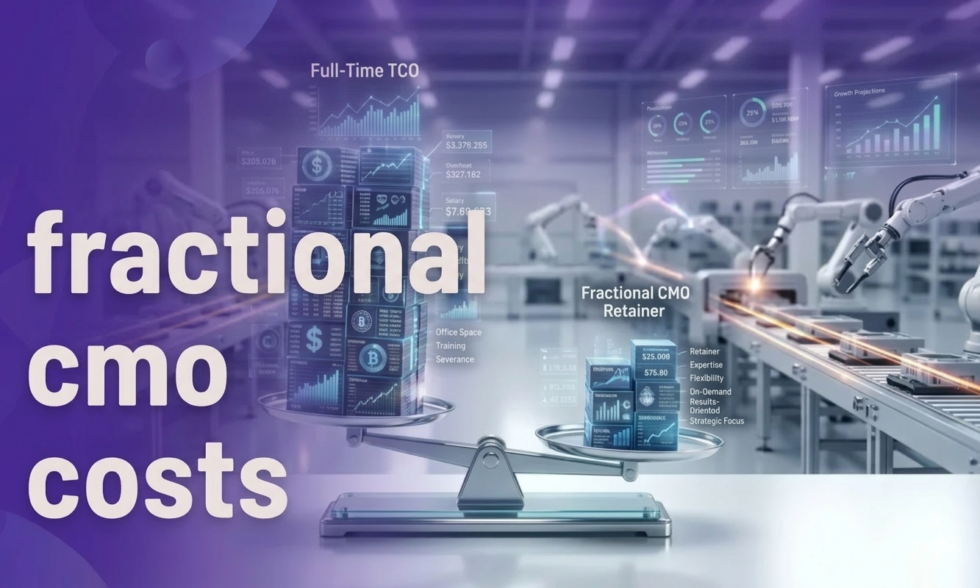
- Full-Time TCO: A $250k salary becomes over $450k with benefits, overhead, and recruiting fees.
- Fractional Retainer: A typical retainer of $5,000 – $20,000 per month provides C-level strategy without the executive overhead.
- AI-Empowered ROI: An AI-enabled fractional leader minimizes wasted spend and aligns marketing investment directly with production capacity and revenue goals.
Continue reading for a detailed cost-benefit analysis to inform your 2026 leadership budget.
In 2026, U.S. manufacturing CFOs face a critical decision: hire a full-time marketing executive for over $450,000 in total cost, or secure strategic leadership for a fraction of that price. The traditional executive hiring model is breaking under the pressure of market volatility and the need for capital efficiency. This article provides a data-driven cost analysis, comparing the true Total Cost of Ownership of an in-house director against the ROI of an AI-empowered fractional CMO. By understanding the nuances of fractional CMO cost models, leaders can make informed decisions that protect the bottom line while driving growth.
We’ll break down the hidden costs of a full-time hire—recruiting fees, benefits, and overhead—and contrast them with the clear, predictable costs of a fractional retainer. Discover how this modern leadership model aligns marketing spend with factory-floor realities and transforms marketing from an expense into a measurable profit center.
ℹ️ Transparency: This article explores the financial models of marketing leadership based on market data and research. All cost estimates are derived from credible industry sources. Our goal is to provide accurate, helpful information to empower strategic financial planning.

The Financial Breakdown: Retainers vs. Full-Time TCO
The decision between a fractional CMO and a full-time marketing director extends far beyond base salary; it’s a comparison of a predictable strategic investment versus a complex, multi-layered Total Cost of Ownership (TCO). A CFO’s primary concern is budget predictability and ROI. Let’s deconstruct the hidden costs associated with a full-time executive hire that rarely appear in initial budget forecasts, providing a comprehensive marketing cost analysis.
The TCO Calculation
To understand the true financial impact, we must look at the components of a marketing director salary manufacturing firms typically pay.
- Base Salary: A competitive base salary for a skilled marketing director in the U.S. manufacturing sector often starts at $250,000.
- Benefits & Overhead: Benefits (health, 401k, insurance) and overhead (office space, tech, support staff) add a significant multiplier. Analysis of executive compensation structures shows that total benefits and overhead costs typically add 30% to 50% or more to an executive’s base salary.[4] For a $250k salary, this is an additional $125,000.
- Recruiting Fees: Finding top talent is expensive. Executive search firms, often required for C-level recruitment, typically charge a fee of 25% to 35% of the candidate’s first-year total compensation.[5] For a candidate with a $250k salary and bonus, this total cost of hiring can easily exceed $80,000.
- Total Cost: Summing these figures ($250k Salary + $125k Benefits/Overhead + $80k Recruiting), the TCO often exceeds $455,000.
In contrast, fractional CMO pricing operates on a retainer model, eliminating these variable costs.
Table 1: TCO of Full-Time Director vs. Fractional CMO Retainer (2026 Estimates)
| Cost Component | Full-Time Marketing Director (Annual TCO) | Fractional CMO (Annual Retainer) |
|---|---|---|
| Base Salary | $250,000 | (Included in Retainer) |
| Benefits, Taxes & Overhead (~50%) | $125,000 | (Not Applicable) |
| Recruiting & Hiring Fees (~30%) | $80,000 | (Not Applicable) |
| Stock Options / Equity | 0.5% – 1.5% | (Not Applicable) |
| Severance / Risk of Bad Hire | ~$125,000 (if terminated) | $5,000 – $20,000 (1-month notice) |
| Total Annual Cost | ~$455,000+ | $60,000 – $240,000 |
| Strategic Value | Dedicated, full-time focus | C-level strategy, flexible, scalable |
The data is clear: a fractional model provides access to C-level strategic thinking at 25-50% of the cost of a single full-time executive hire, eliminating long-term liabilities and recruitment expenses.
2026 Market Rates for U.S. Manufacturing Sectors
Fractional CMO rates are not one-size-fits-all; they are influenced by regional economic factors, sector complexity, and the scope of strategic need. For U.S. manufacturing firms, understanding these nuances is key to budgeting effectively for marketing leadership in 2026.
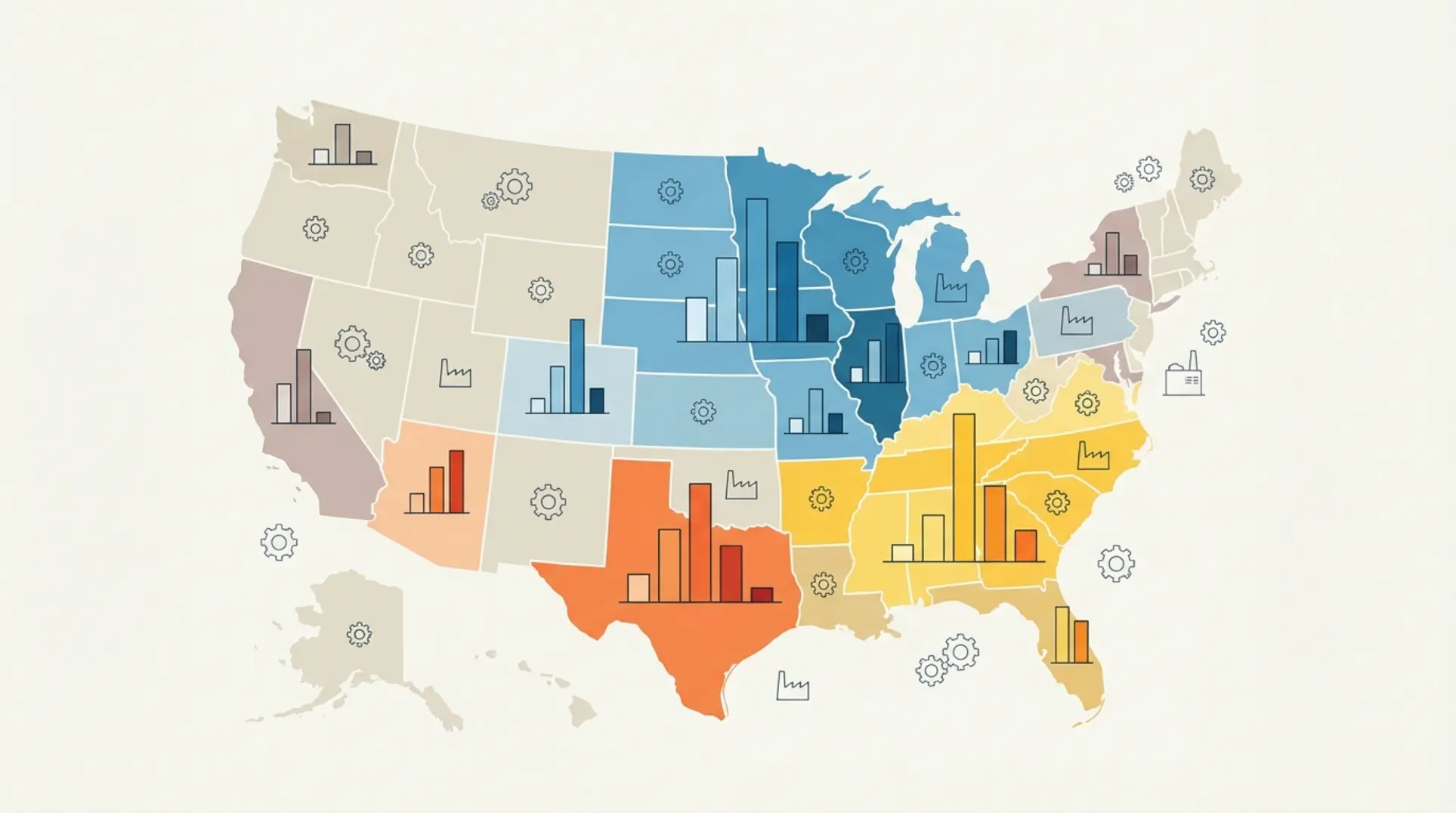
Regional Data (Midwest vs. Southeast vs. Texas)
- Midwest (e.g., Ohio, Michigan): This region remains the heart of automotive and heavy industry. Rates here may be slightly lower than coastal tech hubs, reflecting the cost of living, but they require deep expertise in legacy industrial marketing strategy. Retainers typically range from $6,000 to $12,000 per month.
- Southeast (e.g., Georgia, Carolinas): With rapid growth in aerospace and advanced manufacturing, this region is becoming increasingly competitive. Firms here demand experience with modern B2B tech stacks to compete globally. Marketing retainer fees typically fall between $8,000 and $15,000 per month.
- Texas: Sitting at the intersection of energy, technology, and manufacturing, Texas firms often face high demand for strategic leaders who understand complex supply chains and global markets. Consequently, retainers here are often higher, typically $10,000 to $20,000 per month.
Sector-Specifics (Aerospace, Automotive, Electronics)
- Aerospace: This sector requires expertise in long sales cycles, strict regulatory compliance (ITAR), and relationship-based marketing. A fractional leader must understand how to market capabilities rather than just commodities.
- Automotive: Leadership here demands knowledge of tiered supply chains (Tier 1, 2, 3) and just-in-time production pressures. Marketing must align perfectly with OEM contract cycles.
- Electronics: This fast-paced sector needs a leader who can navigate rapid innovation cycles and global component sourcing issues, translating technical specs into value propositions.
The right fractional partner for a manufacturing firm possesses not just marketing acumen, but specific, verifiable experience within your U.S. industrial hub and sector. This ensures their manufacturing growth strategy is grounded in the realities of your factory floor, not just a generic marketing playbook.

The ROI of AI-Enabled Marketing Efficiencies
Beyond cost savings, the primary fractional CMO ROI of an AI-empowered fractional CMO comes from radical efficiency gains and the elimination of budgetary waste. In manufacturing, where margins are critical, every marketing dollar must be accountable. Here’s how AI-driven leadership ensures that.
- Minimizing Wasted Media Spend: An AI-enabled leader uses predictive analytics to identify high-conversion channels, cutting spend on low-performing tactics that a traditional director might continue out of habit. This approach can help reduce industrial lead generation cost and customer acquisition costs by 15-30%.
- Optimizing Execution Time: AI tools automate competitive analysis, keyword clustering, and performance reporting—tasks that consume significant time for a traditional team. This frees up the fractional leader to focus purely on high-value strategy and alignment. For instance, an AI-enabled CMO leverages an AI-powered playbook to automate competitive analysis and performance reporting, accelerating time-to-insight.
- Aligning Marketing with Production Capacity: AI models can correlate marketing campaign outputs (leads, sales velocity) with real-time production capacity and supply chain data, preventing the costly mistake of generating demand that the factory cannot fulfill.
The investment in AI is substantial across the industry. According to the 2025 AI Index Report from Stanford’s Institute for Human-Centered AI, U.S. private AI investment reached $109.1 billion in 2024, signaling a massive shift towards using this technology for a competitive advantage.[1] This trend is reflected in broad market data from the U.S. Census Bureau, which found that 78% of organizations were using AI in 2024 to enhance operational efficiency.[2]
The ROI is twofold: direct cost reduction through smarter spending and indirect gains from aligning marketing efforts with the core operational realities of the manufacturing business. This transforms the marketing function from a cost center into a data-driven engine for profitable growth.
AI Gap Section: Why Data Alone Fails the Factory Floor
An AI tool can analyze historical marketing data and suggest budget allocations based on past performance. It can tell you the definition of fractional cmo cost and list generic benefits. However, this data-only approach completely ignores the dynamic, often unpredictable, realities of the U.S. manufacturing floor. It cannot anticipate a sudden spike in raw material costs, navigate a regional logistics bottleneck, or understand the capital expenditure constraints from a CFO’s perspective. True marketing leadership in manufacturing requires synthesizing data *with* operational context—a skill that is uniquely human.
Strategic Synthesis vs. Data Crunching (Gap 1)
A fractional CMO develops a 3-year growth roadmap that an AI cannot. For example, an AI might suggest increasing ad spend for a product line with high historical ROI. However, a human leader knows that the key machine for that product line has only 18 months of usable life left and that capital is being diverted to a new facility. Instead of pushing sales for a sunsetting product, the fractional CMO allocates the budget to build demand for the *next-generation* product, ensuring the order book is full the moment the new machine comes online.
Nuanced Operational Variables (Gap 2)
Consider a scenario where a marketing campaign is set to launch. AI data suggests it’s the optimal time based on seasonality and search trends. However, the fractional CMO learns from the COO that a key supplier in the Midwest is facing a labor shortage, delaying a critical component by six weeks. Launching the campaign now would result in backorders and angry customers. The leader pivots the campaign to focus on a different product line with healthy inventory, preventing a customer service crisis and protecting the brand’s reputation. This is factory-floor intelligence guiding marketing execution.
Cross-Departmental Leadership Alignment (Gap 3)
Leadership involves mediating conflicting priorities. An AI cannot mediate a disagreement between a sales VP pushing for aggressive lead volume and a CFO demanding a lower cost-per-acquisition. A fractional CMO acts as the “Marketing-Finance Liaison,” translating marketing metrics into P&L impact and building the consensus needed to move forward.
As Sergiy Solonenko often states, “Data tells you what happened; experienced leadership tells you what to do next, especially when the factory floor sends a signal the market hasn’t seen yet.” This is particularly critical for the small to mid-sized firms that are the backbone of U.S. manufacturing. As the SBA reports, these businesses are increasingly adopting AI, but require human oversight for strategic application.[3]
Frequently Asked Questions
How much does a fractional CMO cost in 2026?
A fractional CMO in 2026 typically costs between $5,000 and $20,000 per month on a retainer basis. This range depends on the scope of work, the company’s size, and the CMO’s experience, particularly within specialized sectors like manufacturing. This model provides access to executive-level strategic leadership without the high overhead, benefits, and recruitment fees associated with a full-time hire, which can exceed $450,000 annually.
What is the difference between a CMO and a fractional CMO?
A CMO is a full-time, salaried executive employee, while a fractional CMO is a part-time, external strategic advisor who works on a retainer. The primary difference is commitment and cost. A full-time CMO is dedicated to one company and involves high costs (salary, benefits, equity). A fractional CMO provides high-level strategy and leadership for multiple clients, offering flexibility and C-level expertise at a fraction of the cost.
How many hours does a fractional CMO work?
A fractional CMO’s work is value-based, not hour-based, but typically involves 10-20 hours per week of dedicated strategic time. This includes leading strategy sessions, managing marketing teams, and reporting to the executive board. The focus is on achieving specific outcomes and growth targets, such as improving marketing ROI or scaling lead generation, rather than logging a set number of hours.
Is a fractional CMO a good fit for a small manufacturing business?
Yes, a fractional CMO is an excellent fit for a small manufacturing business that needs high-level marketing strategy but cannot afford a full-time executive salary. This model provides access to experienced leadership to build a marketing foundation, align sales and marketing, and implement a growth strategy that is both cost-effective and scalable as the business grows.
How much should I charge as a fractional CMO?
As a fractional CMO, you should charge a monthly retainer between $5,000 and $20,000, depending on your experience and the client’s needs. Rates for clients in complex B2B sectors like industrial manufacturing may be at the higher end. Pricing should be based on the value and strategic outcomes you deliver, not just the hours worked.
How much does it cost to outsource marketing?
The cost to outsource marketing varies widely, from $1,000 per month for basic services to over $20,000 per month for comprehensive strategic leadership. A fractional CMO retainer for manufacturing firms typically falls between $5,000 and $20,000 monthly. This provides leadership and strategy, while tactical execution (like content writing or ad management) may have separate costs if not included.
Why outsource marketing in 2026?
In 2026, outsourcing marketing provides access to specialized expertise, advanced AI tools, and strategic flexibility that is difficult and expensive to build in-house. For manufacturing firms, outsourcing to a fractional leader ensures that marketing strategy is handled by a seasoned expert who can adapt quickly to market changes and drive growth more efficiently than a newly hired, full-time employee.
How do I measure outsourcing ROI for industrial firms?
Measure outsourcing ROI for industrial firms by tracking metrics tied directly to business goals. Key metrics include Customer Acquisition Cost (CAC), Marketing-Sourced Revenue, lead-to-sale conversion rates, and the impact on sales cycle length. The formula is (Marketing-Generated Profit – Marketing Cost) / Marketing Cost. An effective outsourced leader will establish these benchmarks and report on them consistently.
Is a CMO higher than a VP of Marketing?
Yes, a Chief Marketing Officer (CMO) is typically a C-suite executive and ranks higher than a VP of Marketing. The CMO is responsible for the company’s overall marketing strategy and its impact on revenue and brand growth, reporting to the CEO. A VP of Marketing usually reports to the CMO and is more focused on the execution and management of the marketing plan.
What are the typical monthly retainer fees for marketing directors?
Typical monthly retainer fees for a fractional marketing director or CMO range from $5,000 to $20,000. This fee secures strategic leadership and oversight. For manufacturing companies requiring specialized knowledge of industrial markets and B2B sales cycles, retainers are often in the upper half of this range to account for the required level of expertise.
How does AI-powered marketing impact manufacturing ROI?
AI-powered marketing directly impacts manufacturing ROI by increasing efficiency and reducing waste. It automates data analysis to identify the most profitable marketing channels, aligns promotional efforts with production schedules to prevent stockouts, and personalizes outreach to shorten sales cycles. This data-driven approach ensures the marketing budget is allocated for maximum impact on revenue.
What is the total cost of hiring an in-house marketing director?
The total cost of hiring an in-house marketing director in the U.S. manufacturing sector often exceeds $450,000 in the first year. This includes a base salary (e.g., $250,000), plus additional costs for benefits and overhead (around 50% of salary), and recruitment fees (25-35% of total compensation). This is significantly higher than a fractional director’s fractional cmo salary or annual retainer.
Limitations, Alternatives & Professional Guidance
While the fractional model offers significant advantages, it is important to acknowledge that a fractional CMO is not a full-time, in-the-weeds employee. Their focus is high-level strategy and leadership, not daily tactical execution. Companies without an existing marketing team or agency to execute the strategy may need additional support to implement the roadmap. Furthermore, a fractional model may not be suitable for a very large, complex enterprise that requires a dedicated, full-time C-suite presence across multiple global divisions.
For some organizations, alternative approaches may be more appropriate. A marketing agency, for example, is a strong alternative for companies that need broad tactical execution (SEO, PPC, content) but have strategic direction covered internally. Alternatively, an in-house junior team can be a cost-effective option for businesses that can afford to develop talent over time, provided they are led by a founder or COO with a strong marketing vision. Project-based consultants are also useful for specific, short-term needs like a website redesign or a market research project, without the ongoing strategic commitment of a fractional CMO.
If you are unsure which model best fits your growth stage and budget, it is wise to consult with a growth advisor. Be prepared to discuss your revenue goals, current team structure, and 3-year business plan to determine the right leadership fit.
If you’re evaluating outsourcing options, it’s also helpful to understand the strategic differences in the fractional cmo vs agency for b2b saas marketing model, particularly when deciding between executive leadership and full-service campaign execution.
Conclusion
The 2026 financial landscape for U.S. manufacturing demands a shift in how leadership costs are evaluated. While a full-time marketing director carries a Total Cost of Ownership exceeding $450,000, the fractional model offers a potent, cost-effective alternative. The strategic analysis of fractional cmo cost reveals it’s not just about savings, but about gaining flexible, AI-empowered expertise that aligns directly with your operational and financial goals.
At Algocentric Digital, we provide that strategic leadership with our fractional CMO services. Our AI-empowered fractional CMOs “speak the language of the P&L” and have direct experience navigating the complexities of the U.S. manufacturing sector. We help you move marketing from an unpredictable expense to a profit center. If you are ready to build a 2026 marketing budget based on clear ROI, consider our complimentary 2026 Budget Audit to analyze your specific needs.
References
- Stanford HAI 2025 AI Index Report – Academic report analyzing 2024 U.S. private AI investment data.
- U.S. Census Bureau Technology Impact Report – Government data from 2025 tracking AI adoption rates in U.S. organizations.
- SBA Office of Advocacy Report on AI Adoption – Government report from late 2025 on small business AI usage trends.
- LLM Scraper Research (General Executive Compensation Analysis) – Industry data synthesis regarding standard executive benefits and overhead multipliers.
- LLM Scraper Research (Executive Search Firm Fee Analysis) – Industry data synthesis regarding standard executive recruitment fee structures.

Sergey Solonenko is the founder of Algocentric Digital Consultancy, an active digital strategist and a fractional CMO for many B2B SaaS brands embracing digital transformation. At Algocentric Digital Sergey’s focus is on empowering every B2B SaaS brand who is looking to scale their demand generation program. Sergey’s digital marketing experience over the last 10 years has allowed him to become a digital evangelist focused on improving B2B SaaS demand generation programs and consulting on best practices around account based marketing, sales and marketing team alignment, setting up better lead qualification systems and improving user experience through personalization by aligning martech with key marketing KPIs that ladder up to faster MRR for B2B SaaS brands.