🎯 Quick Answer
Understanding how fractional cmo can help security companies begins with implementing an AI-powered, outcome-based growth engine that aligns marketing with skeptical CISO buying psychology and integrates compliance into the sales funnel.
• Builds a “Zero-Trust” Marketing Framework: Moves beyond generic tactics to establish authority with technically-minded buyers. • Integrates Compliance as a Marketing Asset: Uses SOC2 and HIPAA milestones to automate trust-building and shorten sales cycles. • Deploys an Outcome-Based Growth Model: Focuses on accelerating MRR growth, not just delivering marketing activities.
Continue reading for a step-by-step guide to scaling your US-based security SaaS.
Many B2B security SaaS companies hit a “growth plateau” where founder-led sales and generic marketing tactics stop delivering results.
The challenge is rarely a lack of leads, but rather a failure to connect with a professionally skeptical audience of Chief Information Security Officers (CISOs) and security buyers in the highly competitive US market. Standard marketing playbooks often fail because they do not account for the “Zero-Trust” mindset inherent to the cybersecurity industry.
This guide details how fractional cmo can help security companies by providing the strategic leadership needed to overcome this plateau. We will explore how to build a secure MarTech foundation, deploy an AI-powered growth engine, and transform compliance from an operational hurdle into a high-velocity marketing asset. Discover the outcome-based framework designed to help accelerate your MRR and build sustainable market authority.
Why Cybersecurity Companies Struggle With Traditional Marketing
Cybersecurity companies face a unique marketing challenge compared to most SaaS businesses. Their buyers are highly technical, risk-averse, and trained to question vendor claims. Traditional SaaS marketing tactics such as feature-driven messaging, aggressive advertising, or generic lead magnets often fail because security buyers prioritize trust, technical validation, and peer reputation over promotional messaging.
Additionally, the cybersecurity buying process is rarely controlled by a single decision maker. Security purchases often involve CISOs, security architects, IT leaders, compliance officers, and procurement teams. Each stakeholder evaluates vendors through a different lens, making it difficult for standard demand generation strategies to produce consistent pipeline growth. This complexity is one of the primary reasons many security companies turn to fractional marketing leadership.
ℹ️ Transparency: This article explores how fractional leadership can scale security companies, based on industry data and proven frameworks. All information is verified and reviewed by Sergiy Solonenko. Our goal is to provide accurate, actionable information to help you make informed growth decisions.
The MarTech Audit: Building a Secure and Scalable Foundation
The first step a fractional CMO takes is a comprehensive MarTech audit to ensure the technology stack can support a secure, AI-powered growth engine. Security companies, in particular, cannot afford data silos or non-compliant tools in their saas marketing efforts. For a CISO evaluating your product, your own digital infrastructure serves as a reflection of your security posture.
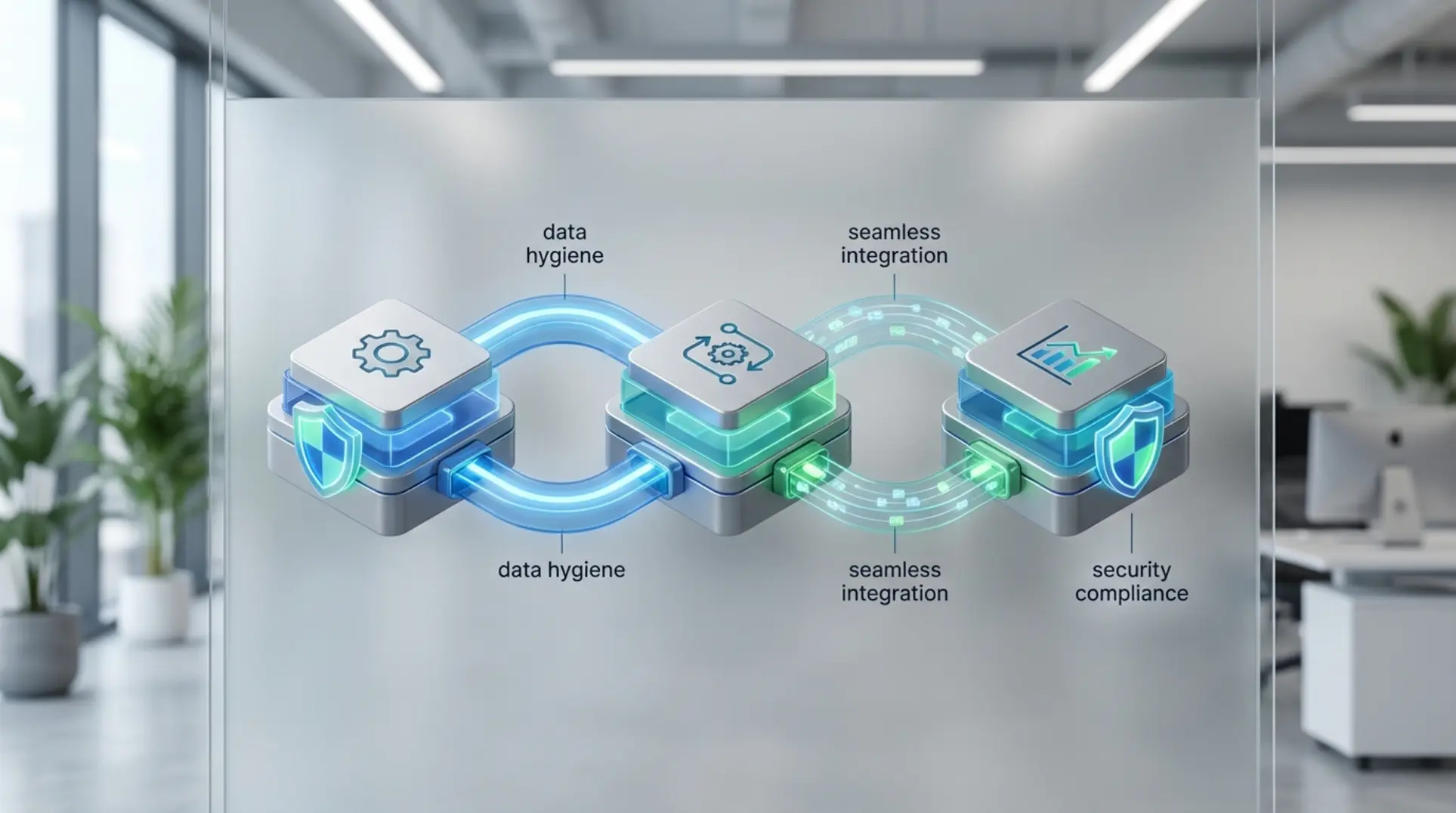
An effective AI-Readiness Assessment typically focuses on three core pillars:
- Data Hygiene and Centralization: Is customer data clean, accessible via APIs, and ready to train machine learning models? Fragmented data often leads to inaccurate targeting in b2b saas marketing campaigns.
- Integration Capabilities: Can your CRM, marketing automation for saas, and analytics platforms seamlessly share data? A unified stack is essential for tracking complex buyer journeys.
- Security and Privacy Compliance: Does the stack adhere to SOC2, HIPAA, and other relevant US regulations? Using non-compliant marketing vendors can introduce unnecessary risk.
This robust technological foundation is a prerequisite for the T2D3 growth methodology—a model designed to triple and then double revenue over consecutive years. Without a scalable infrastructure, rapid growth can fracture a company’s operations. The importance of this digital infrastructure is reflected on a national scale; according to a 2023 economic analysis by the OECD, digitally-deliverable services trade accounts for 49.1% of commercial services trade in the US, highlighting the deep integration of digital infrastructure into the economy. [1]
A properly audited and configured MarTech stack is the bedrock of a predictable revenue machine. Once this foundation is secure, it can be leveraged to power advanced demand generation strategies.

Deploying the AI-Powered Growth Engine for Security SaaS
An AI-powered growth engine uses machine learning to move beyond simple lead generation towards predictable MRR acceleration. This means utilizing data to identify and engage high-intent accounts through Account-Based Marketing (ABM) before they even begin their public buying journey.
The deployment of this demand generation for saas typically follows a structured, three-step methodology:
Step 1: Predictive Audience Modeling
A fractional CMO begins by analyzing historical sales data, CRM records, and third-party intent data. Machine learning models use this data to build a highly accurate profile of your ideal security buyer. Instead of guessing which CISOs are in the market, predictive modeling highlights accounts showing early signals of research and intent.
Step 2: Automated ABM Campaigns
Once target accounts are identified, the engine deploys programmatic advertising and personalized content journeys. This involves optimizing budgets with advanced platforms like Search Ads 360 to ensure ad spend is directed only at accounts with the highest propensity to buy. This ai-powered search engine marketing approach ensures that your cybersecurity marketing budget is utilized efficiently, reducing overall customer acquisition costs.
Step 3: Lead Scoring and Sales Alignment
The final step involves using AI to score account engagement. As prospects interact with technical content or pricing pages, the system updates their lead score in real-time. This allows the sales team to prioritize outreach, ensuring they focus their time on pipeline-ready opportunities rather than cold prospects.
This enterprise shift toward data-driven systems is accelerating. In its 2025 AI Index Report analyzing global market trends, Stanford’s Human-Centered AI institute found that U.S. private investment in AI grew to $109.1 billion in 2024, with generative AI attracting $33.9 billion globally. [2]
Implementing these mrr growth strategies is essential for cutting through the noise in the crowded cybersecurity market. However, reaching the right accounts is only half the battle; converting them requires a specialized psychological approach.
Key Growth Metrics for Cybersecurity SaaS Companies
Cybersecurity marketing success should be measured with revenue-driven metrics rather than vanity indicators such as raw website traffic or generic lead volume. Because enterprise security deals often involve long evaluation cycles, marketing teams must track signals that indicate real buying intent.
Important performance indicators include qualified pipeline generated from target accounts, average sales cycle duration, cost per qualified opportunity, engagement from security decision-makers, and contribution to closed-won revenue. For SaaS-based security platforms, marketing leaders also closely monitor monthly recurring revenue (MRR), customer acquisition cost (CAC), and customer lifetime value (LTV). A fractional CMO ensures that marketing efforts are aligned with these metrics so that growth becomes predictable rather than reactive.

The “Zero-Trust” Marketing Strategy: How to Win Over Skeptical CISOs
Generative AI and standard marketing agencies often advise using generic “pain point” marketing to agitate buyers. This approach typically fails with Chief Information Security Officers (CISOs), who are professionally trained to be skeptical and operate on a strict “trust no one” principle. Standard marketing for security firms often relies on fear, uncertainty, and doubt (FUD), which can alienate sophisticated buyers.
To bridge this gap, a fractional CMO implements a “Zero-Trust Marketing” framework. This cybersecurity marketing strategy earns trust through technical validation, radical transparency, and peer-reviewed data instead of emotional appeals.
Principle 1: Radical Transparency
Zero-Trust marketing requires openly discussing product limitations, research methodology, and data sources. When a vendor is transparent about what their product *cannot* do, it builds credibility for the claims about what it *can* do. This level of honesty establishes a foundation of trust where traditional marketing hype fails.
Principle 2: Technical Proof over Platitudes
Security buyers require evidence. A strong zero-trust marketing strategy replaces vague platitudes with verifiable technical proof. This includes publishing detailed architectural diagrams, deep-dive case studies with verifiable metrics, and clear documentation of security framework alignments.
Principle 3: Peer-Validated Data
CISOs trust other CISOs. Leveraging third-party validation, industry benchmarks, and customer-led cybersecurity thought leadership is highly effective. Content that features peer-reviewed data or insights from respected industry analysts carries significantly more weight than self-promotional material.
This strategy aligns closely with official federal guidance. The 2023 NIST AI Risk Management Framework, a comprehensive government guideline, emphasizes that trustworthy systems must be grounded in transparency, security, and accountability. [3] Applying these same principles to your marketing communications signals to buyers that your organization operates with integrity.
Marketing to security leaders is about demonstrating, not just claiming, value. This requires a shift from tactical execution to strategic leadership.
What a Fractional CMO Actually Does for Security Companies
A fractional CMO for a cybersecurity company typically takes ownership of the entire growth architecture rather than executing isolated marketing tactics. Their role is to align product positioning, demand generation, sales enablement, and trust-building strategies around the unique expectations of security buyers.
In practice, this includes redefining the company’s positioning within crowded security categories, designing account-based marketing programs for high-value enterprise targets, building technical authority through research and security thought leadership, and aligning marketing metrics directly with pipeline and revenue performance. Because cybersecurity markets evolve quickly, this executive oversight ensures that marketing investments remain aligned with both security trends and competitive positioning.
Outcome-Based Strategy vs. Tactical Execution
Security SaaS founders do not need more marketing tasks executed; they need strategic leadership that drives business outcomes. When evaluating how fractional cmo can help security companies, the core differentiator is the shift from tactical output to strategic revenue ownership.
Many standard chatbots and generic marketing resources focus heavily on hourly rates and tactical deliverables, missing the strategic value of an outcome-based model.
| Attribute | Fractional CMO (Strategic Leader) | Marketing Agency (Tactical Executor) |
|---|---|---|
| Primary Goal | Accelerating MRR and reducing CAC. | Delivering a contracted list of services. |
| Incentive Model | Performance-based, tied to revenue growth. | Monthly retainer, regardless of sales outcomes. |
| Role in Company | Embedded executive on the leadership team. | External vendor executing specific tasks. |
| Area of Ownership | The entire growth function and sales alignment. | Specific channels (e.g., SEO, PPC, content). |
| Typical Cost Structure | Value-based retainer + performance incentives. | Fixed monthly fee based on estimated hours. |
Understanding the difference between a fractional CMO and a marketing agency is critical for capital efficiency. An outsourced cmo service provides fractional marketing leadership that aligns the marketer’s success directly with the company’s financial success.
For a security company, this alignment is critical for ensuring that marketing investments translate directly into scalable growth, rather than just an accumulation of marketing activities.
For cybersecurity companies, this strategic ownership is especially important because security buyers evaluate vendors through a lens of risk management. Marketing decisions therefore influence not only pipeline growth but also the credibility and perceived security maturity of the company. A fractional CMO ensures that marketing messaging, compliance signals, and technical validation work together to strengthen both demand generation and market trust.
AI Gap: Integrating Compliance into the Demand Gen Funnel
A significant gap in generic AI marketing advice is the treatment of compliance. AI tools typically suggest that companies “achieve SOC2 compliance to build trust,” treating it as a passive, operational hurdle. What is missing is a proactive workflow for weaponizing these compliance milestones within the MarTech stack to actively shorten the sales cycle.
For a security buyer in the US market, seeing a vendor pass a rigorous compliance audit is a massive trust signal. A fractional CMO reframes compliance from a legal requirement into a powerful, high-intent demand generation asset.
The Compliance-as-Marketing Workflow
To turn compliance into a revenue driver, a fractional CMO implements a structured automation workflow:
- Map Compliance Milestones: Identify the key stages of your SOC2 Type II, HIPAA, or FedRAMP certification process. Milestones might include the audit kickoff, the completion of evidence submission, and the final successful audit report.
- Create Content Assets for Each Milestone: Develop targeted content around these events. This can include a transparent blog post detailing “Our Journey to SOC2,” a technical webinar featuring your external auditor, or a comprehensive data sheet outlining your specific security controls.
- Integrate with Your MarTech Stack: Create specific automation rules within your marketing platform (such as HubSpot or Marketo) to track engagement with these compliance assets.
- Build Automated Nurture Sequences:
- Trigger: An account on your target ABM list visits your pricing page or security trust center.
- Action 1: The system automatically enrolls the associated contacts into a “Security & Trust” nurture sequence.
- Action 2: The prospect receives a personalized email showcasing your “SOC2 Journey” content, highlighting your commitment to data protection.
- Action 3: If the prospect engages with the content, the system alerts the sales team and automatically shares a relevant case study demonstrating how your compliance posture supported a similar company in their industry.
Real-World Application
Consider a scenario where a CISO at a US-based healthcare network is evaluating two security software vendors. Vendor A simply lists a “SOC2 Compliant” badge on their website footer. Vendor B (utilizing a fractional CMO’s strategy) proactively detects the CISO’s research behavior and automatically sends them a detailed, gated breakdown of their recent successful audit, along with an invitation to review their real-time security trust center. Vendor B instantly builds more credibility by demonstrating transparency rather than just claiming it.
This proactive approach is increasingly vital as enterprise technology stacks grow more complex. According to a 2025 survey report by the U.S. Census Bureau, approximately 78% of organizations reported using AI in 2024, making verifiable compliance and risk management more critical than ever for vendor selection. [4]
Furthermore, this proactive communication of compliance aligns directly with the principles of the 2023 NIST AI Risk Management Framework, which emphasizes transparency and trustworthiness in complex digital systems. [3]
As Sergiy Solonenko notes, “Compliance is often the most powerful marketing asset a security company has. Automating its promotion through the MarTech stack is one of the fastest ways to build verifiable trust with a skeptical CISO.”
When Should a Security Company Hire a Fractional CMO?
Security companies usually consider hiring a fractional CMO when founder-led sales and ad-hoc marketing efforts stop producing consistent pipeline growth. This stage often occurs after product-market fit, when the company begins targeting enterprise customers and requires a more structured go-to-market strategy.
Common indicators include unpredictable lead flow, increasing customer acquisition costs, inconsistent messaging across marketing channels, and difficulty explaining technical value to non-technical buyers. In these situations, professional fractional CMO services provide executive-level strategy and leadership without the financial commitment of a full-time CMO, allowing companies to build a scalable marketing engine while maintaining capital efficiency.
Frequently Asked Questions
Have questions about how fractional cmo can help security companies? Review our detailed answers below.
What is the average hourly rate for a fractional CMO?
The average hourly rate for a fractional CMO in the US typically ranges from $250 to $500+. However, focusing on hourly rates is misleading. More effective models are value-based monthly retainers ($5,000 – $20,000+) or outcome-based pricing, where compensation is tied to key business results like MRR growth, ensuring alignment with company goals.
How to get clients for a security company?
To get clients for a security company, you must build trust with skeptical buyers. This involves a “Zero-Trust Marketing” approach: using technical proof and transparent data over marketing hype. Key strategies include creating thought leadership content that aligns with security frameworks (like NIST), leveraging compliance milestones (like SOC2) as marketing assets, and using account-based marketing (ABM) to target high-intent decision-makers.
What are the benefits of a fractional CMO for security SaaS?
The primary benefit is gaining C-suite strategic leadership without the cost of a full-time executive. For security SaaS, a fractional CMO specifically brings expertise in marketing to technical buyers, implementing AI-powered growth systems, aligning sales and marketing around revenue goals (MRR), and turning complex compliance requirements into powerful trust-building assets in the sales process.
How to grow your security guard business vs security software?
Growing a security guard business is typically local and service-focused, relying on reputation and regional sales. In contrast, growing a security software (SaaS) business is about scalable, data-driven demand generation. It requires a sophisticated digital marketing engine, content that builds trust with technical buyers globally, and a sales process that can be automated and measured effectively.
What is the difference between a fractional CMO and a marketing agency?
A fractional CMO is a strategic leader on your executive team; a marketing agency is a team of tactical executors. A fractional CMO owns the growth strategy and is responsible for business outcomes like MRR, often working on a performance basis. An agency is hired to execute specific tasks (like SEO or ads) and is typically paid a retainer for their activities.
When should a security startup hire a CMO?
A security startup should hire a fractional CMO when founder-led sales are no longer scalable and predictable growth is needed. This is typically post-product-market fit, often during or after a Series A funding round. The goal is to build a systematic growth engine to accelerate MRR and prepare the company for its next stage of expansion.
How much does a fractional CMO cost for a security company?
For a security company, a fractional CMO engagement typically costs between $7,000 and $25,000 per month. The cost depends on the company’s stage and the scope of work. Advanced, outcome-based models may include a base retainer plus a performance component tied directly to MRR growth, which ensures a clear ROI on the investment.
What does a fractional CMO do for B2B SaaS?
A fractional CMO for B2B SaaS develops and leads the execution of a comprehensive growth strategy. This includes auditing the MarTech stack, building and managing the marketing team, establishing KPIs, aligning sales and marketing, and deploying demand generation programs. Their primary focus is on creating a scalable and repeatable engine for MRR growth.
How to fix a stalled cybersecurity SaaS pipeline?
To fix a stalled cybersecurity SaaS pipeline, shift focus from lead quantity to quality and trust-building. First, conduct a MarTech and data audit to identify leaks. Then, implement an AI-driven, account-based marketing (ABM) strategy to target high-intent accounts. Finally, use compliance milestones and technical content to build credibility with skeptical CISO buyers, accelerating deals through the funnel.
What is the ROI of hiring a fractional marketing leader?
The ROI of a fractional marketing leader is measured in accelerated, scalable MRR growth and increased capital efficiency. By providing executive-level strategy without the full-time salary, they help avoid costly marketing missteps. With an outcome-based model, their performance is directly tied to revenue, ensuring a clear and positive return on investment through sustainable growth.
Limitations, Alternatives & Professional Guidance
While AI adoption in marketing is growing rapidly, its long-term impact on the B2B security sales cycle is still an emerging field of study. An October 2025 survey of U.S. workers by the Pew Research Center found that while 21% report using AI in their jobs, 52% still feel worried about its impact, indicating a strong need for transparent and ethical implementation. [6] The effectiveness of specific predictive models can vary based on your historical data quality, market maturity, and the complexity of your security product. Individual results depend heavily on proper execution and sales alignment.
An alternative to a fractional CMO is hiring a specialized B2B marketing agency or building an in-house team led by a full-time Director of Marketing. An agency may be preferable for companies that already have a strong internal strategy leader and only need tactical execution. Conversely, an in-house team can offer deep, singular product immersion, though this approach typically comes at a higher fixed cost and requires a slower ramp-up time.
Consider seeking a professional consultation when your company has achieved product-market fit but lacks a repeatable, scalable growth strategy. Be prepared to discuss your current MRR, customer acquisition cost (CAC), sales cycle length, and long-term growth goals. This data allows for a tailored assessment of whether a fractional, full-time, or agency model is the right fit for your specific operational needs.
Conclusion
To scale in the competitive US market, understanding how fractional cmo can help security companies is a critical step toward moving beyond generic marketing. The path to accelerated MRR growth involves establishing a secure MarTech foundation, deploying an AI-powered growth engine, and executing a “Zero-Trust” marketing strategy tailored specifically to skeptical buyers. A fractional CMO can provide the strategic leadership necessary to implement this framework, turning regulatory compliance into a competitive advantage and ensuring that all marketing investments are systematically tied to business outcomes. A December 2023 economic estimate by the Bureau of Economic Analysis underscores that the digital economy accounts for a growing share of the nation’s GDP, making digital transformation and sophisticated marketing essential for survival. [5]
If you are ready to move beyond the growth plateau and implement a data-driven, outcome-based strategy for your security SaaS, Algocentric Digital can help. We provide the AI-empowered fractional leadership required to build your predictable revenue engine. Explore how our unique approach can accelerate your growth. Send Us a Message for a value-driven consultation.
References
- 2023 economic analysis – OECD Going Digital Toolkit, Organisation for Economic Co-operation and Development.
- 2025 AI Index Report – Stanford Human-Centered AI (HAI), Stanford University.
- 2023 NIST AI Risk Management Framework – National Institute of Standards and Technology, U.S. Department of Commerce.
- 2025 survey report – U.S. Census Bureau, U.S. Department of Commerce.
- December 2023 economic estimate – Bureau of Economic Analysis, U.S. Department of Commerce.
- October 2025 survey – Pew Research Center.

Sergey Solonenko is the founder of Algocentric Digital Consultancy, an active digital strategist and a fractional CMO for many B2B SaaS brands embracing digital transformation. At Algocentric Digital Sergey’s focus is on empowering every B2B SaaS brand who is looking to scale their demand generation program. Sergey’s digital marketing experience over the last 10 years has allowed him to become a digital evangelist focused on improving B2B SaaS demand generation programs and consulting on best practices around account based marketing, sales and marketing team alignment, setting up better lead qualification systems and improving user experience through personalization by aligning martech with key marketing KPIs that ladder up to faster MRR for B2B SaaS brands.