🎯 Key Takeaway
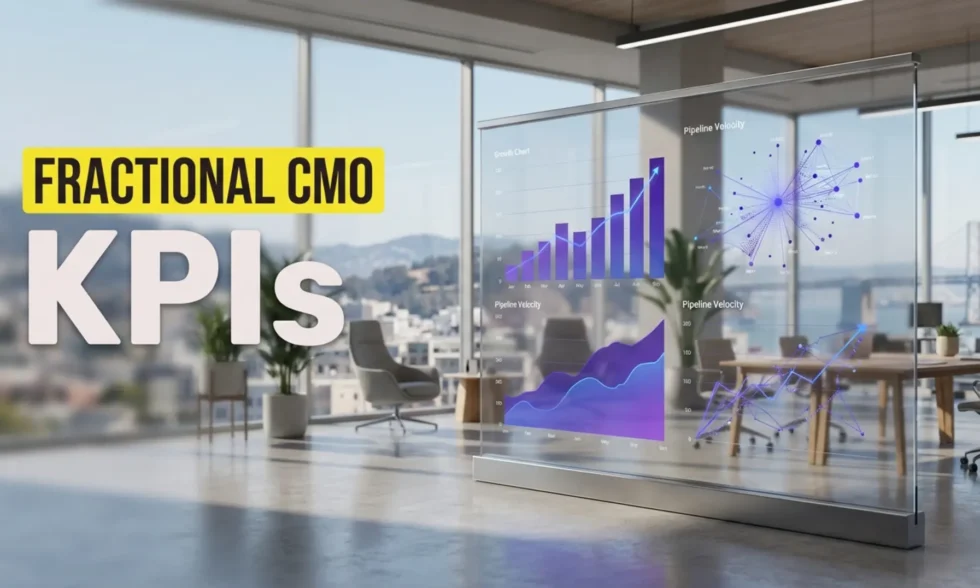
The most effective Fractional CMO KPIs for B2B SaaS founders are those that directly measure revenue growth, capital efficiency, and pipeline velocity, moving beyond vanity metrics to prove tangible business impact.
- Revenue & Pipeline: Focus on Marketing-Sourced Pipeline and Pipeline Velocity as leading indicators of growth.
- Efficiency & Economics: Track LTV:CAC Ratio and CAC Payback Period to ensure sustainable, capital-efficient scaling.
- 90-Day Impact: Measure leading indicators like Sales Qualified Lead (SQL) volume and Demo-to-Close rate to validate ROI quickly.
This guide provides the definitive scorecard to hold fractional leadership accountable for measurable MRR growth.
Introduction
Hiring a fractional CMO is often one of the highest-leverage growth decisions a Series A–C B2B SaaS company can make. The problem is not whether the role works. It’s whether success is measured correctly. Too often, founders are left evaluating impact through vague signals like “more leads” or “higher traffic,” metrics that feel good but rarely correlate with real business performance.
This creates an accountability gap. Marketing activity increases, dashboards look busy, but revenue predictability does not improve. For VC-backed SaaS companies, this is a critical failure. Every marketing dollar must be traceable to pipeline creation, capital efficiency, and ultimately Monthly Recurring Revenue.
This guide closes that gap. We present a definitive KPI scorecard designed specifically for evaluating fractional CMO performance in B2B SaaS. You’ll learn which revenue and pipeline metrics matter most, which unit-economics investors actually scrutinize, and which leading indicators should demonstrate impact within the first 90 days. The goal is simple: remove ambiguity and replace it with measurable, revenue-driven accountability..
👤 Article by: The Algocentric Digital Team
Reviewed by: Sergiy Solonenko, Founder & Fractional CMO for B2B SaaS
Last updated: 03 February 2026
ℹ️ Transparency: This article provides a strategic framework for measuring Fractional CMO performance based on our experience scaling dozens of B2B SaaS companies. All benchmarks are sourced from industry-leading research. Our goal is to provide an accurate, actionable guide for founders.
The Revenue Scorecard: Moving Beyond Leads to MRR & Pipeline
The single most important function of a Fractional CMO is to contribute to building a predictable revenue engine. This starts with shifting focus from top-of-funnel leads to qualified pipeline that directly impacts Monthly Recurring Revenue (MRR). A robust scorecard prioritizes the quality and velocity of revenue opportunities over sheer volume.
Marketing Sourced Pipeline
Marketing sourced pipeline is the total value of sales opportunities generated directly from marketing activities. Unlike “leads,” which can be vague, pipeline value is the most direct link between marketing spend and potential revenue.
To track this effectively, organizations typically use a CRM like HubSpot or Salesforce with first-touch or multi-touch attribution models. This metric answers the fundamental question: “How much potential revenue did marketing put on the table this month?” For a Series B SaaS company, a healthy target is often for marketing to source 30-50% of the total new business pipeline, though this varies by ACV and sales motion.
Pipeline Velocity
While pipeline volume is important, the speed at which that pipeline converts is often a better predictor of health. Pipeline Velocity measures the speed at which qualified leads move through your sales pipeline to become paying customers.
Pipeline Velocity Formula
To calculate this, use the following formula:
Pipeline Velocity = (Number of SQLs x Average Contract Value x Win Rate) / Sales Cycle Length
This metric is a critical leading indicator because it predicts future revenue and helps diagnose bottlenecks in your funnel. A high velocity suggests a healthy, efficient GTM motion where leads are not getting stuck in “decision purgatory.” Conversely, a slowing velocity often indicates issues with lead quality or sales enablement before they show up in missed revenue targets.
Research supports the value of this metric. A 2025 study of 247 B2B organizations confirmed that pipeline velocity is a critical leading indicator of future revenue. Companies that actively track and optimize for velocity are better able to diagnose funnel bottlenecks and achieve more predictable quota attainment [4].
While MRR is the ultimate lagging indicator of success, marketing-sourced pipeline and pipeline velocity are the two leading B2B SaaS MRR growth metrics that show your growth engine is working *today*.
Unit Economics & Efficiency: The KPIs Your Investors Scrutinize
Rapid growth is impressive, but profitable growth is fundable. A strategic Fractional CMO must master the unit economics that determine your company’s long-term viability, especially the relationship between Lifetime Value (LTV) and Customer Acquisition Cost (CAC).
LTV:CAC Ratio
The LTV:CAC ratio compares the total revenue a customer generates over their lifetime versus the cost to acquire them. This is the “north star” metric for efficiency.
To perform a SaaS LTV calculation, you first determine the Lifetime Value (Average Revenue Per Account / Churn Rate) and divide it by the fully loaded CAC (Sales + Marketing Spend / New Customers Acquired).
A healthy ratio proves your business model is sustainable. According to 2025-2026 performance benchmarks, a strong LTV:CAC ratio for a growing B2B SaaS company should be at least 3:1 to ensure profitable growth [1]. If the ratio dips below 3:1, it may indicate that customer acquisition is too expensive or retention is too low. If it exceeds 5:1, you might be under-investing in growth.
CAC Payback Period
The CAC payback period SaaS companies aim for is the number of months it takes to earn back the money invested in acquiring a new customer. This is a critical measure of cash flow and capital efficiency. Shorter payback periods mean you can reinvest capital into growth faster, reducing the burn rate.
Local Market Nuances
It is important to note that customer acquisition cost benchmarks can vary significantly by geography due to labor market differences.
For example, a B2B SaaS marketing consultant SF (San Francisco) might face higher talent and operational costs, pushing CAC higher. In high-cost tech hubs like the Bay Area, a payback period of 12-18 months might be acceptable. Conversely, a Fractional CMO Austin might operate in a market with slightly lower overhead, targeting a faster 9-12 month payback.
Analysis of operational costs shows that higher salaries and greater market saturation in San Francisco can lead to a significantly higher Customer Acquisition Cost (CAC) compared to emerging tech hubs like Austin, directly impacting the expected payback period for startups in those regions [3].
A Fractional CMO’s job isn’t just to grow the top line, but to do so efficiently. Mastering LTV:CAC and CAC Payback Period is non-negotiable for building a business that can scale profitably.
Technical Debt & KPI Friction: The Hidden Reason Your Metrics Are Lying
Generic advice often suggests, “Just track your LTV:CAC in HubSpot!” However, for 80% of Series A-C startups, this is a fantasy. Their CRM is frequently a graveyard of inconsistent lead sources, duplicate contacts, and poorly defined lifecycle stages.
The consequence is that your CAC isn’t just inaccurate; it may be dangerously misleading. You might be making budget decisions based on garbage data. This is “KPI Friction”—the gap between strategy and data reality—and it is a primary reason growth stalls.
The RevOps Audit: A Pre-Requisite for Measurement
This is where an experienced Fractional CMO goes beyond strategy and digs into the technical foundation. Our first step is always a comprehensive RevOps audit to address three common failures.
1. Inconsistent Lead Source Tracking
The Problem: Manual entry errors, broken UTM parameters, and mismatched fields between marketing automation (e.g., Marketo) and CRM (e.g., Salesforce) create “dark” traffic.
The Fix: We implement standardized UTM taxonomies and a lead source property with rigid picklist options, preventing free-text entry. We often run our proven SaaS marketing playbooks to clean historical data and re-attribute sources correctly.
2. Misaligned MQL/SQL Definitions
The Problem: Sales and marketing often have different definitions of a “good lead.” If the CRM definition is vague or unenforced, the “handoff” becomes a drop-off.
The Fix: We facilitate a collaborative workshop to create a data-driven Lead Scoring model and clear, automated lifecycle stage transitions in the CRM. This ensures that an MQL in the dashboard actually represents a qualified prospect.
3. No Closed-Loop Reporting
The Problem: The connection between a marketing campaign, the sales opportunity, and the final “closed-won” revenue is broken.
The Fix: We implement proper campaign association in your CRM and build dashboards that connect first-touch marketing activity directly to final MRR.
The AI-Empowered Advantage
A modern Fractional CMO should also leverage technology to solve these data issues. We quote Sergiy Solonenko regarding this necessity: “We’ve seen companies burn through millions in ad spend because their CRM couldn’t tell them which channels were actually driving revenue. A Fractional CMO who doesn’t start with a RevOps audit is just a strategist; a true growth partner is also a systems thinker.”
This aligns with broader industry principles for AI and data governance. The NIST AI Risk Management Framework emphasizes that trustworthy AI systems rely on data that is accurate, reliable, and transparent—a principle that applies directly to the marketing and sales data feeding any growth model [6].
Furthermore, the 2025 AI Index Report from Stanford’s HAI notes that 78% of organizations are leveraging AI, underscoring the importance of using machine learning scripts to accelerate data cleanup and identify anomalies in CRM data that manual analysis would miss [5]. This isn’t just cleaning data; it’s building a reliable, intelligent data infrastructure for growth.
The First 90 Days: Leading Indicators That Prove ROI Fast
The “Founder’s Dilemma” is common: You cannot wait 12 months to see if your Fractional CMO is working. Lagging indicators like LTV take too long to mature. You need proof of traction within the first 90 days.
When evaluating a fractional CMO, you must focus on leading indicators that signal the engine is starting to turn. A robust Fractional CMO 90 day plan should prioritize the following metrics:
1. Increase in SQL Velocity
You should look for not just more MQLs, but a measurable increase in the number of *sales-accepted* leads per week. This metric demonstrates that marketing is generating what sales actually values, bridging the gap between the two departments.
2. Improved Demo-to-Close Rate
A strategic CMO should be refining messaging, positioning, and ideal customer profile (ICP) targeting immediately. This work should result in a higher conversion rate from product demos to closed-won deals. If the messaging is resonating, the right prospects should be closing at a higher rate.
3. Reduction in Sales Cycle Length
By improving lead quality and implementing nurturing sequences, a Fractional CMO can help the sales team close deals faster. A reduction in the sales cycle directly increases Pipeline Velocity and frees up sales capacity.
This 90-day scorecard provides the early evidence that strategic initiatives are translating into tangible sales pipeline improvements, de-risking your investment long before annual metrics become clear. These are the early-stage Fractional CMO KPIs that matter most for validation.
Frequently Asked Questions
What is a fractional CMO for B2B SaaS?
A fractional CMO for B2B SaaS is a senior-level marketing executive who provides strategic leadership on a part-time or contract basis. Instead of a full-time hire, a founder gets access to top-tier expertise in areas like growth strategy, team building, and RevOps for a fraction of the cost. This model is ideal for Series A-C startups needing high-level guidance without the expense of a full-time C-suite salary.
How do you measure the success of a fractional CMO?
Measure a fractional CMO’s success using KPIs tied directly to revenue and capital efficiency. Key metrics include an increase in Marketing-Sourced Pipeline, improved Pipeline Velocity, a healthy LTV:CAC ratio (ideally 3:1 or higher), and a shorter CAC Payback Period. In the first 90 days, look for leading indicators like higher SQL volume and improved demo-to-close rates.
What are the core KPIs for a B2B SaaS marketing leader?
The core KPIs for a B2B SaaS marketing leader are Monthly Recurring Revenue (MRR) Growth, Customer Acquisition Cost (CAC), and Net Revenue Retention (NRR). Supporting metrics that drive these outcomes include Marketing-Sourced Pipeline, Pipeline Velocity, and Lifetime Value (LTV). A successful leader focuses on both acquiring new customers efficiently and maximizing revenue from the existing customer base.
What is a good CAC payback period for early-stage SaaS?
A good CAC payback period for early-stage B2B SaaS is typically between 9 and 18 months. Companies with efficient, product-led growth models may aim for under 12 months. For those with longer, enterprise sales cycles or operating in high-cost markets like San Francisco, a period closer to 18 months can still be considered healthy and fundable by investors.
What is the difference between a fractional CMO and a marketing agency?
A fractional CMO provides strategic leadership and integrates into your executive team, whereas an agency typically executes specific tactics. While an agency might manage ads or SEO, a fractional CMO oversees the entire holistic strategy, manages vendors (including agencies), and owns the revenue number. For a deeper dive, read about the core differences between a fractional CMO and a marketing agency.
How much does a fractional CMO cost?
A fractional CMO typically costs between $5,000 and $15,000 per month, depending on the time commitment and level of expertise. This is generally significantly less than the $250,000+ annual salary (plus equity and benefits) required for a full-time enterprise CMO. The investment is structured to provide high-leverage strategic value without the overhead of a full-time executive.
When should a Series A startup hire a fractional CMO?
A Series A startup should hire a fractional CMO when they have product-market fit but lack a scalable go-to-market engine. If the founder is still managing marketing, or if a junior team is executing tactics without a unified strategy, a fractional leader can build the necessary infrastructure and strategy to reach Series B metrics.
What is a good LTV:CAC ratio for B2B SaaS?
A good LTV:CAC ratio for B2B SaaS is generally considered to be 3:1 or higher. This means that for every $1 spent on acquiring a customer, the business generates $3 in lifetime gross profit. A ratio of 4:1 or 5:1 is excellent, while a ratio below 3:1 typically signals a need to reduce acquisition costs or improve retention.
How long is a typical fractional CMO engagement?
A typical fractional CMO engagement lasts between 6 to 18 months. The goal is often to build the strategy, install the RevOps infrastructure, hire the permanent team, and then transition leadership to a full-time VP of Marketing or CMO once the company reaches the next stage of growth.
Can a fractional CMO help with fundraising?
Yes, a fractional CMO can significantly assist with fundraising by refining the pitch deck, clarifying the market opportunity, and validating unit economics. By ensuring that KPIs like CAC, LTV, and pipeline velocity are accurately tracked and trending positively, they provide the data-driven confidence investors require during due diligence.
Limitations, Alternatives & Professional Guidance
Limitations of KPI Benchmarks
It is important to acknowledge that the benchmarks provided (e.g., LTV:CAC of 3:1, 12-month payback) are industry averages. Real-world performance will vary based on your specific business model (e.g., enterprise vs. PLG), average contract value (ACV), market maturity, and competitive landscape. These KPIs serve as a starting point for analysis, not a rigid rule for every scenario.
Alternative Approaches
While this guide focuses on quantitative KPIs, qualitative feedback is also crucial. Consider evaluating a Fractional CMO on their ability to mentor your team, improve cross-functional alignment between sales and marketing, and strengthen your brand’s strategic positioning. These contributions are harder to measure on a spreadsheet but are vital for long-term organizational health and success.
Professional Consultation
The metrics discussed require clean, reliable data. If your CRM and analytics infrastructure are not set up for accurate tracking, the first step is a professional RevOps audit. A consultation can help you diagnose data integrity issues and build a trustworthy reporting dashboard before you even begin to measure a Fractional CMO’s performance.
Conclusion
Moving beyond vanity metrics to a scorecard of revenue-focused Fractional CMO KPIs is essential for scalable growth. By focusing on Marketing-Sourced Pipeline, Pipeline Velocity, LTV:CAC, and CAC Payback, B2B SaaS founders can ensure their investment in fractional leadership translates directly to a stronger, more fundable business. Remember that leading indicators in the first 90 days are your best tool for early validation.
The first step towards accountability is knowing where you stand. If you’re unsure about the accuracy of your current marketing KPIs or struggle to connect marketing spend to MRR, it may be time for a professional assessment. Algocentric Digital offers a complimentary, no-obligation KPI Audit to help you identify data gaps and build a reporting system you can trust.
[Book a KPI Audit]
References
- SaaS Hero / OpenView SaaS Benchmarks Report
- Forbes (ROI of Fractional Leadership)
- Industry Analysis (Regional CAC Benchmark Analysis)
- First Page Sage (Sales Pipeline Velocity Metrics)
- Stanford HAI (2025 AI Index Report)
- NIST (AI Risk Management Framework)

Sergiy Solonenko is the founder of Algocentric Digital Consultancy, a seasoned digital strategist, and a fractional CMO for B2B SaaS brands undergoing digital transformation. With over a decade of experience, he specializes in scaling demand-generation programs, optimizing account-based marketing, and aligning sales and marketing teams. Sergiy helps B2B SaaS companies enhance lead qualification, improve user experience through personalization, and leverage Martech to accelerate MRR growth.